INI-CET · Anatomy
Cervical Fascia and Neck Triangles PYQs
- 37 live questions in Cervical Fascia and Neck Triangles.
- 1 of 37 questions carries a recorded exam year: 2019.
- Question set last updated .
37 questions with answers
Shrugging of shoulder following neck surgery due to injury to:-
- Spinal accessory nerve
- Thoracodorsal nerve
- Bell's nerve
- Vagus nerve
Retropharyngeal space extends from the base of the skull to
- Hyoid bone
- Bifurcation of trachea
- Angle of mandible
- Cricoid cartilage
Sublingual space is divided from submandibular space by:
- Fibres of mylohyoid
- Submandibular gland
- Body of mandible
- Geniohyoid
Lateral pharyngeal space is not connected directly by:
- Buccal space
- Sublingual space
- Submandibular space
- Retropharyngeal space
Which of the following is not present in posterior triangle of neck?
- Phrenic nerve
- Subclavian nerve
- External jugular vein
- Hypoglossal nerve
Mark true or false among the following: Contents of Carotid Sheath are A. Internal jugular vein i) true ii) false B. Cervical sympathetic trunk i) true ii) false C. Vagus nerve i) true ii) false D. Internal carotid artery i) true ii) false E. Deep cervical lymph nodes i) true ii) false
- A. ii) B. ii) C. i) D. i) E. i)
- A. i) B. ii) C. ii) D. i) E. i)
- A. i) B. ii) C. i) D. i) E. ii)
- A. i) B. ii) C. i) D. i) E. i)
The deepest layer of cervical fascia is:
- Vertebral
- Carotid sheath
- Deep fascia
- Prevertebral fascia
In oral and maxillofacial surgery, 'danger space' is known as
- Carotid sheath
- Posterior to carotid sheath in posterior triangle of neck
- Posterior to transverse process of vertebrae
- Space between alar &prevertebral fascia
Deepest layer of deep cervical fascia is
- Prevertebral
- Carotid sheath
- Pretracheal
- Temporal
Contents of the suboccipital triangle are formed by all of the following structures, EXCEPT?
- Vertebral artery
- Suboccipital nerve
- Suboccipital venous plexus
- Lesser occipital nerve
On both sides submental triangle is bounded by:
- Hyoid bone
- Anterior digastric
- Posterior digastric
- Mylohyoid
While doing excision of cervical lymph nodes, inadvertent injury to which nerve causes drooping of shoulder
- Supraclavicular nerve
- Suprascapular nerve
- Spinal accessory nerve
- Nerve to serratus anterior
An abscess was surgically removed in a 26 year old man from the middle of the posterior triangle on the right side. During recovery the patient noticed that her shoulder drooped and she could no longer raise her right hand above her head to brush her hair. Which nerve has been accidentaly cut during the surgery?
- Accessory (XI)
- Ansa Cervicalis
- Facial (VII)
- Hypoglossal (XII)
A 45-year-old woman is admitted to the hospital with neck pain. A CT scan reveals a tumor in the left side of her oral cavity. The tumor and related tissues are removed with a radical neck surgical procedure. Two months postoperatively the patient's left shoulder droops quite noticeably. Physical examination reveals distinct weakness in turning her head to the right and impairment of abduction of her left upper limb to the level of the shoulder. Which of the following structures was most likely injured during the radical neck surgery?
- Suprascapular nerve
- Long thoracic nerve
- Spinal accessory nerve
- The junction of spinal nerves C5 and C6 of the brachial plexus
A 42-year-old woman complains of pain and stiffness in her neck. She was injured sliding into second base headfirst during her company softball game. Radiographs reveal no fractures of her spine. However, upon physical examination her right shoulder is drooping and she has difficulty in elevating that shoulder. If you ordered an MRI, it would most likely reveal soft tissue damage to which of the following nerves?
- Thoracodorsal nerve
- Spinal accessory nerve
- Dorsal scapular nerve
- Greater occipital nerve
The axillary sheath is an extension of this fascia around the subclavian artery and brachial plexus. Fascia around nerve bundle of brachial plexus is derived from?
- Prevertebral fascia
- Pretracheal fascia
- Investing layer
- Superficial cervical fascia
Posterior boundary of Carotid Triangle is formed by
- Superior belly of omohyoid
- Posterior belly of digastric
- Sterno hyoid
- Sternocleido mastoid
All of the following form the boundaries of the digastric triangle except
- Anterior belly of digastric
- Posterior belly of digastric
- Superior belly of omohyoid
- Mylohyoid
Danger area of neck is situated between
- Buccopharyngeal and prevertebral fascia
- Pharyngobasilar and prevertebral fascia
- Prevertebral and alar fascia
- Buccopharyngeal and alar fascia
A Lymph node biopsy is taken in the posterior triangle of the neck. The most likely nerve damage occurs
- Phrenic
- Accessory
- Upper brachial plexus
- Lower brachial plexus
The fascia around the nerve bundle of brachial plexus is derived from
- Prevertebral fascia
- Deep cervical fascia
- Clavipectoral fascia
- Pectoral fascia
True regarding the lymphatic drainage of the neck:
- Anterior half of the nasal septum drain to the submandibular node.
- Tonsil drains to the upper deep cervical nodes
- Inevitably all lymphatics ultimately supply to the lower deep cervical nodes.
- All
All are true about Sibson's fascia EXCEPT
- Attached to inner border of first rib
- Covers supraclavicular part of lung
- Modified inner part of scalenus anterior
- Attached to transverse process of C7
Structure piercing investing layer of deep cervical fascia in posterior triangle of neck
- Spinal accessory nerve
- Common carotid artery
- Internal jugular vein
- External jugular vein
Parotid capsule is derived from?
- Superficial cervical fascia
- Deep cervical fascia
- Both of the above
- None of the above
Hyoid lies at the level of ?
- C3
- C5
- C7
- T2
Fascial planes in the neck are of considerable surgical importance. Features of the neck fascia include all except
- Superficial fascia contains platysma, external and anterior jugular veins
- Pretracheal fascia extends as far as the fibrous pericardium
- Investing layer of deep cervical fascia lies deep to the parotid gland
- Prevertebral fascia extends from base of skull to the axilla
Show answer
C. Investing layer of deep cervical fascia lies deep to the parotid gland
Think this answer is wrong? Report itAll the following are contents of sub-occipital triangle, except -
- Vertebral artery
- Dorsal ramus of C1 nerve
- Suboccipital plexus of vein
- Occipital artery
Superficial incision on posterior triangle of neck lead to
- Difficulty in shrugging of shoulder
- Difficulty in start of abduction
- Difficulty in rotation of face towards the same side
- Difficulty in flexion
Which one of the following structures is not enclosed by the carotid sheath?
- Internal jugular vein
- Carotid artery
- Vagus nerve
- Cervical sympathetic chain
Carotid sheath encloses all except
- CCA and ICA.
- ECA and ICA.
- Internal jugular vein
- Vagus nerve.
Axillary sheath is an extension of-
- Pretracheal fascia
- Prevertebral layer of deep cervical fascia
- Investing layer of deep cervical fascia
A person receives a laceration along the anterior border of the trapezius muscle in the neck and subsequently the point of his shoulder (scapula) sags and he has some difficulty fully abducting his arm. What nerve appears to have been severed?
- Accessory (Cr. N. XI)
- Axillary
- Dorsal scapular
- Greater occipital
Exposure of left subclavian artery by supraclavicular approach does not require cutting of ?
- Sternocleidomastoid
- Scalenus anterior
- Scalenus medius
- Omohyoid
Superficial incision on posterior triangle of neck leads to
- Difficulty in shrugging of shoulder
- Difficulty in start of abduction
- Difficulty in rotation of face towards the same side
- Difficulty in flexion
False about the carotid triangle
- Posterior by anterior border of Sternocleidomastoid
- Part of anterior triangle of neck
- Superiorly by the anterior belly of the digastric muscle.
- Anteroinferiorly, by the superior belly of the Omohyoid.
Show answer
C. Superiorly by the anterior belly of the digastric muscle.
Think this answer is wrong? Report itAn axial contrast-enhanced CT of the neck at the level of the mid-cervical vertebrae is shown; the arrow indicates one of the opacified arteries lying lateral to the airway and anterolateral to the vertebral column. This vessel lies within the carotid sheath. Which two structures accompany it inside that sheath?
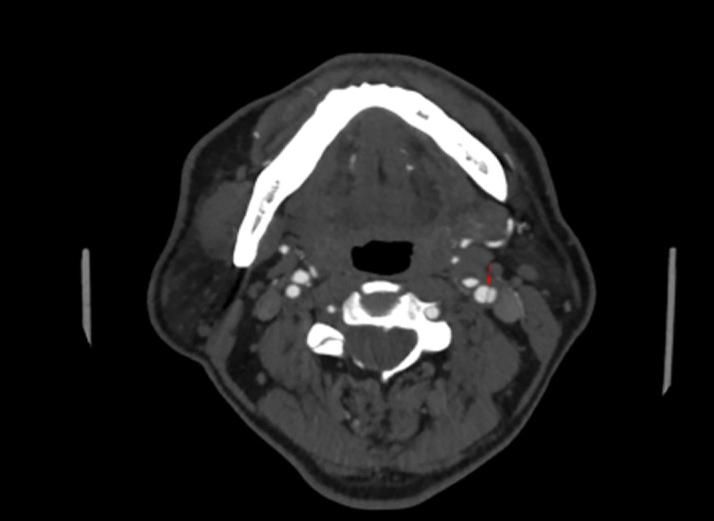
Image: PMC7487535, CC BY - Anterior jugular vein and hypoglossal nerve
- Internal jugular vein and vagus nerve
- Vertebral artery and cervical sympathetic chain
- External jugular vein and accessory nerve
Answer key
- A Spinal accessory nerve
- B Bifurcation of trachea
- A Fibres of mylohyoid
- A Buccal space
- D Hypoglossal nerve
- D A. i) B. ii) C. i) D. i) E. i)
- D Prevertebral fascia
- D Space between alar &prevertebral fascia
- A Prevertebral
- D Lesser occipital nerve
- B Anterior digastric
- C Spinal accessory nerve
- A Accessory (XI)
- C Spinal accessory nerve
- B Spinal accessory nerve
- A Prevertebral fascia
- D Sternocleido mastoid
- C Superior belly of omohyoid
- C Prevertebral and alar fascia
- B Accessory
- A Prevertebral fascia
- D All
- C Modified inner part of scalenus anterior
- D External jugular vein
- B Deep cervical fascia
- A C3
- C Investing layer of deep cervical fascia lies deep to the parotid gland
- D Occipital artery
- A Difficulty in shrugging of shoulder
- D Cervical sympathetic chain
- B ECA and ICA
- B Prevertebral layer of deep cervical fascia
- A Accessory (Cr. N. XI)
- C Scalenus medius
- A Difficulty in shrugging of shoulder
- C Superiorly by the anterior belly of the digastric muscle
- B Internal jugular vein and vagus nerve
About these questions
Previous year questions on Cervical Fascia and Neck Triangles for INI-CET (Institutes of National Importance Combined Entrance Test), from the Anatomy section of the exam.
Most questions here come from previous-year papers of Indian postgraduate medical entrance and licensing exams; where a paper and year are recorded the question carries them. The image-based questions are original vignettes written around an openly licensed figure, and were never asked in any exam.
Anatomy is worth about 11 of the 200 questions on the exam. See every subject’s weightage.