INI-CET · Anatomy
Lumbosacral Nerves and Lower Limb Vessels PYQs
- 20 live questions in Lumbosacral Nerves and Lower Limb Vessels.
- 1 of 20 questions carries a recorded exam year: 2018.
- Question set last updated .
20 questions with answers
Dorsum of first webspace is supplied by nerve
- Superficial peroneal
- Deep peroneal
- Sural
- Posterior tibial
Foot drop is caused by damage to
- Common peroneal nerve
- Femoral nerve
- Tibial nerve
- Sciatic nerve
"Anaesthesia on the sole of the foot" is caused by injury to
- Common peroneal nerve
- Tibial nerve
- Superficial peroneal nerve
- Deep peroneal nerve
Foot drop is due to injury to which nerve:
- Peroneal nerve
- Tibial nerve
- Femoral nerve
- Obturator nerve
Ankle reflex nerve root:
- L4
- L5
- S1
- S2
All are seen in injury to common peroneal nerve except?
- Loss of sensation over sole
- Foot drop
- Injury to neck of fibula
- Loss of dorsiflexion of toe
Skin and fascia of great toe drains into ?
- Superficial inguinal lymph nodes
- External iliac nodes
- Internal iliac nodes
- Deep inguinal nodes
Dermatome of posterior thigh :
- L4
- L5
- S1
- S2
A patient presented with defective adduction of the hip joint with pain in the knee and hip joint, the nerve involved is?
- Obturator nerve
- Tibial nerve
- Femoral nerve
- Saphenous nerve
TRUE about Lumbar plexus is
- The femoral nerve carries contributions from the ventral divisions of anterior rami of L2 to L4
- Root value of Lateral Cutaneous nerve of thigh is L3 and L4
- L3 is also known as Nervus furcalis
- Root value of Genitofemoral nerve is L1 and L2
"Scissor gait" is a condition in which one limb crosses in front of the other during stepping as a result of powerful hip adduction caused by continuous, unwanted nerve activity. Overactivity of which of the nerves can cause this condition?
- Femoral
- Inferior gluteal
- Obturator
- Tibial
All of the following can be involved in an injury to the head of the fibula, EXCEPT?
- Anterior tibial nerve
- Common peroneal nerve
- Superficial peroneal nerve
- Tibial nerve
Obturator nerve enters thigh at
- Adductor canal
- Obturator canal
- Superficial inguinal ring
- Femoral canal
Skin of dorsum of first web space of foot is supplied by
- Sural nerve
- Saphenous nerve
- Deep peroneal nerve
- Lateral plantar nerve
Blood supply of posterior compartment of thigh is -
- Superior gluteal artery
- Inferior epigastric artery
- Profunda femoris artery
- Internal iliac artery
True about the anatomy of great saphenous vein:
- Stas as a continuation of medial marginal vein
- Ends of femoral vein 2.5 cm below the inguinal ligament
- There are 2 - 5 valves below the knee.
- Ascends 2.5 - 3 cm behind tibial malleolus
Nerve of anterior compartment of leg
- Superficial peroneal
- Deep peroneal
- Saphenous
- Sural
Root value for nerve to Quadratus femoris ?
- L1,L2,L3
- L2,L3,L4
- L4,L5 ,S1
- S1, S2,S3
The thickest nerve of the body is?
- Radial
- Median
- Sciatic
- Axillary
A 58-year-old man with long-standing lower-limb swelling has the non-healing ulcer shown in the photograph, surrounded by brownish pigmentation and thickened indurated skin, lying in the gaiter region just above the medial malleolus. Incompetence of perforating veins draining into which superficial vein most characteristically produces an ulcer at this site?
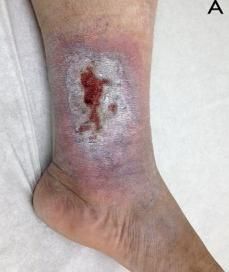
Image: PMC8276648, CC BY - Dorsal venous arch of the foot
- Small saphenous vein
- Anterior accessory saphenous vein
- Great saphenous vein
Answer key
- B Deep peroneal
- A Common peroneal nerve
- B Tibial nerve
- A Peroneal nerve
- C S1
- A Loss of sensation over sole
- A Superficial inguinal lymph nodes
- D S2
- A Obturator nerve
- D Root value of Genitofemoral nerve is L1 and L2
- C Obturator
- D Tibial nerve
- B Obturator canal
- C Deep peroneal nerve
- C Profunda femoris artery
- A Stas as a continuation of medial marginal vein
- B Deep peroneal
- C L4,L5 ,S1
- C Sciatic
- D Great saphenous vein
About these questions
Previous year questions on Lumbosacral Nerves and Lower Limb Vessels for INI-CET (Institutes of National Importance Combined Entrance Test), from the Anatomy section of the exam.
Most questions here come from previous-year papers of Indian postgraduate medical entrance and licensing exams; where a paper and year are recorded the question carries them. The image-based questions are original vignettes written around an openly licensed figure, and were never asked in any exam.
Anatomy is worth about 11 of the 200 questions on the exam. See every subject’s weightage.