INI-CET · Medicine
Bedside Clinical Examination PYQs
- 27 live questions in Bedside Clinical Examination.
- 2 of 27 questions carry a recorded exam year: 2018, 2019.
- Question set last updated .
27 questions with answers
What is the name of this technique for palpation of thyroid. A thumb is placed on the lateral side of trachea and patient is swallowing?
- Lahey's method
- Kocher's test
- Pizzilo method
- Crile method
Which is NOT a feature of pleural effusion?
- Horizontal fluid level
- Low lung volume
- Muffled heart sound
- Decreased chest movements
Stony dull note on percussion is characteristic of-
- Pleural effusion
- Consolidation
- Pleurisy
- Tuberculosis cavity
Limbs elevated against gravity but not against force is which power
- Grade I
- Grade II
- Grade III
- Grade IV
Which of the following is not a potential aetiology of peripheral cyanosis?
- Cold exposure
- Deep venous thrombosis
- Methemoglobinemia
- Peripheral vascular disease
Coarse tremors of tongue is seen in all except:
- Parkinsonism
- Alcohol
- Thyrotoxicosis
- General paresis
A patient came with complaints of lower limb weakness. Examiner places one hand under the patient's heel and patient is asked to raise his other leg against downward resistance. What is the name of this test?
- Hoover test
- Waddell's test
- O'Donoghue test
- McBride test
Which of the following would you consider orthostatic hypotension?
- SBP fall by 20 mm hg, DBP fall by 10 mm hg within 3 minutes
- SBP fall by 20 mm hg, DBP fall by 10 mm Hg within 6 minutes
- SBP fall by 30 mm hg, DBP fall by 20 mm Hg within 3 minutes
- SBP fall by 30 mm hg, DBP fall by 20 mm hg within 6 minutes
Show answer
A. SBP fall by 20 mm hg, DBP fall by 10 mm hg within 3 minutes
Think this answer is wrong? Report itOne of the causes of finger clubbing is:
- Carcinoma of the lung
- Cardiac failure
- Bronchial asthma
- Ischaemia heart disease
Which among the following is NOT a feature of Consolidation?
- Increased Vocal fremitus
- Dull note on percussion
- Bronchial breath sounds
- Trachea shifted to side of consolidation
Waddling gait is seen in - a) Bilateral dislocation of hip b) Myopathies c) Common peroneal nerve injury d) Unilateral dislocation of the hip
- ac
- a
- ab
- bc
UMN lesion is characterised by :
- Weakness & spasticity
- Fasciculations
- Rigidity
- Localised muscle atrophy
Cause of central cyanosis include all of the following, Except-
- Chronic Asthma
- Congenital Pulmonary stenosis
- Congestive heart failure
- Alveolar hypoventilation
Cyanosis of Lip is present in:
- Polycythemia
- MI
- Angina
- All of the above
Pronator drift is a sign of -
- UMN lesion of upper limb
- LMN lesion
- Dorsal syringomyelia
- Carpel tunnel syndrome
Which of the following statements regarding dyspnoea are True / False? a) Tripod positioned breathing, characterized by sitting with one's hands braced on the knees is indicative of increased airway resistance b) Paradoxical movement of the abdomen a sign of diaphragmatic weakness c) Left atrial failure should be considered when the patient complains of platypnea d) Raynaud's disease may be an indirect clue to the underlying pulmonary hypertension in a patient with dyspnoea e) If the heart rate is >85% of the predicted maximum an abnormality of the cardiovascular system is likely the explanation for dyspnoea
- c,d,e -True a,b -False
- a,d,e -True b,c -False
- a,b,d,e -True c -False
- a,d -True b,c,e -False
For clinically detectable ascites, the minimal amount of fluid should be
- 300 cc
- 600 cc
- 1 litre
- 2 litre
In which condition breath sounds are absent:
- Bronchial asthma
- Pneumothorax
- Emphysema
- Pneumonia
The minimum concentration of reduced hemoglobin required for cyanosis is
- 1gm/dl.
- 3 gm/dl
- 7 gm/dl
- 5 gm/dl
Which of the following is not a feature of consolidation
- Increased vocal resonance
- Dull Percussion note
- Bronchial Breath sounds
- Tracheal shift to side of consolidation
Which of the following is the most important bedside measurement from which volume status can be assessed
- JVP
- ECG
- Pulse rate
- None of the above
Elevated JVP is seen in
- Corpulmonale
- Pneumonia
- ARDS
- Pleural effusion
Pronator drift is a sign of -
- UMN lesion of upper limb
- LMN lesion
- Dorsal syringomyelia
- Carpal tunnel syndrome
Clubbing of the fingers is seen in all of the following conditions except:
- Bronchiectasis
- Coronary artery disease
- Lung abscess
- Tetralogy of Fallot
What is the name of this test to be done before drawing an arterial blood gas sample:
- Virchow test
- Water hammer test
- Allen test
- Trendelenburg test
When you conduct a physical examination on a 2-year-old boy, which of the following procedures is most effective?
- Ask the parent to leave the room so that you can handle the child better
- Ask the child's permission to do the examination before you begin
- Start the examination at the child's feet and work your way up toward the head
- Carefully explain to the child what you are going to do and why you are going to do it before you begin
Show answer
C. Start the examination at the child's feet and work your way up toward the head
Think this answer is wrong? Report itA 24-year-old man reports difficulty seeing in dim light since childhood and progressive narrowing of his visual fields, so that he now bumps into objects at the sides. Fundus examination of the right eye is shown. Which is the most likely diagnosis?
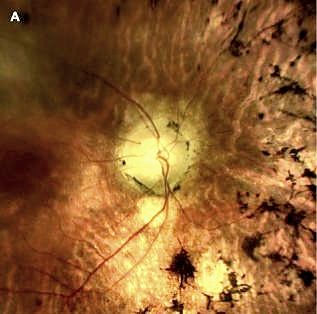
Image: PMC5663731, CC BY - Central retinal vein occlusion
- Choroidal melanoma
- Proliferative diabetic retinopathy
- Retinitis pigmentosa
Answer key
- D Crile method
- A Horizontal fluid level
- A Pleural effusion
- C Grade III
- C Methemoglobinemia
- C Thyrotoxicosis
- A Hoover test
- A SBP fall by 20 mm hg, DBP fall by 10 mm hg within 3 minutes
- A Carcinoma of the lung
- D Trachea shifted to side of consolidation
- C ab
- A Weakness & spasticity
- C Congestive heart failure
- A Polycythemia
- A UMN lesion of upper limb
- C a,b,d,e -True c -False
- C 1 litre
- B Pneumothorax
- D 5 gm/dl
- D Tracheal shift to side of consolidation
- A JVP
- A Corpulmonale
- A UMN lesion of upper limb
- B Coronary artery disease
- C Allen test
- C Start the examination at the child's feet and work your way up toward the head
- D Retinitis pigmentosa
About these questions
Previous year questions on Bedside Clinical Examination for INI-CET (Institutes of National Importance Combined Entrance Test), from the Medicine section of the exam.
Most questions here come from previous-year papers of Indian postgraduate medical entrance and licensing exams; where a paper and year are recorded the question carries them. The image-based questions are original vignettes written around an openly licensed figure, and were never asked in any exam.
Medicine is worth about 19 of the 200 questions on the exam. See every subject’s weightage.
More in Medicine
- HIV and AIDS: Epidemiology and Clinical Features
- HIV and AIDS: Treatment and Prophylaxis
- Pulmonary and Extrapulmonary Tuberculosis
- Malaria, Dengue and Other Tropical Fevers
- COVID-19: Diagnostic Investigations
- COVID-19: Management
- Disorders of Acid-Base Balance
- Anterior Pituitary Disorders
- Pituitary Tumours and Sheehan Syndrome
- Posterior Pituitary: ADH, Oxytocin and Diabetes Insipidus
- Syndrome of Inappropriate ADH Secretion (SIADH)
- Thyroid Disorders: Clinical Presentation