INI-CET · Medicine
Diabetes Mellitus: Complications and Their Care PYQs
- 47 live questions in Diabetes Mellitus: Complications and Their Care.
- 3 of 47 questions carry a recorded exam year: 2018, 2019.
- Question set last updated .
47 questions with answers
Which of the following is the earliest finding seen in Diabetic nephropathy?
- Hematuria
- Macroalbuminuria
- Microalbuminuria
- Exudates
Long term diabetic PATIENT with blisters walked barefoot few miles on hot sand. He presented with this clinical condition. What is the most probable diagnosis?
- Diabetic foot
- Burn
- Necrotizing Fasciitis
- Cellulitis
A 45 year old male , known case of diabetes mellitus from last 15 years ,presents with Diabetic ketoacidosis . What shall be the initial line of management?
- 3 % saline
- 5% dextrose
- 0.9 % saline
- Colloids
Each of the following can cause hypoglycemia Except
- Beta blockers
- Hepatoma
- Pituitary insufficiency
- Multiple endocrine neoplasia (MEN) syndrome, type II
Show answer
D. Multiple endocrine neoplasia (MEN) syndrome, type II
Think this answer is wrong? Report itLegacy effect is related to which of the diabetes complication ?
- Renal
- Neuropathy
- Retinopathy
- Cardiovascular
A 50 years old male with type 2 diabetes mellitus is found to have 24-hour urinary albumin of 250 mg. Which of the following drugs may be used to retard the progression of the renal disease?
- Hydrochlorothiazide
- Enalapril
- Amiloride
- Aspirin
A 50 years old male with type 2 diabetes mellitus is found to have 24-hour urinary albumin of 250 mg. Which of the following drugs may be used to retard progression of the renal disease?
- Hydrochlorothiazide
- Enalapril
- Amiloride
- Aspirin
Which of the following causative factors is not involved in the pathogenesis of Diabetic gangrene?
- Infection
- Myelopathy
- Atherosclerosis
- Osteoarthropathy
A middle-aged man comes after a road traffic accident with bleeding from the scalp. He is unconscious. A card in his pocket reveals that he is a known diabetic on Tab Glimepiride + Metformin 2 tablets twice daily. What should the next step in management?
- Send blood for tests, start IV glucose and send to CT
- Start normal saline and send to CT
- Dextrose solution, CT scan
- Airway, CT scan. Blood sugar if <70 start dextrose
Show answer
D. Airway, CT scan. Blood sugar if <70 start dextrose
Think this answer is wrong? Report itAcetone breath is a feature of:
- Liver disease
- Sinusitis
- Renal disease
- Diabetes mellitus
A known 60-year-old male Diabetic and hypertensive patient was found unconscious in the morning. On examination pulse- 120, bp- 180/100 and there was positive extensor plantar. What is next step to be done?
- Order CT scan
- Immediately reduces bp with antihypertensives
- Give I/v mannitol
- Check blood glucose
All of these are true about microalbuminuria except:
- Urine protein levels range from 20 mg/d to 200 mg/d
- It is an independent risk factor for cardiovascular morbidity in diabetic patients
- It is the earliest marker of diabetic nephropathy
- It is not detected by routine dipstick method
Show answer
A. Urine protein levels range from 20 mg/d to 200 mg/d
Think this answer is wrong? Report itRecurrent balanoposthitis seen in :
- DM
- Herpes simplex
- Smoking
- Alcohol
A hypertensive, diabetic is having proteinuria, antihypertensive of choice is :
- Propanolol
- Clonidine
- Enalapril
- Alpha methyldopa
Ulcers in diabetes are precipitated by all of the following except
- Trophic changes due to peripheral neuritis
- Neuropathy
- Microangiopathic changes in blood vessels
- Macroangiopathy
Intravenous fluid of choice in management of diabetic ketoacidosis
- Normal saline
- Colloids
- 5% dextrose
- Dextran - 70
Which of the following is the specific therapy that suppresses lipolysis and ketogenesis and thereby reverses the ketoacidosis in Diabetic Ketoacidosis?
- Normal saline
- Bicarbonate
- Potassium
- Insulin
Diabetic Amyotrophy presents with?
- Pain in front of thigh
- 3rd nerve palsy with pupillary sparing
- Distal areflexia
- Symmetric distal motor weakness
Hypoglycemic unawareness that occurs in diabetic patients when transfered from oral hypoglycemics to insulin, is due to -
- Autonomic neuropathy
- Insulin resistance
- Lipodystrophy
- Somogi phenomenon
Rotten apple smell of breath is associated with:
- Liver insufficiency
- Kidney insufficiency
- Unbalanced insulin dependent diabetes
- Respiratory problems
The Recommended treatment of early diabetic nephropathy manifested by microalbuminuria is
- Strict glycemic control
- Low protein Diet
- Strict glycemic control and Low Protein Diet
- Strict glycemic control, Low protein Diet and ACE Inhibitors
Show answer
D. Strict glycemic control, Low protein Diet and ACE Inhibitors
Think this answer is wrong? Report itDiabetes mellitus associated with
- ↑ HDL
- ↑Triglycerides
- ↓Triglycerides
- ↓ Cholesterol
The most common form of diabetic neuropathy is -
- Acute mononeuropathy
- Autonomic neuropathy
- Polyradiculopathy
- Distal symmetric polyneuropathy
A 63-year-old woman has Type II diabetes mellitus, which is well-controlled. Her physical examination is positive for peripheral neuropathy in the feet and non-proliferative retinopathy. A urinalysis is positive for proteinuria. Which of the following treatments is most likely to attenuate the course of renal disease?
- calcium channel blockers
- ACE inhibitors
- hepatic hydroxymethylglutaryl-coenzyme A (HMG-CoA) inhibitors
- dietary carbohydrate restriction
A 60-year old man with diabetes mellitus presents with painless, swollen right ankle joint. Radiographs of the ankle show destroyed joint with large number of loose bodies. The most probable diagnosis is:
- Charcot's joint
- Clutton's joint
- Osteoarthritis
- Rheumatoid arthritis
Charcot's joint in diabetes affects commonly -
- Shoulder joint
- Knee joint
- Hip joint
- Tarsal joint
Which of the following drugs is used for painful diabetic neuropathy
- Duloxetine
- Pregabalin
- Amitriptyline
- All of the above
Foot Ulcers in diabetes are due to all except?
- Decreased immunity
- Neuropathy
- Microangiopathy
- Macroangiopathy
Which of the following statements about Diabetic Ketoacidosis is true -
- Decreased Bicarbonate
- Increased Lactate
- Normal anion gap
- Glucose < 250 mg\/dl
All are used in painful diabetic neuropathy, except-
- Phenytoin
- Local use of capsicum
- Dextroamphetamine
- Amitriptyline
Most common form of diabetic neuropathy is:
- Cranial neuropathies
- Radiculopathies
- Sensorimotor polyneuropathy
- Limb mononeuropathies
A patient with DM of 4 yrs duration presents with dizziness and HR 52/min, probable cause is
- Hypoglycaemia
- Inferior wall MI
- Sick-sinus syndrome
- Autonomic dysfunction
Diabetes dyslipidemia pattern of HDL -
- Decreased Triglycerides
- Decreased HDL
- Increased HDL
- Decreased cholesterol
All are seen in DKA except,
- Tachypnoea
- Dehydration
- Bradycardia
- Abdominal pain/tenderness
Most common ophthalmic complication of diabetes mellitus is
- Retinopathy
- Cataract
- Rubeosis iridis
- Vitreous hemorrhage
Which of the following tests is most suited for early detection of diabetic nephropathy?
- Ultrasonography
- Creatinine clearance
- Urine albumin
- Serum Creatinine
A 50-YEAR-old male presented with blurring of vision. Urine examination showed proteinuria. fundus examination showed dot n blot hemorrhages, microaneurysm and cotton wool spots. What is the most probable diagnosis?
- Kimmelstiel-Wilson lesions
- Crescents
- Amyloid
- Segmental sclerosis
In diabetic nephropathy all of the following are true, except-
- Cardiovascular abnormalities can occur
- Micro and macro albuminuria can occur
- ACE inhibitors can reduce micro albuminuria
- Insulin requirement becomes high
In hyperosmolar hyperglycemic non ketotic coma the blood glucose level is around -
- 55 mmol/l
- 20 mmol/l
- 80 mmol/l
- 5 mmol/l
A 45 year old male known case of diabetes presents with nausea, multiple episodes of vomiting and abdominal pain. He is stuporous, having blood glucose level of 402 mg% and on urine examination Ketone bodies are detected. He is having tachycardia along with orthostatic hypotension. On lab investigation, his potassium levels are 3 meq/L. The next best step in the management will be:
- Manage hypokalemia-Repeat serum K+ levels- IV fluids and start IV regular insulin
- IV fluids-give IV regular insulin and lastly manage hypokalemia
- Give IV regular insulin along with K+ - IV fluids after the K+ level is normal
- IV fluids - give Lente insulin and side by side manage hypokalemia
Show answer
A. Manage hypokalemia-Repeat serum K+ levels- IV fluids and start IV regular insulin
Think this answer is wrong? Report itWhich of the following is not seen in Non-ketotic hyperosmolar coma?
- Insidious onset
- Kussmaul's breathing
- Seen in elderly
- Seen in type 2 DM
The earliest feature of diabetic nephropathy is-
- Microalbuminuria
- Increased serum creatinine
- Nephrotic syndrome
- Hematuria
Diabetic ketoacidosis is said to be present if:
- Hyperglycemia, heavy glycosuria, ketonemia, ketonuria, acidosis are present
- Hyperglycemia, glycosuria, hyperkalemia and hypocalcemia are present
- Hypoglycemia, hypokalemia, hypercalcemia, ketonemia are present
- Hypoglycemia, ketonemia, ketonuria hypokalemia are present
Show answer
A. Hyperglycemia, heavy glycosuria, ketonemia, ketonuria, acidosis are present
Think this answer is wrong? Report itOsmotic damage is operative in all of the following complications of diabetes mellitus EXCEPT
- The formation of cataracts
- Insulin receptor deficiency
- Microaneurysms in retinal vessels
- Peripheral neuropathy
A 55-year-old man with type 2 diabetes mellitus of 14 years' duration undergoes fundus fluorescein angiography for reduced central vision. The angiogram shown demonstrates multiple discrete pinpoint hyperfluorescent dots clustered around the macula, each smaller than the calibre of the adjacent retinal vessels. What do these punctate hyperfluorescent dots represent?
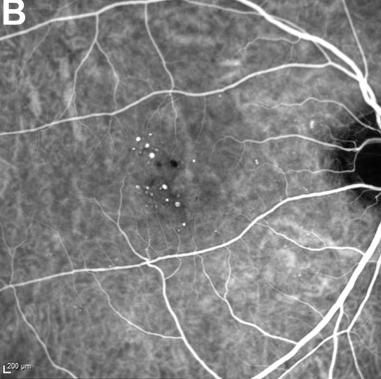
Image: PMC5045476, CC BY - Blocked fluorescence from deep retinal haemorrhages
- Optic disc drusen
- Retinal capillary microaneurysms
- Cotton-wool spots
A 55-year-old man with long-standing type 2 diabetes mellitus and a HbA1c of 9.4% complains of gradually blurring central vision. His colour fundus photograph is shown, with small waxy yellow deposits with sharp margins clustered at the macula together with a few tiny red dots. Which retinal finding is illustrated?
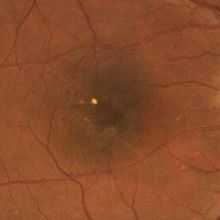
Image: PMC5045476, CC BY - Chorioretinal atrophy
- Hard exudates
- Retinal neovascularisation
- Cotton-wool spots
A 52-year-old man with type 2 diabetes is admitted in diabetic ketoacidosis. He complains of right-sided facial pain, nasal blockage and blood-stained nasal discharge. Diagnostic nasal endoscopy of the right middle meatus is shown. Which is the most appropriate next step?
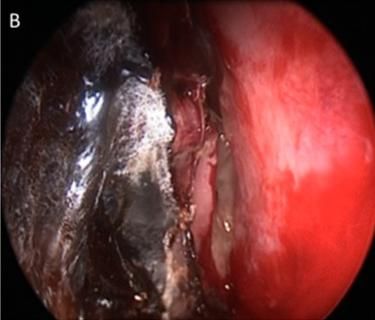
Image: PMC6462957, CC BY - Oral fluconazole with topical nasal decongestants
- Intravenous voriconazole alone, with surgery deferred unless the disease progresses on treatment
- Intravenous amoxicillin-clavulanate with functional endoscopic sinus surgery for complicated bacterial sinusitis
- Endoscopic biopsy with KOH smear, urgent surgical debridement and intravenous liposomal amphotericin B
Show answer
D. Endoscopic biopsy with KOH smear, urgent surgical debridement and intravenous liposomal amphotericin B
Think this answer is wrong? Report it
Answer key
- C Microalbuminuria
- B Burn
- C 0.9 % saline
- D Multiple endocrine neoplasia (MEN) syndrome, type II
- D Cardiovascular
- B Enalapril
- B Enalapril
- B Myelopathy
- D Airway, CT scan. Blood sugar if <70 start dextrose
- D Diabetes mellitus
- D Check blood glucose
- A Urine protein levels range from 20 mg/d to 200 mg/d
- A DM
- C Enalapril
- C Microangiopathic changes in blood vessels
- A Normal saline
- D Insulin
- A Pain in front of thigh
- A Autonomic neuropathy
- C Unbalanced insulin dependent diabetes
- D Strict glycemic control, Low protein Diet and ACE Inhibitors
- B ↑Triglycerides
- D Distal symmetric polyneuropathy
- B ACE inhibitors
- A Charcot's joint
- D Tarsal joint
- D All of the above
- C Microangiopathy
- A Decreased Bicarbonate
- C Dextroamphetamine
- C Sensorimotor polyneuropathy
- B Inferior wall MI
- B Decreased HDL
- C Bradycardia
- A Retinopathy
- C Urine albumin
- A Kimmelstiel-Wilson lesions
- D Insulin requirement becomes high
- A 55 mmol/l
- A Manage hypokalemia-Repeat serum K+ levels- IV fluids and start IV regular insulin
- B Kussmaul's breathing
- A Microalbuminuria
- A Hyperglycemia, heavy glycosuria, ketonemia, ketonuria, acidosis are present
- B Insulin receptor deficiency
- C Retinal capillary microaneurysms
- B Hard exudates
- D Endoscopic biopsy with KOH smear, urgent surgical debridement and intravenous liposomal amphotericin B
About these questions
Previous year questions on Diabetes Mellitus: Complications and Their Care for INI-CET (Institutes of National Importance Combined Entrance Test), from the Medicine section of the exam.
Most questions here come from previous-year papers of Indian postgraduate medical entrance and licensing exams; where a paper and year are recorded the question carries them. The image-based questions are original vignettes written around an openly licensed figure, and were never asked in any exam.
Medicine is worth about 19 of the 200 questions on the exam. See every subject’s weightage.
More in Endocrine System
- Thyroid Disorders: Treatment Approach
- Multiple Endocrine Neoplasia Syndromes
- Phaeochromocytoma
- Cushing Syndrome
- Adrenal Insufficiency and Aldosterone Excess
- Diabetes Mellitus: Classification, Presentation and Treatment
- Endocrinology of Reproduction
- Parathyroid Disorders and Calcium Balance
- Obesity
- Anterior Pituitary Disorders
- Pituitary Tumours and Sheehan Syndrome
- Posterior Pituitary: ADH, Oxytocin and Diabetes Insipidus