INI-CET · Medicine
Ischemic Heart Disease: Clinical Presentation and Diagnosis PYQs
- 42 live questions in Ischemic Heart Disease: Clinical Presentation and Diagnosis.
- 1 of 42 questions carries a recorded exam year: 2018.
- Question set last updated .
42 questions with answers
Preferred biochemical marker(s) in patients presenting with myocardial infarction:
- Myoglobin
- Cardiac specific Troponins
- CK-MB
- All of the above
Wellen's syndrome suggests
- Stable angina
- Unstable angina
- Ludwig's angina
- Prinzmetal angina
ST depression and T wave inversion in V1 to V6 and aVL leads indicate
- Anterolateral wall AMI
- Posterior wall AMI
- Inferior AMI
- Lateral wall AMI
________occurs whenever there is an imbalance between myocardial oxygen supply and demand.
- Sudden Death
- Stable angina
- Unstable angina
- Myocardial infarction
Serum glutamic oxaloacetic transaminase is increased in:
- Renal failure
- Prostatic carcinoma
- Myocardial infarction
- Pulmonary edema
Unstable Angina, True is
- Chest pain occurs at rest.
- Pain lasts for 10 minutes.
- Pain subsides on rest.
- All of the above.
Crescendo angina is
- Stable angina
- Heart failure
- Unstable angina
- MI
Enzymes elevated in the plasma in MI
- CPK-MB
- SGOT (AST)
- LDH
- All of the above
Myocardial infarction; signs are all except
- ‘a’ wave elevation
- Levine’s sign
- Kussmaul’s sign
- Bradycardia in case of infarction of anterior portion of heart
Show answer
D. Bradycardia in case of infarction of anterior portion of heart
Think this answer is wrong? Report itFeatures of cardiac rest pain are all, except
- Compressive.
- Radiating
- Excruciating
- None of the above
Marker appearing last in MI
- LDH
- CPK-MB
- Troponin T
- Troponin I
Proteins elevated in the plasma in myocardial infarction
- Troponin T
- Troponin H
- Troponin K
- Troponin M
Which of the following is true about Prinzmetal's (variant) angina?
- Focal spasm most commonly involves the right coronary artery, giving transient ST elevation in the inferior leads
- Coronary artery spasm most commonly occurs distal to atherosclerotic area.
- No changes in ECG, Q wave become normal after few hours.
- All of the above
Show answer
A. Focal spasm most commonly involves the right coronary artery, giving transient ST elevation in the inferior leads
Think this answer is wrong? Report itPrinzmetal angina is-
- Angina after extreme exertion
- Caused due to atherosclerotic blockade
- Caused due to spasm of artery
- Calcium channel blockers not effective
All of the following are indication for Treadmill testing, except-
- To evaluate unstable angina
- To evaluate chronic stable angina
- To assess outcome after coronary revascularization
- To diagnose and evaluate the treatment of exercise induced arrhythmias
In syndrome X, patients have all of the following except -
- Angina like chest pain
- Ischemic ST segment depression
- Abnormal coronary arteriogram
- Excellent prognosis
Sensitive and specific marker for MI
- CK-MB
- Troponin
- Myoglobulin
- LDH
Patient complaining of retrosternal chest pain for more than half an hour is most likely to be:
- Angina
- MI
- CHF
- Congenital heart problem
A patient has normal total CK and CK-MB levels 2 days after the onset of chest pain. Which of the following is true?
- Does not exclude the diagnosis of MI
- Confirms reperfusion after MI
- Confirms an extracardiac source of pain
- Indicates recent cardiac surgery
The Most sensitive marker of cardiac injury is
- LDH
- Myoglobin
- CPK-MB4
- Troponin
Which of the following is a feature of hibernating myocardium?
- Elevated cardiac troponins
- Depressed ST segment
- Elevated ST segment
- Left bundle branch block
Troponin -T is preferable to CPK- MB in the diagnosis of acute myocardial Infarction (MI) in all of the following situations except-
- Bedside diagnosis of MI
- postoperatively (after CABG)
- Reinfarction after 4 days
- Small infarcts
Test for reversible cardiac ischemia is:
- Angiography
- Thallium scan
- MUGA
- Resting Echocardiography
Which of the following tests is used to detect reversible myocardial ischemia
- Angiography
- Thallium scan
- MUGA
- Resting Echocardiography
Judkins technique used for?
- Central venous line placement
- Coronary arteriography
- Renal angiography
- Chest tube insertion
A Myocardial infarcted patients presented with nausea, vomiting, epigastric pain, with bradycardia. ECG records first degree heart block. Most common involvement is
- Left anterior descending artery
- Right coronary artery
- Oblique artery
- Left circumflex coronary artery
What is diagnostic of fresh myocardial infarction in ECG :
- QT interval prolongation
- P mitrale
- ST segment elevation
- ST segment depression
A 64 years old gentleman is brought with severe central chest pain radiating to the left arm for the last 30 minutes. He is profusely sweating and is in agony. Which of the following disease he is likely to be suffering from?
- Stable angina
- Oesophagitis
- Acute myocardial infarction
- Pleurisy
ECG is poor in detecting ischemia in areas supplied by which of the following vessels?
- Left Anterior Descending (LAD)
- Right Coronary Artery (RCA)
- Left Circumflex (LCx)
- Left Coronary Artery (LCA)
Agatson scoring is done for?
- Coronary artery disease
- End organ damage in hypertension
- End organ damage in SLE
- CHF with preserved ejection fraction
Which of the following is the preferred marker for detecting Acute STEMI in Athletes:
- CK-MB
- Troponin T/I
- C-Reactive Protein
- LDH
All statements are true regarding non-ST elevation acute coronary syndromes (NSTE-ACS) and ST elevation myocardial infarctions (STEMI) except ?
- The relative incidence of NSTEMI is rising due to the increasing burden of diabetes and chronic kidney disease in an aging population.
- Pump failure is now the primary cause of in-hospital death from STEMI
- Infarction of >=60% of the left ventricle usually results in cardiogenic shock
- PCI is the treatment of choice for patients with acute coronary syndromes
Show answer
C. Infarction of >=60% of the left ventricle usually results in cardiogenic shock
Think this answer is wrong? Report itAngina pectoris is best diagnosed by
- History
- ECG
- Cardiac Enzyme
- Echo
The most common site of Myocardial infarction is:
- Anterior wall
- Interventricular septum
- Posterior wall
- Inferior wall
What is diagnosis of fresh myocardial infarction in ECG-
- QT interval prolongation
- P mitrale
- ST segment elevation
- ST segment depression
Cardiac biomarker for choice of diagnosis of Reinfarction 8 days after initial ischemia is
- Troponins
- CK-MB
- Myoglobin
- LDH
Troponin-T is preferable to CPK-MB in the diagnosis of acute MI in all of the following situations except ?
- Bedside diagnosis of MI
- After CABG
- Reinfarction after 4 days
- Small infarct
A 45-year-old man experiences crushing substernal chest pain after arriving at work one morning. Over the next 4 hours, the pain persists and begins to radiate to his left arm. He becomes diaphoretic and short of breath but waits until the end of his 8-hour shift to go to the hospital. An elevated serum value of which of the following laboratory tests would be most useful for the diagnosis of this patient on admission to the hospital?
- ALT
- AST
- CK-MB fraction
- C-reactive protein
First cardiac biomarker to be raised in MI is ?
- CPK-MB
- LDH
- Myoglobin
- Troponin-I
Which of the following is not true about cardiac biomarkers in myocardial infarction?
- Last marker to increase is lactate dehydrogenase
- One of the earliest markers to rise is myoglobin
- CK-MB is useful for diagnosis of reinfarction because it returns to normal within 48–72 hours
- Troponin returns to normal within 48–72 hours
A 56-year-old asymptomatic man with hypertension and dyslipidaemia has a normal resting electrocardiogram. A curved reformatted image of his left circumflex coronary artery from a CT coronary angiogram is shown; scattered very high attenuation foci lie in the vessel wall, and the contrast-filled lumen adjacent to them remains only minimally narrowed. Which is the most appropriate management?
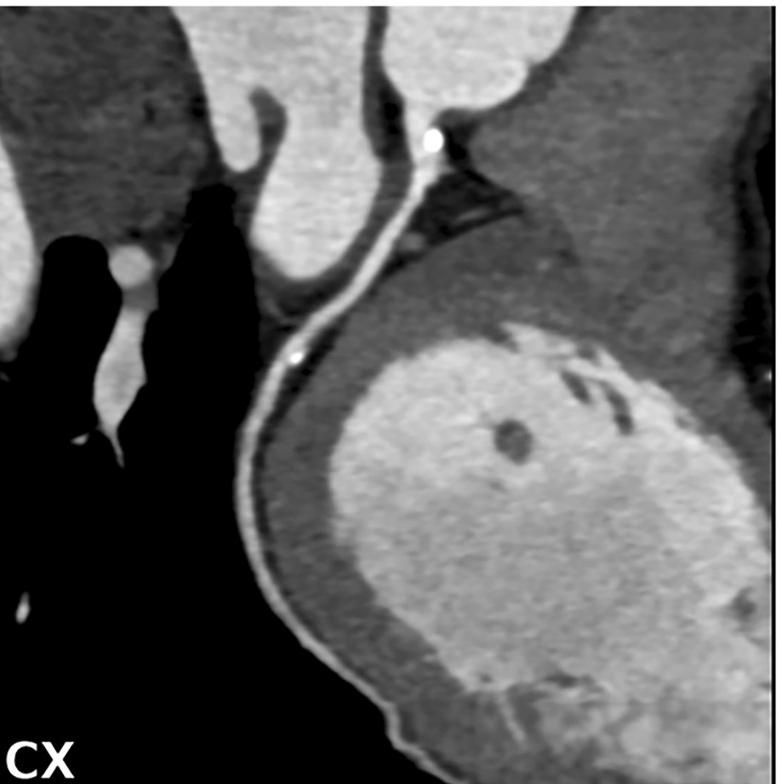
Image: PMC7559787, CC BY - Immediate percutaneous coronary intervention of the circumflex artery
- Referral for coronary artery bypass grafting
- Intensive risk-factor modification with high-intensity statin therapy
- Invasive coronary angiography to assess the circumflex lesion further
Show answer
C. Intensive risk-factor modification with high-intensity statin therapy
Think this answer is wrong? Report itA 56-year-old man undergoes CT coronary angiography. The curved reformatted image of the left anterior descending artery shown demonstrates several sharply defined foci of very high attenuation, brighter than the contrast-opacified lumen, lying within the vessel wall. What do these bright foci represent?
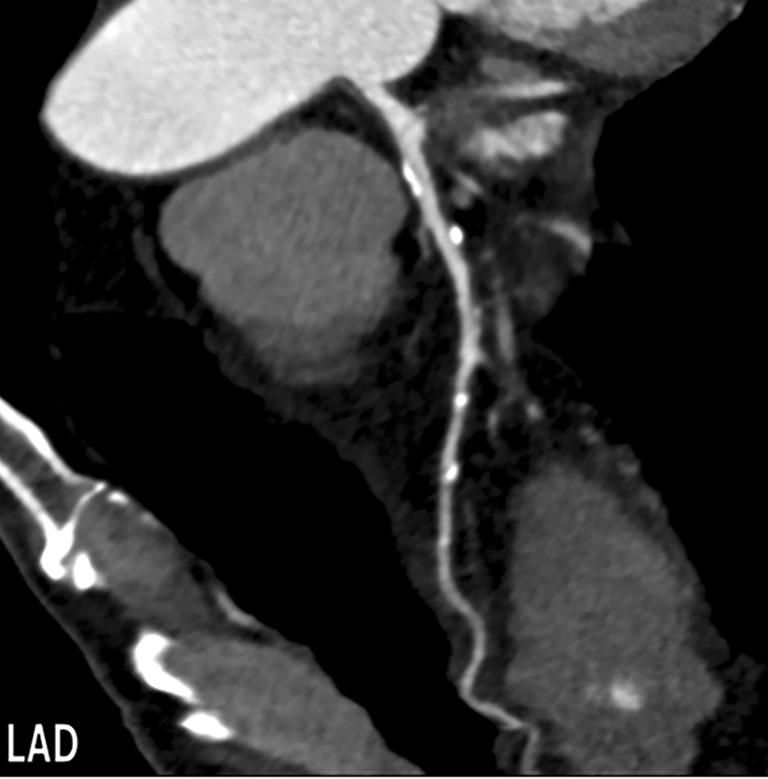
Image: PMC7559787, CC BY - Extravasated contrast from coronary perforation
- Acute intraluminal thrombus
- A previously deployed coronary stent
- Calcified atherosclerotic plaque
Answer key
- B Cardiac specific Troponins
- B Unstable angina
- A Anterolateral wall AMI
- B Stable angina
- C Myocardial infarction
- A Chest pain occurs at rest
- C Unstable angina
- D All of the above
- D Bradycardia in case of infarction of anterior portion of heart
- D None of the above
- A LDH
- A Troponin T
- A Focal spasm most commonly involves the right coronary artery, giving transient ST elevation in the inferior leads
- C Caused due to spasm of artery
- A To evaluate unstable angina
- C Abnormal coronary arteriogram
- B Troponin
- B MI
- A Does not exclude the diagnosis of MI
- D Troponin
- B Depressed ST segment
- C Reinfarction after 4 days
- B Thallium scan
- B Thallium scan
- B Coronary arteriography
- B Right coronary artery
- C ST segment elevation
- C Acute myocardial infarction
- C Left Circumflex (LCx)
- A Coronary artery disease
- B Troponin T/I
- C Infarction of >=60% of the left ventricle usually results in cardiogenic shock
- A History
- A Anterior wall
- C ST segment elevation
- B CK-MB
- C Reinfarction after 4 days
- C CK-MB fraction
- C Myoglobin
- D Troponin returns to normal within 48–72 hours
- C Intensive risk-factor modification with high-intensity statin therapy
- D Calcified atherosclerotic plaque
About these questions
Previous year questions on Ischemic Heart Disease: Clinical Presentation and Diagnosis for INI-CET (Institutes of National Importance Combined Entrance Test), from the Medicine section of the exam.
Most questions here come from previous-year papers of Indian postgraduate medical entrance and licensing exams; where a paper and year are recorded the question carries them. The image-based questions are original vignettes written around an openly licensed figure, and were never asked in any exam.
Medicine is worth about 19 of the 200 questions on the exam. See every subject’s weightage.
More in Cardiovascular System
- Fundamentals of the ECG
- Supraventricular Tachyarrhythmias
- Ventricular Arrhythmias and Conduction Blocks
- Diseases of the Cardiac Valves
- Infective Endocarditis and Rheumatic Fever
- Systemic Hypertension and Vascular Disease
- Ischemic Heart Disease: Complications and Treatment
- Myocarditis and the Cardiomyopathies
- Heart Failure
- Disorders of the Pericardium
- Pulmonary Hypertension
- Aortic and Peripheral Arterial Disease