INI-CET · Pathology
Tubulointerstitial, Vascular and Cystic Renal Disease PYQs
- 46 live questions in Tubulointerstitial, Vascular and Cystic Renal Disease.
- Question set last updated .
46 questions with answers
Xanthogranulomatous pyelonephritis is most often due to
- E. coli
- Proteus
- Pseudomonas
- Klebsiella
Renal papillary necrosis is caused by?
- NSAID
- Cocaine
- Heroin
- Morphine
Striped fibrosis of kidney is seen in
- Chronic rejection
- Diabetes mellitus
- Malignant hypertension
- Cyclosporin toxicity
Interstitial nephritis is seen with all except:
- INH
- Diuretics
- Allopurinol
- RIFAMPICIN
The commonest histological finding in Hypertensive Nephrosclerosis is
- Proliferative endarteritis
- Necrotizing arteriolitis
- Hyaline arteriosclerosis
- Cystic medial necrosis
Antibody coated bacteria (A.C.B.) is characteristic of which one of the following conditions?
- Glomerulonephritis
- Pyelonephritis
- Hypertension
- Perinephric abscess
In a 60 yr old hypertensive male with renal failure, renal biopsy shows onion skin appearance. The most likely diagnosis is
- Hyaline arteriosclerosis
- Thrombophlebitis obliterans
- Hyperplastic arteriosclerosis
- Arteriosclerosis obliterans
True about adult polycystic kidney disease is all, except:
- Autosomal dominant inheritance
- Hypertension is rare
- Can be associated with cysts in liver, lungs and pancreas
- Pyelonephritis is common
A lady presents with complaints of abdominal pain. CECT shows bilateral papillary necrosis. Which of the following test shall not be done to investigate the cause of her papillary necrosis?
- Urine acidification test
- Sickling test
- Urine -PCR for TB
- Bacterial culture of urine
Nephrocalcinosis seen in all except:
- Sarcoidosis
- Acute pancreatitis
- Hyperparathyroidism
- Vitamin D intoxication
Salt losing nephropathy -
- Interstitial nephritis
- Lupus nephritis
- Amyloidosis
- Post-streptococcal GN
Most important cause of interstitial nephritis is -
- Drugs
- Infection
- Malignancy
- Dehydration
Which of the following is a common feature of NSAID induced allergic interstitial nephritis?
- Fever
- Rash
- Eosinophilia
- Heavy proteinuria
Common pathological changes seen in kidney in benign hypertension are -
- Fibrinoid necrosis
- Microaneurysm
- Hyaline arteriosclerosis
- Thinning of walls
Nephrocalcinosis is a feature of A/E:
- Primary hyperparathyroidism
- Medullary sponge kidney
- Vitamin D intoxication
- Pseudo hypoparathyroidism
Which of the following is associated with Renal Papillary Necrosis
- Alcohol
- Heroin
- Morphine
- Tramadol
Acute tubulointerstitial injury due to intratubular cast formation (cast nephropathy) is caused by which of the following proteins?
- Amyloid
- Fibrinogen
- Vitamin D binding protein
- Light chain
Atrophic kidney with papillary calcification in a garland pattern is seen in?
- TB
- Analgesic nephropathy
- Hypercalcemic nephropathy
- Vesico-ureteric reflux
What is the mode of inheritance of APKD?
- Autosomal dominant
- Autosomal recessive
- X-linked recessive
- Mitochondrial inheritance
An important factor for chronic pyelonephritis is ?
- Obstruction
- Vesico-ureteral reflux
- Pelvi-ureteric junction obstruction
- Catheter induced
Renal papillary necrosis seen in all except -
- Diabetes mellitus
- Sickle cell anemia
- Analgesic nephropathy
- Nephrosclerosis
All are causes of Granular Contracted kidneys, except:
- Benign nephrosclerosis
- Diabetes mellitus
- Chronic PyeloNephritis
- Chronic GlomeruloNephritis
In a specimen of kidney, fibrinoid necrosis is seen and onion peel appearance is also present. Most probable pathology is -
- Hyaline degeneration
- Hyperplastic arteriosclerosis
- Glomerulosclerosis
- Fibrillary glomerulonephritis
Which of the following is not associated with Adult Polycystic Kidney Disease
- Autosomal dominant inheritance
- Mutations involving gene affecting cell-cell-matrix interaction
- Intracranial berry aneurysm may be present
- Tricuspid valve prolapse
Which of the following statements about Xanthogranulomatous pyelonephritis is not true -
- Foam cells are seen
- Associated with tuberculosis
- Yellow nodules are seen
- Giant cells may be seen
NOT a cause of granular contracted kidney ?
- Diabetes mellitus
- Chronic pyelonephritis
- Benign nephrosclerosis
- Chronic glomerulonephritis
Necrotizing papillitis may be seen in all of the following conditions except -
- Sickle cell disease
- Tuberculous pyelonephritis
- Diabetes mellitus
- Analgesic nephropathy
A 40-year-old diabetic woman complains of flank pain and fever. Her temperature is 38.7°C (103°F), respirations are 25 per minute, and blood pressure is 150/90 mm Hg. Urinalysis reveals pyuria with WBC casts. Which of the following features of diabetes is the most important contributing factor in development of flank pain and fever in this patient?
- Anti-insulin antibodies
- Glycosylation of hemoglobin
- Peripheral insulin resistance
- Hyperglycemia
Bilateral contracted kidney occurs in all except
- Diabetes mellitus
- Benign nephrosclerosis
- Chronic pyelonephritis
- Chronic glomerular nephritis
Salt loosing nephropathy seen in
- Amyloidosis
- Lupus nephritis
- Post streptococcal glomerulonephritis
- Interstitial nephritis
The most common infectious agent associated with chronic pyelonephritis is ?
- Proteus vulgaris
- Klebsiella pneumoniae
- Staphylococcus aureus
- Escherichia coli
Presence of islands of undifferentiated mesenchyme, often with cartilage, and immature collecting ducts on light microscopy will be seen in which cystic disease of kidney?
- Medullary sponge kidney
- Autosomal recessive polycystic kidney disease (ARPKD)
- Autosomal dominant polycystic kidney disease (ADPKD)
- Multicystic renal dysplasia
All are true about nephronophthisis except
- Interstitial fibrosis
- Cortical tubular hypertrophy
- Cysts in the medulla
- 20% cases are non-familial
Most common cause of renal papillary necrosis is
- Analgesic nephropathy
- Sickle cell disease
- Diabetes mellitus
- Chronic pyelonephritis
A 40-year-old hypertensive male was admitted to the hospital with sudden onset of headache and altered sensorium. On Examination his Blood Pressure was observed to be 220/110mm Hg and the patient died. What is likely pathological finding in his kidneys -
- Small kidney with granular surface
- Small kidney with petechial hemorrhages
- Large kidney with waxy appearance
- Large kidney with granular surface
Large kidney is seen in all of the following, except
- Amyloidosis
- Diabetes mellitus
- Lymphoma
- Benign nephrosclerosis
Which is not a feature of benign hypertension in Kidney?
- Hyaline arteriosclerosis
- Interstitial lobular fibrosis
- Medial hypertrophy of small vessels
- Fibrinoid necrosis
Salt losing nephropathy:
- Interstitial nephritis
- Amyloidosis
- Lupus nephritis
- Post-streptococcal GN
Autosomal recessive kidney disease is caused due to mutation in:
- Fibrocystin
- Polycystin-1
- Polycystin-2
- All of the above
Papillary necrosis is seen in all except:
- Sickle cell anemia
- Analgesic nephropathy
- Diabetes mellitus
- Chronic alcoholism
Onion peeling of renal vessels is seen in
- Malignant Hypertension
- SLE
- Diabetic nephropathy
- Renal artery stenosis
Congenital hepatic fibrosis is a characteristic feature of
- Multicystic renal dysplasia
- ARPKD
- Familial juvenile nephronophthisis
- Medullary sponge kidney
Normal to increased kidney size is seen in all of the following except:
- Diabetic nephropathy
- Polycystic kidney
- AIDS related nephropathy
- Chronic glomerulonephritis
A 32-year-old woman presents with severe hypertension, acute kidney injury, thrombocytopenia and schistocytes on the peripheral blood film. A renal biopsy is performed and a high-power haematoxylin and eosin section of a glomerulus is shown. What does the arrow indicate?
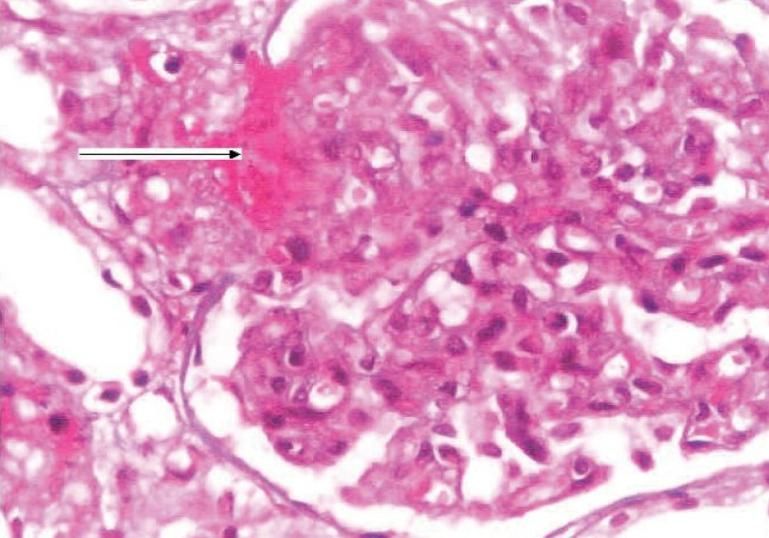
Image: PMC2813136, CC BY - A platelet-fibrin thrombus occluding a glomerular capillary
- A cellular crescent filling Bowman space
- A Kimmelstiel-Wilson nodule of mesangial sclerosis
- A subepithelial hump-like immune deposit
Show answer
A. A platelet-fibrin thrombus occluding a glomerular capillary
Think this answer is wrong? Report itA 54-year-old diabetic woman has high fever, rigors, left loin pain and pyuria; the non-functioning kidney is removed. The H&E-stained section is shown, in which a sharply demarcated zone of dense neutrophil-rich suppurative inflammation destroys tubules and spills into the interstitium, adjacent to relatively preserved glomeruli. What is the most likely diagnosis?
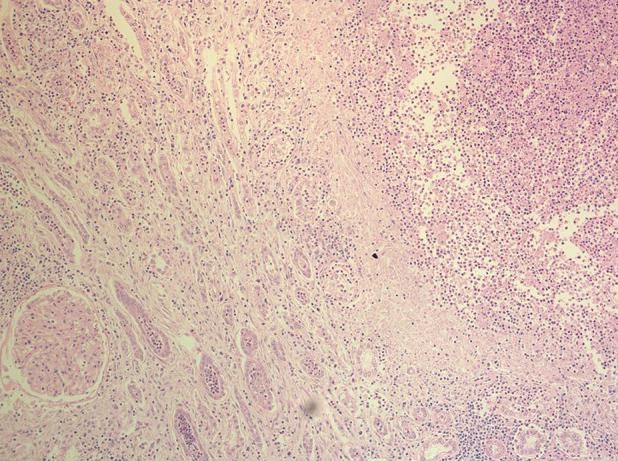
Image: PMC3955493, CC BY - Acute tubular necrosis
- Acute pyelonephritis
- Chronic pyelonephritis with thyroidisation
- Renal cortical infarct
A 46-year-old woman with recurrent childhood urinary infections has hypertension and a serum creatinine of 2.4 mg/dL. A renal biopsy stained with periodic acid-Schiff is shown: the glomeruli are essentially unremarkable, the interstitium is widened and fibrotic, and many atrophic tubules are dilated and filled with dense homogeneous eosinophilic casts giving a follicle-like appearance. Which term best describes this tubular change?
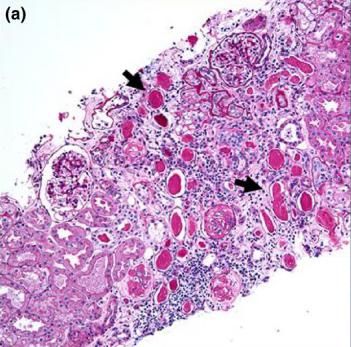
Image: PMC6900359, CC BY - Acute tubular necrosis
- Myeloma cast nephropathy
- Nephrocalcinosis
- Thyroidisation of tubules
Answer key
- B Proteus
- A NSAID
- D Cyclosporin toxicity
- A INH
- C Hyaline arteriosclerosis
- B Pyelonephritis
- C Hyperplastic arteriosclerosis
- B Hypertension is rare
- A Urine acidification test
- B Acute pancreatitis
- A Interstitial nephritis
- A Drugs
- D Heavy proteinuria
- C Hyaline arteriosclerosis
- D Pseudo hypoparathyroidism
- A Alcohol
- D Light chain
- B Analgesic nephropathy
- A Autosomal dominant
- B Vesico-ureteral reflux
- D Nephrosclerosis
- B Diabetes mellitus
- B Hyperplastic arteriosclerosis
- D Tricuspid valve prolapse
- B Associated with tuberculosis
- A Diabetes mellitus
- B Tuberculous pyelonephritis
- D Hyperglycemia
- A Diabetes mellitus
- D Interstitial nephritis
- D Escherichia coli
- D Multicystic renal dysplasia
- B Cortical tubular hypertrophy
- C Diabetes mellitus
- B Small kidney with petechial hemorrhages
- D Benign nephrosclerosis
- D Fibrinoid necrosis
- A Interstitial nephritis
- A Fibrocystin
- D Chronic alcoholism
- A Malignant Hypertension
- B ARPKD
- D Chronic glomerulonephritis
- A A platelet-fibrin thrombus occluding a glomerular capillary
- B Acute pyelonephritis
- D Thyroidisation of tubules
About these questions
Previous year questions on Tubulointerstitial, Vascular and Cystic Renal Disease for INI-CET (Institutes of National Importance Combined Entrance Test), from the Pathology section of the exam.
Most questions here come from previous-year papers of Indian postgraduate medical entrance and licensing exams; where a paper and year are recorded the question carries them. The image-based questions are original vignettes written around an openly licensed figure, and were never asked in any exam.
Pathology is worth about 15 of the 200 questions on the exam. See every subject’s weightage.