INI-CET · Radiology
Basic Principles of Medical Imaging PYQs
- 61 live questions in Basic Principles of Medical Imaging.
- 1 of 61 questions carries a recorded exam year: 2018.
- Question set last updated .
61 questions with answers
Which of the following investigation work on the same principle?
- CT and MRI
- CT and X-ray
- USG and HIDA Scan
- MRI and PET Scan
Which of the following is hypointense (dark) on T2-weighted MRI?
- CSF
- Fat
- Edema
- Hard calcification
NMR is based on the principle of
- Electron beam
- Proton beam
- Neutron beam
- Magnetic field
Which of the following has the maximum ionization potential
- Electron
- Helium ion
- Proton
- Gamma photon
Xray artifact is
- A radiolucent area
- Any abnormal opacity in the radiograph
- Produced when patient moves while taking the film
- All of the above
The magnetic field in MRI is measured in
- Hounsfield units
- Tesla
- MHz
Which of the following is the most commonly used MR sequence for non-contrast angiography?
- Time-of-flight (TOF)
- Phase contrast
- TRUFI
- Arterial spin labeling
Doppler effect results from the change in
- Amplitude of sound
- Frequency of sound
- Direction of sound
- Intensity of sound
Disadvantages of using a GRID during radiography is:
- Increased patient exposure due to more exposure time
- Decreased exposure time
- Increased secondary radiation fog to film
- Reduces secondary radiation to film
Show answer
A. Increased patient exposure due to more exposure time
Think this answer is wrong? Report itIntensifying screen is used in extraoral radiograph to:
- Decrease radiation to patient
- Increase contrast
- Decrease contrast
- Collimation
Density of radiograph is affected by all, except:
- mA
- kVp
- Cone angulation
- Thickness of object
The darkening of radiograph X-ray depends on all except:
- Thickness of object
- Quality and quantity of X-rays
- Angulation cone
- Velocity of electron emitted from cathode
Radio density can be increased by
- Decreasing MA
- Decreasing kVp
- Decreasing target film distance
- Increasing target film distance
The base of an X-ray film is composed of:
- Polyester
- Gelatin
- Nylon
- Bromide
The speed with which the electrons travel from the filament of cathode to the anode depends upon
- Potential difference between the two electrodes
- Number of milliamperes in the tube circuit
- Angle between the filament and target
- Voltage of the filament
The maximum penetration among the following is seen with which ray:
- Alpha
- Beta
- Gamma
- Electron Beam
Which of the following statements about developing a dental radiograph is false?
- It involves chemically precipitating metallic silver
- If it is too long, it results in an over dark radiograph
- If high temperatures are used, it results in a fogged, over dark radiograph
- It typically involves a developer containing sodium thiosulphate
Show answer
D. It typically involves a developer containing sodium thiosulphate
Think this answer is wrong? Report itYellowish-brown staining of the IOPA dental X-ray film is due to:
- Immersion in fixer without washing
- Increased temperature of developer
- Increased exposure time
- Drying away of the developer solution
In cephalometric radiography, the distance between the subject and the source of X-ray is
- 2 feet
- 48 inches
- 4.8 metres
- 5 feet
A disadvantage of using a grid in radiography is:
- Increased scattered radiation reaching the film
- Increase exposure time
- Doesn't improve image
- Overall density of radiograph is increased
Consistent density and contrast of dental radiographs from film to film is a recognised advantage of:
- Long cone technique
- Fixed kvp & mA
- Automatic processing
- Manual developing by visual inspection
For maintaining parallelism between object the and film, film is placed at a distance to avoid distortion what should be done:
- Increase target to object distance
- Decrease target to object distance
- Both of the above
- None of the above
Which of the following is most radiolucent?
- Bone
- Dentin
- Enamel
- Air space
Hardener among the following is:
- Sodium sulfite
- Ammonium sulfite
- Aluminium salts
- None of the above
The ingredient of the fixing solution (fixer) of the X-ray is:
- Hydroquinone
- Elon
- Sodium bisulphate
- Acetic acid
Who discovered X-rays: September 2007
- Roentgen
- Curie
- Becquerel
- Gray
Which of the following is not echogenic on ultrasonography-
- Bile
- Gas
- Bone
- Gall Stones
Coventional X-ray film is made of?
- Silver chloride
- Silver bromide
- Silver nitrate
- Gold chloride
Screen films differ from non-screen films by that:
- They are more sensitive to light than x rays
- They are more sensitive to X-rays than light
- They are usually used in intra oral radiography
- They do not need intensifying screens
Gyromagnetic property of Hydrogen nucleus is used in
- USG
- PET
- CT
- MRI
Wavelength of x- rays?
- 1 to 10 nm
- 0.1 to 10 nm
- 0.01 to 10 nm
- 0.001 to 10 nm
Density of a radiograph depends on :
- Thickness of object
- The quality and quantity of X-rays.
- The velocity of e - emitted from the cathode.
- All of the above
MRI can be done in:
- Cardiac pacemaker
- Insulin pumps
- Cochlear implants
- Pregnancy
Nucleus of an atom contains:
- Electrons
- Only protons
- Electrons and protons
- Protons and neutrons
The contrast in X-rays is dependent -
- Kvp
- Mas
- Duration of exposure
- Distance between source and object
Which probe is used for Thyroid Ultrasound?
- Linear
- Curvilinear
- Endocavitary
- Phase array
Which of the follow ing techniques use piezoelectric crystals?
- Ultrasonography
- X-ray diffraction
- NMR imaging
- Xeroradiography
With optical density of 2, percentage of light transmitted is:
- 100%
- 10%
- 1%
- 0.10%
X-rays are:
- Electrons
- Protons
- Neutrons
- Electromagnetic waves
Grid is used in radiography to:
- Reduce KVP
- Reduce exposure time
- Reduce fogging
- None of the above
Gyromagnetic property of proton is seen in -
- MRI
- CT
- PET scan
- USG
______________ is not a property of X-rays
- Ionization
- Action on photographic film
- Excitation
- Collimation
A radiographic (X-ray) artifact may:
- Appear as a spurious radiolucent (dark) area on the film
- Appear as a spurious opacity not due to the patient's anatomy or pathology
- Be produced when the patient moves during the exposure
- All of the above
The inherent filtration of X-ray machines range from ___________ thickness of aluminium
- 0.5 - 2 mm
- 1.5 - 2.5 mm
- 2.5 - 5 mm
- 1.0 - 2.5 mm
A 25 year old male patient complains of pain in the lower back tooth region. History of similar complaint 6 months ago. Intra-oral examination reveals pericoronitis with 36. An IOPA is taken with the same tooth. During film processing, the thermometer in the manual processing tank reads 68◦F. The approximate time to keep the x-ray film in the developer solution is?
- 2 minutes
- 3 minutes
- 4 minutes
- 5 minutes
Mammography uses
- Bremsstrahiung X rays
- Characteristic X rays
- Electrons
- Gamma rays
Posterior acoustic enhancement is seen with
- Air
- Bone
- Cyst
- Calcification
Slip ring technology is used in
- First generation CT
- Ultrasound
- MRI
- Spiral CT
On MR-spectroscope, at 3.2ppm which peak is seen?
- Lipid lactate
- N-acetyl aspartate
- Creatinine
- Choline
Most commonly used method of display of ultrasound is
- A-Mode
- B-Mode
- M-Mode
- D-Mode
X-rays are a type of
- Atomic radiation
- Ultrasonic radiation
- Electromagnetic radiation
- Particulate radiation
During the production of X-rays, how much of electron energy is converted into heat
- 99%
- 94%
- 89%
- 84%
NMR principle is based on
- Positron
- Neutron
- Proton
- Electron
Amount of X-rays that undergo Compton scattering:
- 7%
- 23%
- 57%
- 70%
Patient with a metallic foreign body in the eye,which of the following investigation is contraindicated?
- X-Ray
- CT
- USG
- MRI
Red Color on color doppler suggests?
- Arterial Blood
- Venous Blood
- Flow towards the transducer
- Flow Away from the transducer
The quantity of X-rays is controlled by:
- Kilovoltage
- Milliamperage
- Total filteration
- Exposure time
Bone algorithm is used as a principle in which of the following modality?
- Spiral CT
- Multidetector CT
- Dual source CT
- HRCT
A man with a clinically suspicious pelvic lesion undergoes endocavitary ultrasound with shear-wave elastography; each pair shows the colour elastogram superimposed on the B-mode image (top) and the corresponding plain B-mode image (bottom), with the colour scale displayed at the left of each panel. Comparing pair B on the right with pair A on the left, the colour coding within the region of interest in pair B indicates which of the following?
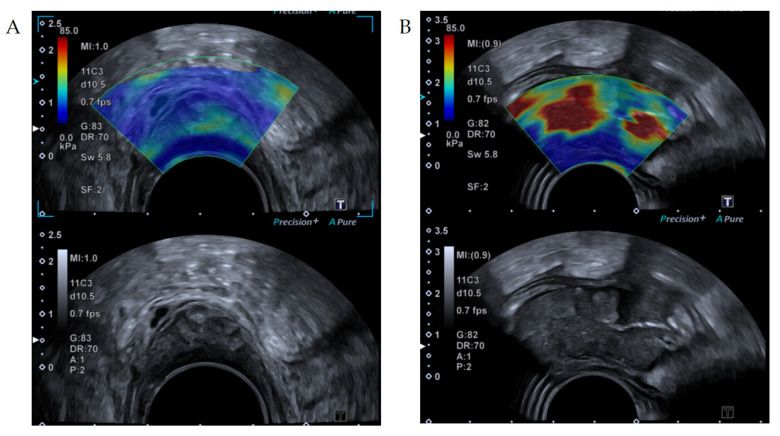
Image: PMC8391413, CC BY - High-velocity blood flow within the lesion
- Markedly increased tissue softness and normal elasticity
- Markedly increased tissue stiffness, a feature suspicious for malignancy
- Fluid content indicating a simple cyst
Show answer
C. Markedly increased tissue stiffness, a feature suspicious for malignancy
Think this answer is wrong? Report itA 45-year-old man who has a hip endoprosthesis is being assessed for suspected local tumour recurrence. A coronal contrast-enhanced T1-weighted MRI of the pelvis is shown. What is the principal cause of the marked signal loss and geometric distortion seen around the implant?
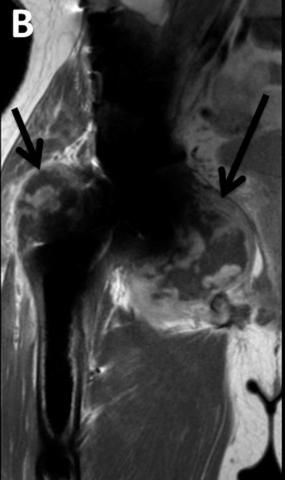
Image: PMC4409347, CC BY - Chemical shift misregistration at fat-water interfaces
- Radiofrequency coil inhomogeneity
- Magnetic susceptibility difference between the metal implant and adjacent tissue
- Patient motion during acquisition
Show answer
C. Magnetic susceptibility difference between the metal implant and adjacent tissue
Think this answer is wrong? Report itA colour Doppler ultrasound of the porta hepatis is performed to assess portal venous flow in a patient with deranged liver function. The image obtained is shown. What does the focal mosaic pattern of mixed colours within the vessel indicate?
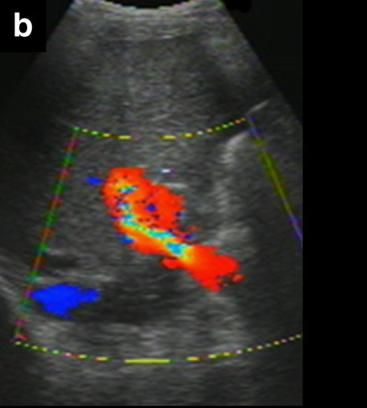
Image: PMC6694376, CC BY - Aliasing from high-velocity turbulent flow at a site of luminal narrowing
- Complete thrombotic occlusion of the vessel
- Reversal of flow direction throughout the vessel
- An artefact produced by insonating the vessel at exactly 90 degrees
Show answer
A. Aliasing from high-velocity turbulent flow at a site of luminal narrowing
Think this answer is wrong? Report it
Answer key
- B CT and X-ray
- D Hard calcification
- D Magnetic field
- B Helium ion
- D All of the above
- B Tesla
- A Time-of-flight (TOF)
- B Frequency of sound
- A Increased patient exposure due to more exposure time
- A Decrease radiation to patient
- C Cone angulation
- C Angulation cone
- C Decreasing target film distance
- A Polyester
- A Potential difference between the two electrodes
- C Gamma
- D It typically involves a developer containing sodium thiosulphate
- A Immersion in fixer without washing
- D 5 feet
- B Increase exposure time
- C Automatic processing
- A Increase target to object distance
- D Air space
- C Aluminium salts
- D Acetic acid
- A Roentgen
- A Bile
- B Silver bromide
- A They are more sensitive to light than x rays
- D MRI
- C 0.01 to 10 nm
- D All of the above
- D Pregnancy
- D Protons and neutrons
- A Kvp
- A Linear
- A Ultrasonography
- C 1%
- D Electromagnetic waves
- C Reduce fogging
- A MRI
- D Collimation
- D All of the above
- A 0.5 - 2 mm
- D 5 minutes
- B Characteristic X rays
- C Cyst
- D Spiral CT
- D Choline
- B B-Mode
- C Electromagnetic radiation
- A 99%
- C Proton
- C 57%
- D MRI
- C Flow towards the transducer
- B Milliamperage
- D HRCT
- C Markedly increased tissue stiffness, a feature suspicious for malignancy
- C Magnetic susceptibility difference between the metal implant and adjacent tissue
- A Aliasing from high-velocity turbulent flow at a site of luminal narrowing
About these questions
Previous year questions on Basic Principles of Medical Imaging for INI-CET (Institutes of National Importance Combined Entrance Test), from the Radiology section of the exam.
Most questions here come from previous-year papers of Indian postgraduate medical entrance and licensing exams; where a paper and year are recorded the question carries them. The image-based questions are original vignettes written around an openly licensed figure, and were never asked in any exam.
Radiology is worth about 6 of the 200 questions on the exam. See every subject’s weightage.
More in Radiology
- Renal and Urinary Tract Imaging
- Imaging in Women's Health
- Bone and Joint Imaging
- Nuclear Medicine Imaging
- Radiotherapy
- Interventional Procedures and Emergency Imaging
- Radiation Exposure and Protection
- Contrast Agents and Patient Preparation
- Identifying Imaging Modalities
- Chest Radiograph Fundamentals
- Chest Imaging: Pulmonary Disease
- Chest Imaging: Pleural and Mediastinal Disease