NEET PG · Anatomy
Hip, Knee and Ankle Joints PYQs
- 25 live questions in Hip, Knee and Ankle Joints.
- 1 of 25 questions carries a recorded exam year: 2018.
- Question set last updated .
25 questions with answers
Inversion and eversion of foot occur at which joint
- Subtalar
- Tibiotalar
- Inferior tibiofibular
- Ankle
The arteries supplying the femoral head include the following except
- Medial circumflex artery
- Lateral circumflex artery
- Profunda femoral artery
- Ligamentum teres artery
Largest bursa of the body is
- Ilio-psoas bursa
- Suprapatellar bursa
- Subcoracoid bursa
- Olecranon bursa
The bursa communicating with knee joint is:
- Infrapatellar
- Prepatellar
- Suprapatellar
- Lateral patellar
Which of the following about menisci is not true?
- Lateral meniscus is more mobile than medial meniscus
- Are made up predominantly of Collagen Type II
- Lateral meniscus covers more area of tibial articular surface than medial
- Menisci are composed of around 70-75% of water
The fibular collateral ligament is the continuation of
- Peroneus longus
- Biceps femoris
- Semimembranosus
- Adductor magnus
Posterior dislocation of tibia on femur is prevented by:
- Posterior cruciate ligament
- Anterior cruciate ligament
- Medial meniscus
- Lateral meniscus
All are true about menisci of knee joint except -
- Lateral meniscus covers more articular surface of tibia
- Lateral meniscus is more mobile
- Lateral meniscus is more prone to injury
- Lateral meniscus is nearly circular
Not involved in the stability of ankle joint
- Deltoid ligament
- Spring ligament
- Anterior Talofibular ligament
- Posterior Talofibular ligament
Unlocking of knee is caused by-
- Rectusfemoris
- Quadriceps
- Hamstrings
- Popliteus
Not true about anterior cruciate ligament.
- It begins just behind the anterior horn of lateral meniscus on tibia
- It is taut in extension
- It provides proprioceptive inputs to knee
- It is extra-synovial
Show answer
A. It begins just behind the anterior horn of lateral meniscus on tibia
Think this answer is wrong? Report itCoronary ligaments of the knee joint connect ?
- Menisci to tibia
- Menisci to femur
- Lateral meniscus to capsule
- Anterior horns of both menisci
Physiological locking of the knee joint in the weight-bearing position (foot fixed on the ground) involves
- Internal rotation of femur over stabilized tibia
- Internal rotation of tibia over stabilized femur
- External rotation of tibia over stabilized femur
- External rotation of femur over stabilized tibia
All of the following statements regarding 'Menisci' is true except:
- Medial meniscus is more mobile than lateral
- Lateral meniscus covers more tibial articular surface than medial
- Medial meniscus is more commonly injured than lateral
- Menisci are predominantly made up of Type I Collagen
Most important arterial blood supply of femoral head is: (PGI June 2008)
- Femoral artery
- Obturator artery
- Internal pudendal artery
- Medial circumflex femoral artery.
Joint involved in forefoot eversion and inversion:
- Talocrural joint
- Calcaneocuboid joint
- Cuneocuboid joint
- Inferior tibiofibular joint
Housemaid knee is an inflammation of:
- Lateral bursa
- Prepatellar bursa
- Suprapatellar bursa
- Anserine bursa
Unlocking of knee:
- Popliteus
- Quadriceps femoris
- Semitendinosus
- Semimembranosus
Which of the following prevents hyperextension of thigh
- Ischiofemoral ligament
- Iliofemoral ligament
- Pectofemoral ligament
- Puboischial ligament
Anterior cruciate ligament prevents :
- Anterior dislocation of tibia
- Posterior dislocation of tibia
- Anterior dislocation of femur
- Lateral dislocation of patella
Which of the ligaments limits extension at the hip joint?
- Iliofemoral
- Ligamentum capitis femoris
- Pubofemoral
- Zona orbicularis
A 42-year-old mother of three children visits the outpatient clinic complaining that her youngest son cannot walk yet. Radiographic and physical examinations reveal an unstable hip joint. Which of the following ligaments is responsible for stabilization of the hip joint in childhood?
- Iliofemoral
- Pubofemoral
- Ischiofemoral
- Ligament of the head of the femur
All of the following ligaments contribute to the stability of ankle (talocrural) joint except
- Calcaneonavicular (spring)
- Deltoid
- Lateral
- Posterior talofibular
Ligaments for antero-posterior stability of knee is
- Cruciate ligaments
- Medial collateral ligament
- Lateral collateral ligament
- Patellar ligaments
After a fall on the flexed knee, a lateral radiograph shows a thin bony fragment pulled off the lower pole of the patella together with a distended suprapatellar recess. Which structure attaches at the site of the avulsion?
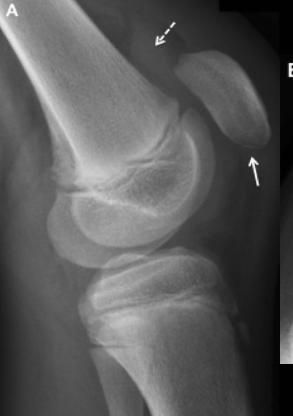
Image: PMC7181494, CC BY - Medial patellofemoral ligament
- Lateral patellar retinaculum
- Patellar ligament
- Quadriceps femoris tendon
Answer key
- A Subtalar
- C Profunda femoral artery
- A Ilio-psoas bursa
- C Suprapatellar
- B Are made up predominantly of Collagen Type II
- A Peroneus longus
- A Posterior cruciate ligament
- C Lateral meniscus is more prone to injury
- B Spring ligament
- D Popliteus
- A It begins just behind the anterior horn of lateral meniscus on tibia
- A Menisci to tibia
- A Internal rotation of femur over stabilized tibia
- A Medial meniscus is more mobile than lateral
- D Medial circumflex femoral artery
- B Calcaneocuboid joint
- B Prepatellar bursa
- A Popliteus
- B Iliofemoral ligament
- A Anterior dislocation of tibia
- A Iliofemoral
- D Ligament of the head of the femur
- A Calcaneonavicular (spring)
- A Cruciate ligaments
- C Patellar ligament
About these questions
Previous year questions on Hip, Knee and Ankle Joints for NEET PG (National Eligibility cum Entrance Test - Postgraduate), from the Anatomy section of the exam.
Most questions here come from previous-year papers of Indian postgraduate medical entrance and licensing exams; where a paper and year are recorded the question carries them. The image-based questions are original vignettes written around an openly licensed figure, and were never asked in any exam.
Anatomy is worth about 11 of the 200 questions on the exam. See every subject’s weightage.