NEET PG · Medicine
Peptic Ulcer Disease and Allied Conditions PYQs
- 24 live questions in Peptic Ulcer Disease and Allied Conditions.
- 1 of 24 questions carries a recorded exam year: 2019.
- Question set last updated .
24 questions with answers
The causative agent for duodenal ulcer is;
- Shigella
- E. coli
- H. Pylori
- Lactobacilli
Eradication of H. pylori has been proved to be beneficial in the following condition except
- Duodenal ulcer
- Gastric ulcer
- Low grade MALT lymphoma
- Hypertrophic gastritis
Which one is not associated with peptic ulcer
- Smoking cigarette
- Zollinger Ellison syndrome
- Plummer Vinsons syndrome
- Cirrhosis
Which of the following regarding stress ulcers is true?
- Cimetidine should be used prophylactically in intensive care patients to prevent stress ulcers
- Stress erosions take days to develop and resolve slowly
- Surgery is usually the best way to cure stress ulcers
- Stress ulcers most often involve the body and fundus of the stomach
Show answer
D. Stress ulcers most often involve the body and fundus of the stomach
Think this answer is wrong? Report itA patient is found to have a duodenal ulcer by upper endoscopy. The likelihood of this patient having H. pylori in the gastric antrum is?
- 5%
- 20%
- 60%
- 95%
Monitoring and diagnosis after completion of H. pylori treatment is done through
- Gastric acid test
- urea breath test
- bacterial culture of stool
- sodium chloride test
All of the following are criteria for admission in upper GI bleed except:
- Shock index >1.5
- Hematocrit > 40%
- Frank blood in nasogastric aspirate
- BP <100 mm Hg
BAO/ MAO ratio > ______ is suggestive of diagnosis of ZES?
- 0.1
- 0.3
- 0.6
- 0.9
Most common cause of decrease in incidence of H.pylori in west is d/t -
- Change in lifestyle
- Increased use of PPI
- Chemotherapy
- Mutation in organism
Commonest site of peptic ulcer is :
- 1st part of Duodenum
- IInd part of duodenum
- Distal 1/3 of stomach
- Pylorus of the stomach
Forrest classification is used for evaluating:
- Upper GI bleeding
- Liver transplantation
- Lower GI bleeding
- Familial adenomatous polyposis
All of the following are true regarding a patient with acid peptic disease except
- Misoprostol is the drug of choice in patients on NSAIDS
- DU is preventable by the use of single night time H2 blockers
- Omeprazole may help ulcers refractory to H2 blockers
- Misoprostol is DOC in pregnant patients
Test for confirming H.pylori eradication is
- Urea breath test
- Serology
- Urine antigen test
- Endoscopy biopsy test
Ulcer in lesser curvature in 65-year-old male biopsy negative for malignancy not healing after 6 weeks of H2 blocker next treatment is -
- Repeat biopsy
- Total gastrectomy
- Partial gastrectomy
- H2 blocker for another 6 weeks
A 65 years old woman with known duodenal ulcer being treated by H2 blocker therapy is admitted with upper gastrointestinal bleeding. After blood replacement is begun the next step in her management should be:
- Institute anti H. pylori treatment
- Repeated gastric lavage
- Endoscopy and coagulation of bleeding vessel
- Pylor duodenotomy and oversewing of the bleeding
All of the following diseases are having a strong association with peptic ulcer disease, EXCEPT:
- COPD
- Coronary artery disease
- Chronic renal failure
- Nephrolithiasis
Which of the following statements about peptic ulcer disease is true :
- Helicobacter pylori eradication increases the likelihood of occurrence of complications
- The incidence of complications has remained unchanged
- The incidence of Helicobacter pylori reinfection in India is very low.
- Helicobacter pylori eradication does not alter the recurrence ratio.
Show answer
B. The incidence of complications has remained unchanged
Think this answer is wrong? Report itWhich indicates least chances of re-bleeding after hematemesis episodes:
- Adherent clot on ulcer
- Clean based ulcer
- Gastric ulcer with AV malformation
- Visible bleeding vessel.
Most common site of peptic ulcer in duodenum -
- 1st part
- 2nd part
- 3rd part
- 4th part
A 58-year-old man has three months of vomiting large volumes of food eaten the previous day, early satiety and 9 kg of weight loss. Upper endoscopy shows the appearance illustrated, with nodular, eroded and irregular antral mucosa, residual food debris and a narrowed non-distensible outlet. Which is the most likely explanation for his vomiting?
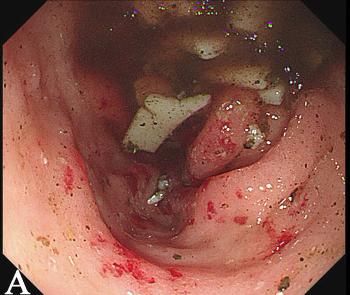
Image: PMC7353757, CC BY - Superior mesenteric artery syndrome
- Gastric outlet obstruction
- Diabetic gastroparesis
- Achalasia cardia
A 47-year-old man presents with epigastric pain, ankle swelling and periorbital puffiness. Serum albumin is 2.1 g/dL with normal liver enzymes and no proteinuria. Upper endoscopy of the gastric body shows the appearance illustrated, with grossly thickened, tortuous, convoluted mucosal folds that persist on insufflation. Which is the most likely diagnosis?
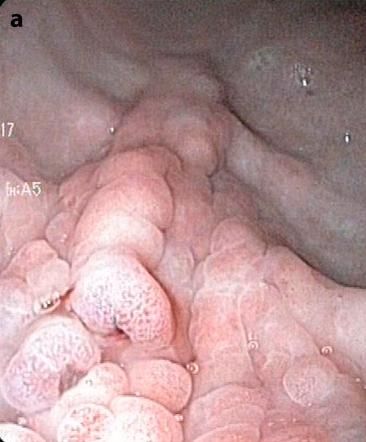
Image: PMC7923814, CC BY - Portal hypertensive gastropathy
- Gastric antral vascular ectasia
- Menetrier disease
- Helicobacter pylori-associated antral gastritis
A 58-year-old woman taking diclofenac daily for knee osteoarthritis develops epigastric pain and passes one episode of dark stool. Upper endoscopy shows the appearance illustrated: diffusely erythematous mucosa studded with multiple small flat haemorrhagic erosions, without any deep excavated crater. Which is the most likely diagnosis?
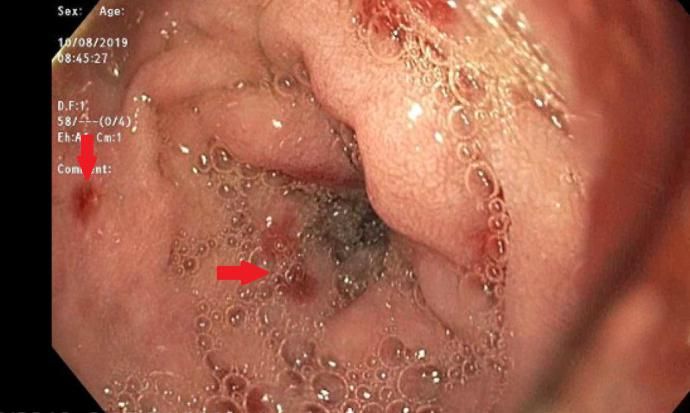
Image: PMC8043251, CC BY - Infiltrative gastric carcinoma
- Chronic gastric ulcer with a visible vessel
- Erosive haemorrhagic gastritis
- Portal hypertensive gastropathy
A 34-year-old man has months of vomiting undigested food several hours after meals, with a succussion splash on examination. A supine film taken 15 minutes after swallowing barium is shown: the stomach is grossly dilated and holds a large pool of contrast with a horizontal fluid level, while no contrast has passed into the small bowel loops beyond. At which level does the obstruction lie?
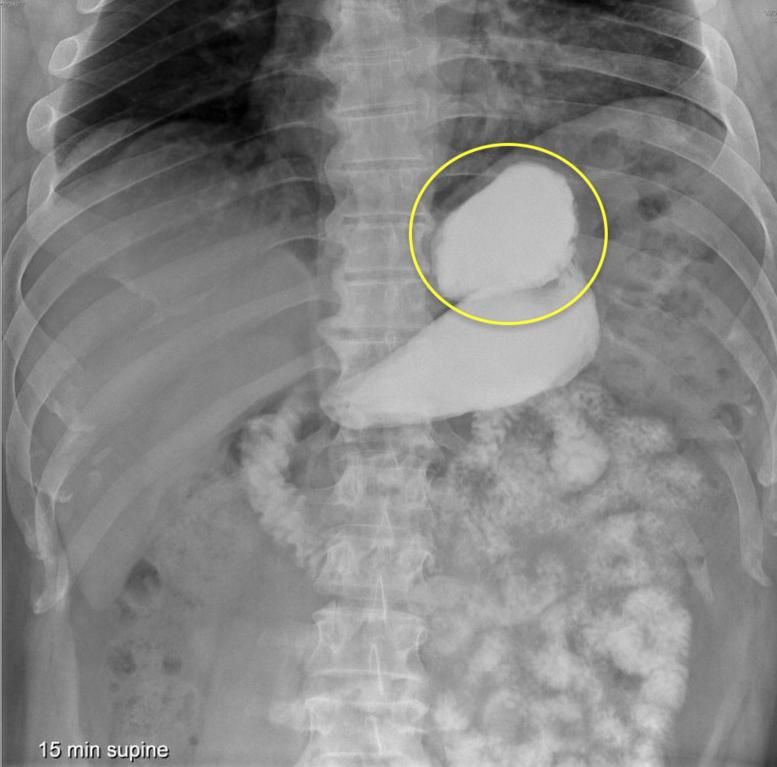
Image: PMC6298623, CC BY - Gastric outlet
- Ileocaecal junction
- Gastro-oesophageal junction
- Proximal jejunum
A 63-year-old man reports three months of epigastric pain, anorexia and 6 kg weight loss. Haemoglobin is 9.1 g/dL. Upper gastrointestinal endoscopy of the anterior wall of the gastric body is shown. Which feature of this lesion most strongly favours malignancy?
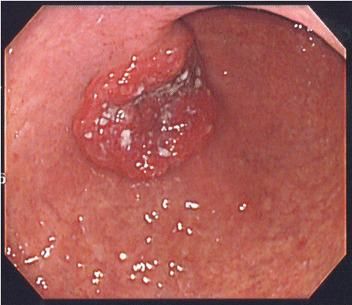
Image: PMC4690825, CC BY - Irregular, heaped-up nodular margins surrounding the depressed centre
- A smooth, punched-out edge with a clean grey base
- Location on the gastric body rather than the antrum
- Mucosal folds radiating right up to the ulcer edge
Show answer
A. Irregular, heaped-up nodular margins surrounding the depressed centre
Think this answer is wrong? Report it
Answer key
- C H. Pylori
- D Hypertrophic gastritis
- C Plummer Vinsons syndrome
- D Stress ulcers most often involve the body and fundus of the stomach
- D 95%
- B urea breath test
- B Hematocrit > 40%
- C 0.6
- A Change in lifestyle
- A 1st part of Duodenum
- A Upper GI bleeding
- D Misoprostol is DOC in pregnant patients
- A Urea breath test
- D H2 blocker for another 6 weeks
- C Endoscopy and coagulation of bleeding vessel
- B Coronary artery disease
- B The incidence of complications has remained unchanged
- B Clean based ulcer
- A 1st part
- B Gastric outlet obstruction
- C Menetrier disease
- C Erosive haemorrhagic gastritis
- A Gastric outlet
- A Irregular, heaped-up nodular margins surrounding the depressed centre
About these questions
Previous year questions on Peptic Ulcer Disease and Allied Conditions for NEET PG (National Eligibility cum Entrance Test - Postgraduate), from the Medicine section of the exam.
Most questions here come from previous-year papers of Indian postgraduate medical entrance and licensing exams; where a paper and year are recorded the question carries them. The image-based questions are original vignettes written around an openly licensed figure, and were never asked in any exam.
Medicine is worth about 22 of the 200 questions on the exam. See every subject’s weightage.
More in Gastrointestinal System
- Alcohol-Related and Non-Alcoholic Fatty Liver Disease
- Viral Hepatitis
- Autoimmune Hepatobiliary Disease
- Acute Liver Failure and Transplantation
- Haemochromatosis and Wilson Disease
- Cirrhosis and Its Complications
- Approach to Diarrhoea
- Irritable Bowel Syndrome
- Inflammatory Bowel Disease: Presentation and Diagnosis
- Inflammatory Bowel Disease: Complications and Therapy
- Syndromes of Malabsorption
- Miscellaneous Gastrointestinal Disorders