NEET PG · Pathology
Acute Myeloid Leukemia (AML) PYQs
- 15 live questions in Acute Myeloid Leukemia (AML).
- 1 of 15 questions carries a recorded exam year: 2018.
- Question set last updated .
15 questions with answers
Which of the following is not a provisional entity as per WHO 2016 classification of Acute leukemia?
- AML with hyperploidy
- B - ALL with BCR - ABL like mutation
- AML with BCR - ABL
- Early T - cell precursor leukemia / Lymphoma
ATRA is used in treatment of tumour which is associated with which of the following
- PML RARA
- BCR ABL
- C myc
- CEBPA
Marker for granulocytic sarcoma
- CD33
- CD38
- CD117
- CD137
Chloroma is
- Lymphoma
- Leukemia
- Sarcoma
- Carcinoma
Stain used for the diagnosis of granulocytic sarcoma
- Myeloperoxidase
- Leucocyte alkaline phosphatase
- Non specific esterase
- Neuron specific esterase
All of the following acute myeloid leukaemia are diagnosed regardless of blast count Except
- AML with t(8;21)
- AML with t(15;17)
- AML with t(16;16)
- AML with t(1;9)
A 15-years-old boy presented with one day history of bleeding gum,subconjunctival bleed and purpuric rash. Investigations revealed followed results:Hb- 6.4 gm/dL; TLC-26, 500/mm3 platelet 35,000 mm3; prothrombin time-20 sec with a control of 13 sec; partial thromboplastin time-50sec; and Fibrinogen 10mg/dL.Peripheral smear was suggestive of acute myeloblastic leukemia. Which of the following is the most likely diagnosis?
- Myeloblastic leukemia without maturation
- Myeloblastic leukemia with maturation
- Promyelocytic leukemia
- Myelomonocytic leukemia
Myeloid sarcoma, which is tumor mass consisting of myeloid blasts occurring at anatomic sites other than bone marrow, are often characterized by chromosome aberrations all, EXCEPT:
- Monosomy 7
- Trisomy 8
- inv (16)
- t (15;17)
Auer rods are seen in -
- AML
- CML
- ALL
- CLL
Poor prognosis in AML is indicated by:
- Inversion 16
- Translocation 15;17 (t15; 17)
- Normal cytogenecity
- Monosomy 7
All of the following immunohistochemical markers are positive in the neoplastic cells of granulocytic sarcoma, except -
- CD45RO
- CD43
- Myeloperoxidase
- Lysozyme
The cause of the severe hemorrhage in Acute Promyelocytic Leukemia is?
- Disseminated intravascular coagulation
- Immune complex deposits on blood vessels
- Thrombocytopenia
- Thrombocytosis
DIC is seen most commonly seen in which AML type?
- M2
- M3
- M4
- M5
A 42-year old man was referred with a 2 week history of fever weakness and bleeding gum. Peripheral smear showed pancytopenia. The bone marrow examination revealed 26% blasts frequently exhibiting Auer rods and mature myeloid cells. An occasional neutrophil with pseudo Pelger-Huet anomaly was also noted : Which of the following cytochemical stains is most likely to be positive ?
- Acid phosphatase
- Non specific esterase.
- Myeloperoxidase
- Toluidine blue.
A 47-year-old man presents with two weeks of fatigue, fever and easy bruising. His haemoglobin is 7.2 g/dL, platelets 22,000/uL and white cell count 3,200/uL. A bone marrow trephine biopsy section is shown. What is the most likely diagnosis?
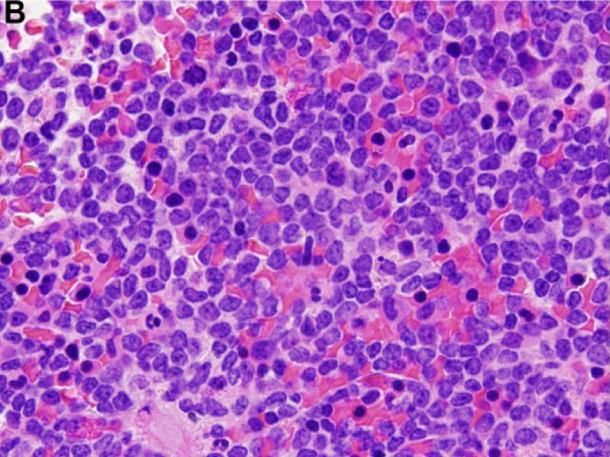
Image: PMC5036134, CC BY - Aplastic anaemia
- Megaloblastic anaemia
- Primary myelofibrosis
- Acute leukaemia
Answer key
About these questions
Previous year questions on Acute Myeloid Leukemia (AML) for NEET PG (National Eligibility cum Entrance Test - Postgraduate), from the Pathology section of the exam.
Most questions here come from previous-year papers of Indian postgraduate medical entrance and licensing exams; where a paper and year are recorded the question carries them. The image-based questions are original vignettes written around an openly licensed figure, and were never asked in any exam.
Pathology is worth about 17 of the 200 questions on the exam. See every subject’s weightage.
More in Hematology
- Extravascular Hemolytic Anemias
- G6PD Deficiency and Autoimmune Hemolysis
- Disorders of Platelets
- Disorders of the Coagulation Cascade
- Blood Components and Transfusion Reactions
- Acute Lymphoblastic Leukemia (ALL)
- Hodgkin Lymphoma
- Non-Hodgkin Lymphoma: Overview
- Non-Hodgkin Lymphoma: Low Grade
- Non-Hodgkin Lymphoma: High Grade
- Multiple Myeloma and Other Plasma Cell Neoplasms
- Myelodysplastic and Myeloproliferative Neoplasms and Histiocytosis