NEET PG · Pathology
Vascular Tumours PYQs
- 20 live questions in Vascular Tumours.
- 1 of 20 questions carries a recorded exam year: 2018.
- Question set last updated .
20 questions with answers
A teenager has a progressively increasing soft reddish swelling on his chest. Which of the following is the likely diagnosis?
- Lipoma
- Hemangioma
- Fibroadenoma
- Fibroma
Kaposi sarcoma is commonly seen in -
- Upper limbs
- Lower limbs
- Head and Neck
- Trunk
True about Epithelioid hemangioendothelioma
- Rare vascular tumor of infants
- Usually solitary
- Underlying cirrhosis common
- Expresses factor VIII antigen
True regarding Kaposi's sarcoma is all except
- May occur even in the presence of a normal CD4+ T cell count
- HHV8 has been strongly implicated as a cofactor in the pathogenesis
- Koebner's Phenomenon may be seen
- Lymph node involvement suggests worst prognosis
Propranolol is drug of choice for -
- Ulcerated infantile hemangioma
- Lymphangioma
- Pyogenic granuloma
- Capillary malformation
Port wine stain (nevus flammeus) is a type of:
- Melanocytic nevus
- Capillary vascular malformation
- Melanoma
- All the above
Neoplasia of blood vessel is called
- Angioma
- Hematoma
- Lymphosarcoma
- Papilloma
Which of the following is not a vascular malformation?
- Infantile haemangioma
- Salmon patch
- Po wine stain
- Naevus aneamicus
A newborn had a flat pinkish-red patch over the upper eyelid, present since birth. There was no lid edema or eye involvement and the lesion faded spontaneously by about one year of age. What is the diagnosis:
- Port wine stain
- Capillary hemangioma
- Salmon patch
- Cirsoid aneurysm
Which of the following statements about Kaposi sarcoma is not true?
- The most common site is scalp
- Lesions are dark blue or purple mostly
- They are usually multifocal
- Lymph nodes may be involved
True about Kaposi's sarcoma -
- Does not occur in non HIV positive persons
- Incidence among AIDS patients has declined with antiretroviral therapy
- No GI bleeding
- Uncommon among homosexual HIV Positive
Show answer
B. Incidence among AIDS patients has declined with antiretroviral therapy
Think this answer is wrong? Report itA serious coagulopathy characterized by severe thrombocytopenia and haemorrhage due to platelet trapping within the tumor is called
- Phace (S) Syndrome
- Kasabach- Merrit Phenomenon
- Kaposi's sarcoma
- Hemangioma
Phleboliths are seen in
- Dental Pulp
- Salivary Gland duct
- Cavernous Hemangiomas
- Subepithelial Bulla
A 3-year-old child's mother notes that a large port wine stain on the left side of the child's face has not diminished in size since birth. This irregular, slightly raised, red-blue area is not painful, but is very disfiguring. Histologically, this lesion is most likely composed of a proliferation of which of the following tissue components?
- Capillaries
- Fibroblasts
- Lymphatics
- Lymphoblasts
Which of the following type of Kaposi sarcoma is associated with HIV
- Endemic kaposi sarcoma
- Classic kaposi sarcoma
- European kaposi sarcoma
- None of the above
What could be the most appropriate provisional diagnosis for multiple nodular exophytic reddish lesions of oral mucosa in an AIDS patient?
- Hemangioma
- Focal epithelial hyperplasia
- Acute pseudo-membranous candidiasis
- Kaposi's sarcoma
The tissue of which lesion has been described as resembling a 'blood soaked sponge with large pores'?
- Cavernous hemangioma
- Capillary hemangioma
- Aneurysmal bone cyst
- Eruption hematoma
A 38-year-old woman has a soft, compressible bluish swelling that has enlarged slowly over several years and is excised. The H&E-stained section is shown, composed of large, dilated, thin-walled blood-filled spaces separated by scant fibrous septa. What is the most likely diagnosis?
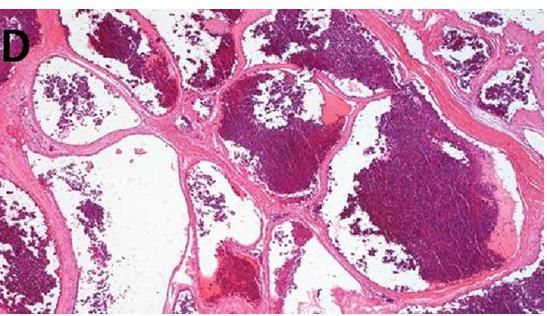
Image: PMC4020549, CC BY - Capillary haemangioma
- Angiosarcoma
- Cavernous haemangioma
- Kaposi sarcoma
A 45-year-old woman is found to have a well-defined posterior mediastinal mass at the level of T3. The hematoxylin and eosin-stained section of the resected tumour shows solid sheets of small uniform rounded cells with sharply defined borders arranged around dilated, branching thin-walled vascular channels. What is the most likely diagnosis?
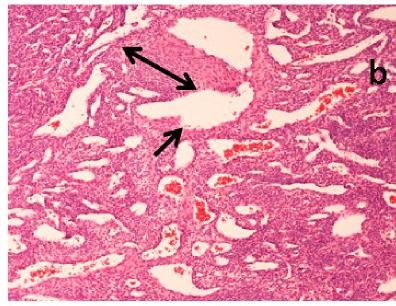
Image: PMC4579308, CC BY - Ganglioneuroma
- Glomus tumour
- Schwannoma
- Paraganglioma
A 34-year-old woman has a slowly enlarging, ill-defined plaque on the distal forearm that is excised. A hematoxylin and eosin-stained section of the lesion is shown. Which diagnosis best explains the long, narrow, branching vascular channels arranged in an antler-like pattern?
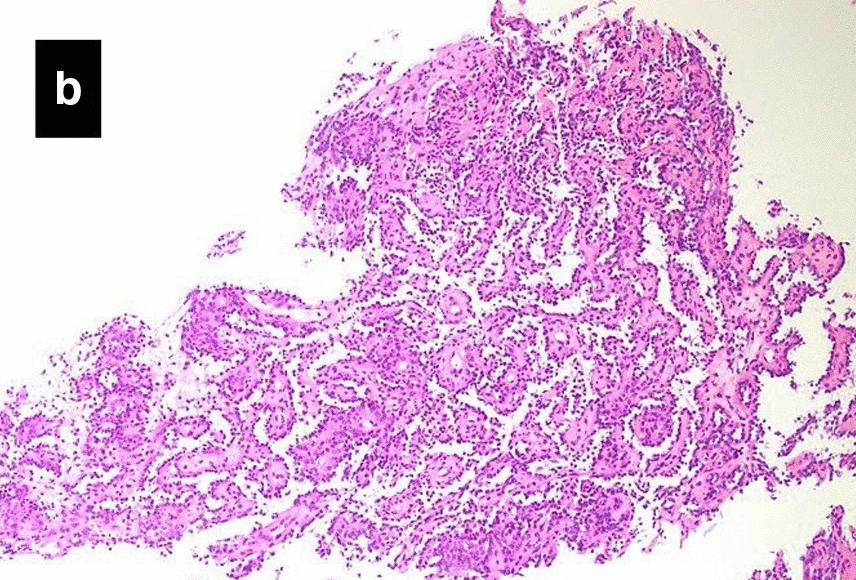
Image: PMC7887779, CC BY - Retiform hemangioendothelioma
- Cavernous haemangioma
- Nodular fasciitis
- Glomus tumour
Answer key
- B Hemangioma
- B Lower limbs
- D Expresses factor VIII antigen
- D Lymph node involvement suggests worst prognosis
- A Ulcerated infantile hemangioma
- B Capillary vascular malformation
- A Angioma
- A Infantile haemangioma
- C Salmon patch
- A The most common site is scalp
- B Incidence among AIDS patients has declined with antiretroviral therapy
- B Kasabach- Merrit Phenomenon
- C Cavernous Hemangiomas
- A Capillaries
- D None of the above
- D Kaposi's sarcoma
- C Aneurysmal bone cyst
- C Cavernous haemangioma
- B Glomus tumour
- A Retiform hemangioendothelioma
About these questions
Previous year questions on Vascular Tumours for NEET PG (National Eligibility cum Entrance Test - Postgraduate), from the Pathology section of the exam.
Most questions here come from previous-year papers of Indian postgraduate medical entrance and licensing exams; where a paper and year are recorded the question carries them. The image-based questions are original vignettes written around an openly licensed figure, and were never asked in any exam.
Pathology is worth about 17 of the 200 questions on the exam. See every subject’s weightage.