NEET PG · Pathology
White Cell Disorders and Lymphadenitis PYQs
- 25 live questions in White Cell Disorders and Lymphadenitis.
- Question set last updated .
25 questions with answers
Which of the following is most useful in Rx of Kostmann's Syndrome ?
- Sargramostim
- Aldesleukin
- Oprelvekin
- Filgrastim
Absolute lymphocytosis seen in
- SLE
- Typhoid
- IMN
- Brucellosis
Which of the following is LEAST likely to be accompanied by lymphocytosis in the peripheral blood?
- Viral infection
- Fungal infection
- Bacterial infection
- Protozoal infection
Dilated endoplasmic reticulum is called
- Asteroid bodies
- Bamboo bodies
- Hirano bodies
- Dohle bodies
Generalized necrotizing lymphadenopathy is
- Kimura disease
- Kikuchi disease
- Non hodgkins lymphoma
- Castle mans disease
Serious infections can occur when absolute neutrophil count decreases below
- <500/microliter
- <800/microliter
- <1000/microlitre
- <2000/microliter
Eosinophilic abscess in lymph node is characteristically
- Kimura disease
- Hodgkins lymphoma
- Tuberculosis
- Sarcoidosis
Histiocytic necrotizing lymphadenitis is
- Kimura disease
- Kikuchi disease
- Hodgkin's disease
- Castleman's disease
Increased monocytic count (monocytosis) is seen in Typhoid and in which of the following bacterial infections?
- Parasitic infections
- Sub-Acute Bacterial Endocarditis
- Hodgkin's Lymphoma
- None of the above
Hypereosinophilic syndrome is a disease characterized by elevated eosinophil count in the blood for at least 6 months, without any recognizable cause, with involve-ment of either heart, nervous system or bone marrow. What should be the eosinophil count for diagnosis?
- >500/mm3
- >1000/ mm3
- >1500/ mm3
- >2000/ mm3
Elevated WBC count is seen in all except?
- Typhoid
- Pertussis
- Lymphoreticular malignancy
- TB
Causes of eosinophilia - a) Hodgkin's disease b) Filariasis c) MI d) HIV infection
- acd
- bcd
- abd
- ab
Dilantoin sodium may cause -
- Follicular hyperplasia
- Paracortial hyperplasia
- Sinus histiocytosis
- Atrophy of lymph nodes
Basophils are decreased in-
- Polycythemia
- Basophilic leukemia
- Cushing's syndrome
- CML
A 68-year-old man with prostate cancer and bone metastases presents with shaking chills and fever. The peripheral WBC count is 1,000/mL (normal = 4,000 to 11,000/mL). Which of the following terms best describes this hematologic finding?
- Leukocytosis
- Leukopenia
- Neutrophilia
- Leukemoid reaction
Generalized necrotising lymphadenopathy is-
- Kimura disease
- Kikuchi disease
- Non-Hodgkin's lymphoma
- Castleman's disease
Dohle bodies are seen in
- Multiple myeloma
- May-hegglin anomaly
- Waldenstrom macroglobulinemia
- Lymphoma
In which of the following condition neutropenia occurs
- Vasculitis
- Myeloproliferative neoplasm
- Exercise
- Aplastic Anemia
In leucopenia, which cell type is predominantly involved?
- Erythrocytes
- Granulocytes
- Eosinophils
- Monocytes
The following are recognized causes of neutropenia EXCEPT
- Corticosteroid therapy
- Typhoid fever
- Aplastic anemia
- Viral infection
Lymphocytosis is seen in
- Fungal infections
- Viral infections
- Bacterial infections
- Protozoal infections
Leucopenia is characteristic of
- Appendicitis
- Enteric fever
- Meningitis
- Myocardial Infarction
The difference between leukemia and leukemoid reaction is done by -
- Leukocyte alkaline phosphatase
- Immature cells
- Total leukocyte count
- E.S.R.
A reduction in the total leucocyte count is called:
- Leucocytosis
- Leucopenia
- Leucorrhoea
- Leukemia
A 28-year-old East Asian man has a slowly growing painless postauricular subcutaneous swelling with regional lymphadenopathy, marked peripheral blood eosinophilia and a raised serum IgE. A hematoxylin and eosin-stained section of the excised lymph node is shown. What is the most likely diagnosis?
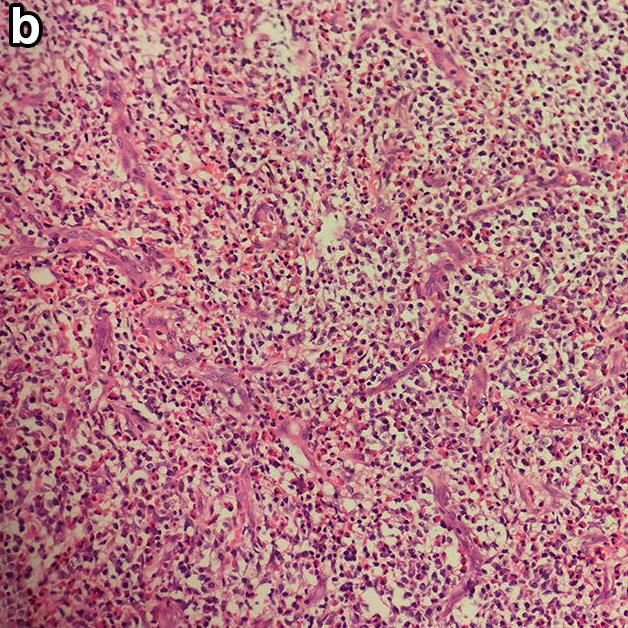
Image: PMC6937823, CC BY - Classical Hodgkin lymphoma
- Langerhans cell histiocytosis
- Kikuchi-Fujimoto disease
- Kimura disease
Answer key
- D Filgrastim
- C IMN
- C Bacterial infection
- D Dohle bodies
- B Kikuchi disease
- A <500/microliter
- A Kimura disease
- B Kikuchi disease
- B Sub-Acute Bacterial Endocarditis
- C >1500/ mm3
- A Typhoid
- C abd
- B Paracortial hyperplasia
- C Cushing's syndrome
- B Leukopenia
- B Kikuchi disease
- B May-hegglin anomaly
- D Aplastic Anemia
- B Granulocytes
- A Corticosteroid therapy
- B Viral infections
- B Enteric fever
- A Leukocyte alkaline phosphatase
- B Leucopenia
- D Kimura disease
About these questions
Previous year questions on White Cell Disorders and Lymphadenitis for NEET PG (National Eligibility cum Entrance Test - Postgraduate), from the Pathology section of the exam.
Most questions here come from previous-year papers of Indian postgraduate medical entrance and licensing exams; where a paper and year are recorded the question carries them. The image-based questions are original vignettes written around an openly licensed figure, and were never asked in any exam.
Pathology is worth about 17 of the 200 questions on the exam. See every subject’s weightage.
More in Hematology
- Hodgkin Lymphoma
- Non-Hodgkin Lymphoma: Overview
- Non-Hodgkin Lymphoma: Low Grade
- Non-Hodgkin Lymphoma: High Grade
- Multiple Myeloma and Other Plasma Cell Neoplasms
- Myelodysplastic and Myeloproliferative Neoplasms and Histiocytosis
- Microcytic Anemias
- Normocytic and Macrocytic Anemias
- Hemolysis Overview and Intravascular Hemolysis
- Extravascular Hemolytic Anemias
- G6PD Deficiency and Autoimmune Hemolysis
- Disorders of Platelets