INI-CET · Pathology
Heart Failure and Ischemic Heart Disease PYQs
- 18 live questions in Heart Failure and Ischemic Heart Disease.
- 2 of 18 questions carry a recorded exam year: 2018, 2020.
- Question set last updated .
18 questions with answers
Microscopic examination of the reperfused myocardium is likely to have which of the following findings?
- Cardiac myocyte swelling
- Waviness of fibres
- Contraction band necrosis
- Neutrophilic infiltration
Histopathological finding 6 hours after ischemic injury to heart is?
- Karyorrhexis of myocytes
- Neocapillary invasion of myocytes
- Hyper-eosinophilia of myocytes
- Coagulation necrosis of myocytes
After 72 hours of Myocardial infarction, the predominant cells are
- Mast cells
- Macrophages
- Lymphocytes
- Leukocytes
which of the following is seen in the biopsy of a patient who had a post Mi reperfusion injury
- wavy fibres
- Eosinophilic infiltration
- Endothelial swelling
- Contraction band necrosis
In myocardial infarction, the infarct acquires hyperemic rim with a yellow center at
- 1-2 hours
- 3-7 days
- 7-14 days
- 10-20 days
During autopsy of a patient died due to suspected myocardial infarction, the heart was stained with triphenyltetrazolium chloride dye. What will be the color of the viable myocardium?
- White
- Red
- Blue
- Dark Brown
A 68 years old man had severe chest pain. The patient died on the way to the hospital. In the hospital, at autopsy tetrazolium chloride staining of the heart was done. What will be the color of viable myocardium?
- Red
- Blue
- Dark brown
- Pink
In Myocardial infarction, the major pathology is
- Ischemia caused by dynamic obstruction of a coronary artery.
- Myocardial necrosis caused by acute occlusion of a coronary artery.
- Ischemia due to fixed atheromatous stenosis of one or more coronal artery.
- Altered conduction due to ischemia or infarction.
Show answer
B. Myocardial necrosis caused by acute occlusion of a coronary artery.
Think this answer is wrong? Report itThe region of myocardium most prone for infarction is:
- Rt. ventricular epicardial
- Lft. ventricular epicardial
- Rt. Ventricular sub endocardial
- Lft. Ventricular sub endocardial
A 56-year-old man experienced episodes of severe substernal chest pain every time he performs a task that requires moderate exercise. The episodes have become more frequent and severe over the past year, but they can be relieved by sublingual nitroglycerin. On physical examination, he is afebrile, his pulse is 78/min and regular, and there are no murmurs or gallops. Laboratory studies show creatinine, 1.1 mg/dL; glucose, 130 mg/dL; and total serum cholesterol, 223 mg/ dL. Which of the following cardiac lesions is most likely to be present in this man?
- Calcific aortic stenosis
- Coronary atherosclerosis
- Restrictive cardiomyopathy
- Rheumatic mitral stenosis
Earliest light microscopic change in myocardial infarction is:
- Waviness of the fibers
- Neutrophilic infiltration
- Phagocytic infiltration
- Coagulative necrosis
Autopsy finding after 12hrs in a case of death due to MI
- Coagulative necrosis
- Caseous necrosis
- Fat necrosis
- Liquefactive necrosis
A myocardial infarct specimen is showing early granulation tissue. According to this change when has the infarct occurred?
- Less than 1 hour
- Within 24 hours
- Within 1 week
- Within 1 month
Which is the first organ to be affected in left ventricular failure?
- Lungs
- Liver
- Kidney
- Brain
Which of the following causes 'no-reflow' phenomenon in acute myocardial infarction contributing to reperfusion injury?
- Myocyte hypercontracture
- Leucocyte aggregation
- Free radicals
- Complement activation
A 58-year-old man had chest pain persisting for 4 hours. A radiographic imaging procedure showed an infarction involving a 4-cm area of the posterior left ventricular free wall. Laboratory findings showed serum creatine kinase of 600 U/L. Which of the following pathologic findings would most likely be seen in the left ventricular lesion 1 month later?
- Chronic inflammation
- Coagulative necrosis
- Complete resolution
- Fibrous scar
Atherosclerosis in the coronary circulation most commonly affects -
- Left anterior descending artery
- Left circumflex
- Right coronary
- All of the above
A 77-year-old hypertensive woman is found gasping and unresponsive in bed and cannot be resuscitated. At autopsy a hematoxylin and eosin-stained section of her left ventricular myocardium is shown (arrows). Which finding is demonstrated?
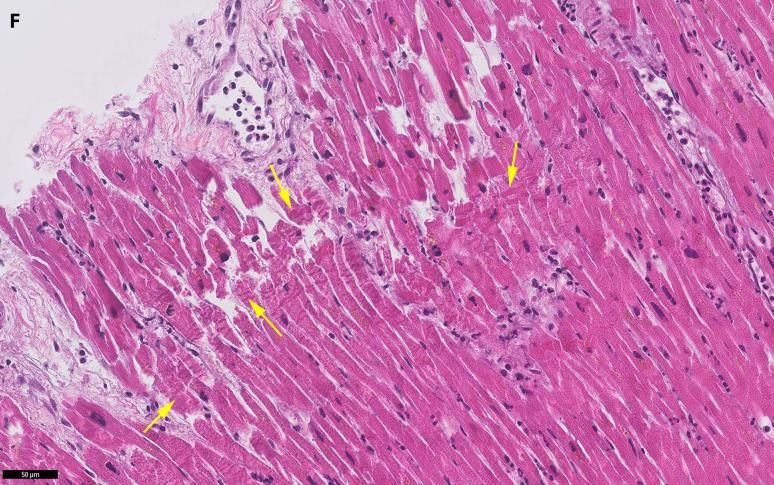
Image: PMC6634385, CC BY - Granulomatous myocarditis
- Myocyte hypertrophy with box-car nuclei only
- Contraction band necrosis
- Interstitial amyloid deposition
Answer key
- C Contraction band necrosis
- D Coagulation necrosis of myocytes
- B Macrophages
- D Contraction band necrosis
- B 3-7 days
- B Red
- A Red
- B Myocardial necrosis caused by acute occlusion of a coronary artery
- D Lft. Ventricular sub endocardial
- B Coronary atherosclerosis
- A Waviness of the fibers
- A Coagulative necrosis
- C Within 1 week
- A Lungs
- B Leucocyte aggregation
- D Fibrous scar
- A Left anterior descending artery
- C Contraction band necrosis
About these questions
Previous year questions on Heart Failure and Ischemic Heart Disease for INI-CET (Institutes of National Importance Combined Entrance Test), from the Pathology section of the exam.
Most questions here come from previous-year papers of Indian postgraduate medical entrance and licensing exams; where a paper and year are recorded the question carries them. The image-based questions are original vignettes written around an openly licensed figure, and were never asked in any exam.
Pathology is worth about 15 of the 200 questions on the exam. See every subject’s weightage.