INI-CET · Pathology
Vasculitis PYQs
- 25 live questions in Vasculitis.
- 2 of 25 questions carry a recorded exam year: 2017, 2020.
- Question set last updated .
25 questions with answers
Which of the following is true about polyarteritis nodosa?
- It shows fibrinoid necrosis in large blood vessels
- It has ANCA positivity
- HBsAg is positive in 30% patients
- Affected individuals have involvement of pulmonary circulation.
ANCA negative vasculitis amongst the following is:
- Wegner granulomatosis
- Churg strauss syndrome
- Polyarteritis nodosa
- Microscopic polyangiitis
The most common leukocytoclastic vasculitis affecting children is
- Takayasu disease
- Mucocutaneous lymph node syndrome (Kawasaki disease)
- Henoch Schonlein purpura
- Polyarteritis nodose
Hypersensitivity vasculitis is seen most commonly in -
- Post capillary venules
- Arterioles
- Veins
- Capillaries
Following are Granulomatous vasculitis except
- Churg Straus disease
- Takayasu's arteritis
- Wegener's granulomatosis
- Buerger's disease
A lady complains of headache, nausea and tenderness in temporal region with migraine. On microscopic investigation what will be seen
- Temporal aneurysm
- Giant cell arteritis
- Granulomatous giant cell lesions
- Luminal thrombosis
A 75 year old woman complains to a physician of facial pain, headache, and intermittent visual symptoms. Both temporal arteries are biopsied. If the biopsies show abnormal vessels, which of the following would be the most likely pathological finding?
- Atherosclerotic plaque
- Fibrinoid necrosis
- Focal granulomatous inflammation
- Fungal hyphae
All the following Vasculitis causes necrotizing inflammation except -
- Polyarteritis nodosa
- Wegener's granulomatosis
- Kawasaki disease
- Microscopic polyangiitis
Small vessel vasculitis are - a) Classical PAN b) Wegener's granulomatosis c) Giant cell arteritis d) HSP e) Churg-strauss syndrome
- bde
- ade
- ace
- bce
True about Henoch Schonlein purpura is -
- Medium vessels vasculitis
- Renal symptoms start late in the disease
- IgA deposition in mesangium
- Low Platelet count
A 50-year-old man has had a chronic cough for the past 18 months. Physical examination shows nasopharyngeal ulcers, and the lungs have diffuse crackles bilaterally on auscultation. Laboratory studies include a serum urea nitrogen level of 75 mg/dL and a creatinine concentration of 6.7 mg/dL. Urinalysis shows 50 RBCs per high-power field and RBC casts. His serologic titer for C-ANCA (proteinase 3) is elevated. A chest radiograph shows multiple, small, bilateral pulmonary nodules. A transbronchial lung biopsy specimen shows a necrotizing inflammatory process involving the small peripheral pulmonary arteries and arterioles. Which of the following is the most likely diagnosis?
- Granulomatosis with polyangiitis
- Fibromuscular dysplasia
- Granuloma pyogenicum
- Kaposi sarcoma
The MOST commonly affected arteries seen by arteriography in Takayasu's arteritis is:
- Abdominal aorta
- Common carotid
- Subclavian
- Aortic arch or root
A 5 year old child presents with perivascular IgA deposition and neutrophilic collection. There is erythematous rash on the lower limbs and non - blanching purpura. The likely diagnosis in the child is
- Henoch - schonlein purpura
- Wegener's granulomatosis
- Giant cell vasculitis
- Kawasaki disease
All of the following condition(s) are associated with raised ANCA, except -
- Wegener's granulomatosis
- Polyarteritis Nodosa
- Microscopic Polyangitis
- Churg-Strauss syndrome
A 45-year-old man presents to his physician with hematuria. Renal biopsy demonstrates a focal necrotizing glomerulitis with crescent formation. The patient has a history of intermittent hemoptysis and intermittent chest pain of moderate intensity. A previous chest x-ray had demonstrated multiple opacities, some of which were cavitated. The patient also has chronic cold-like nasal symptoms. Which of the following is the most likely diagnosis?
- Aspergillosis
- Polyarteritis nodosa
- Renal carcinoma metastatic to the lung
- Wegener's granulomatosis
Arterial biopsy of elderly male shows fragmentation of elastic lamina, lymphocyte infiltration and giant cells ?
- Temporal arteritis
- Takayasu disease
- Polyarteritis nodosa
- Kawasaki disease
The most dreadful complication of Kawasaki disease is
- Rash
- Lymph node
- Cardiac involvement
- Thrombocytosis
Thromboangitis obliterans is associated with -
- HLA B27
- HLA - DR4
- HLA -B5
- HLA - DR2
Which is not a characteristic of wegeners granulomatosis -
- Granuloma in vessel wall
- Focal necrotising glomerulonephritis
- Positive for c ANCA
- Involves large vessels
True about Henoch-schonlein pupura -
- Palpable pupura
- Thrombocytopenia
- C-ANCA positive
- All
All of the following are true about temporal arteritis except -
- Polymyalgia rheumatica
- Anemia
- Low ESR
- Sudden blindness
In polyarteritis nodosa (PAN), aneurysms (microaneurysms) of the vessels are seen in all of the following organs except
- Lung
- Pancreas
- Liver
- Heart
NOT a small vessel vasculitis among the following
- Wegener's granulomatosis
- Churg Strauss Syndrome
- Takayasu's arteritis
- Microscopic polyangitis
c-ANCA is positive in
- Microscopic Polyangitis
- Wegener's Granulomatosis
- Churg Strauss Syndrome
- Behcet's syndrome
A 63-year-old man presents with haemoptysis, active urinary sediment and a creatinine of 5.2 mg/dL; MPO-ANCA is strongly positive. A renal biopsy stained with Masson trichrome is shown, in which small interstitial vessels contain bright red amorphous material within their walls while the surrounding interstitium is expanded by blue-staining collagen. The red intramural material represents which change?
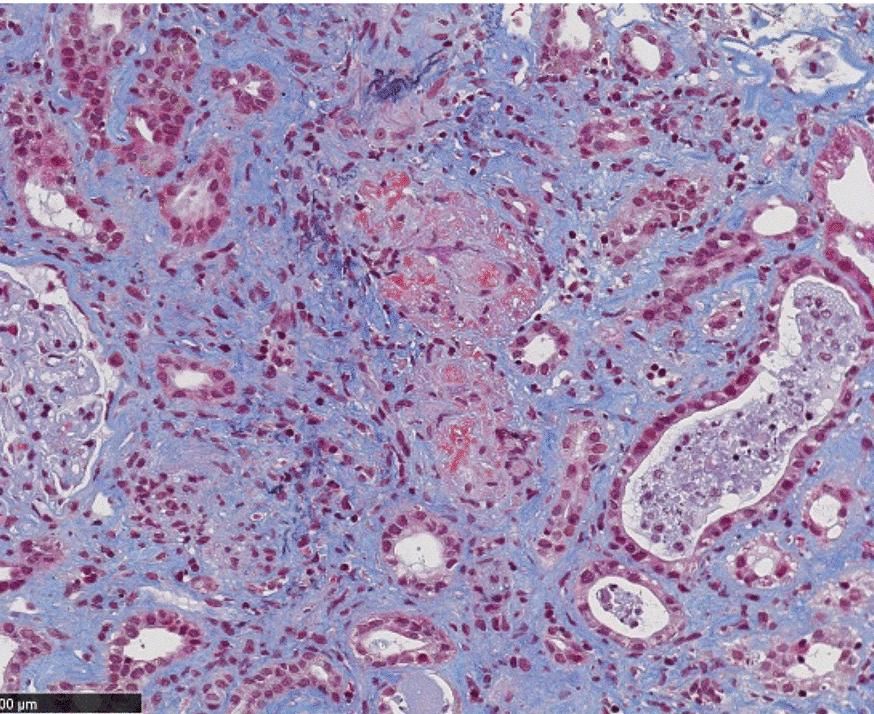
Image: PMC7849101, CC BY - Fibrinoid necrosis of the vessel wall
- Cholesterol embolus
- Dystrophic calcification
- Amyloid deposition
Answer key
- C HBsAg is positive in 30% patients
- C Polyarteritis nodosa
- C Henoch Schonlein purpura
- A Post capillary venules
- D Buerger's disease
- C Granulomatous giant cell lesions
- C Focal granulomatous inflammation
- C Kawasaki disease
- A bde
- C IgA deposition in mesangium
- A Granulomatosis with polyangiitis
- C Subclavian
- A Henoch - schonlein purpura
- B Polyarteritis Nodosa
- D Wegener's granulomatosis
- A Temporal arteritis
- C Cardiac involvement
- C HLA -B5
- D Involves large vessels
- A Palpable pupura
- C Low ESR
- A Lung
- C Takayasu's arteritis
- B Wegener's Granulomatosis
- A Fibrinoid necrosis of the vessel wall
About these questions
Previous year questions on Vasculitis for INI-CET (Institutes of National Importance Combined Entrance Test), from the Pathology section of the exam.
Most questions here come from previous-year papers of Indian postgraduate medical entrance and licensing exams; where a paper and year are recorded the question carries them. The image-based questions are original vignettes written around an openly licensed figure, and were never asked in any exam.
Pathology is worth about 15 of the 200 questions on the exam. See every subject’s weightage.