INI-CET · Pathology
Joint and Soft Tissue Pathology PYQs
- 23 live questions in Joint and Soft Tissue Pathology.
- 3 of 23 questions carry a recorded exam year: 2017, 2018, 2019.
- Question set last updated .
23 questions with answers
In alveolar variant of rhabdomyosarcoma , the resultant fusion protein is believed to function as
- Activated growth factor receptor
- Chimeric transcription factor
- Constitutively active kinase
- Novel growth factor
Which of the following is a most important infiltrate in rheumatoid arthritis?
- Dendritic cells
- Macrophages
- Neutrophils
- CD4+ Helper cells
Most common presentation of abdominal desmoids tumor is?
- Abdominal pain
- Abdominal mass
- Fever
- Urinary retention
Translocation seen in Synovial cell sarcoma
- t (1;19)
- t (2;14)
- t (x; 18)
- t (2;13)
All are true regarding synovial sarcoma except?
- More common at extra articular sites
- Knee and foot are commonly involved
- Usually seen in individuals less than 50 years of age
- Originates from the synovial lining
Commonest surgical procedure for soft tissue sarcoma
- Marginal excision
- Enucleation
- Wide local excision
- Compartmental excision
In Rheumatoid arthritis, which type of cells are prominently present ?
- B cells
- T cells
- Macrophages
- Dendritic cells
Symptoms from a retroperitoneal sarcoma are usually produced by
- Bleeding into the tumor mass
- Compression of adjacent tissues
- Invasion of retroperitoneal organs
- Metastases to retroperitoneal lymph nodes
All of the following are properties of synovial fluid Except
- It is a pale yellow , clear and sufficiently viscous fluid that droplets expelled from a needle tip fall in a long string
- It is a Non Newtonian fluid
- It doesn't clot since it lacks in fibrinogen
- Normal WBC count in synovial fluid is 350 - 3500 / mm3
Show answer
D. Normal WBC count in synovial fluid is 350 - 3500 / mm3
Think this answer is wrong? Report itWhich of the following is not true about synovial sarcoma?
- It does not arise from synovium
- It occurs more common at extra-articular sites
- It is seen at >50 yrs of age
- Knee and foot are common sites involved
All of the following statements about synovial cell sarcoma, are true, except -
- Originate from synovial lining
- Occur more often at extraarticular sites
- Usually seen in patients less than 50 years of age
- Knee and foot are common sites involved
Which of the following is biphasic tumor?
- Rhabdomyosarcoma
- Synovial sarcoma
- Osteosarcoma
- Osteoblastoma
Synovial chondromatosis commonly affects
- Hands
- Knees
- Pelvis
- Vertebrae
Lymph node metastasis is common in a) Osteosarcoma b) Fibrous histiocytoma c) Angiosarcoma d) Rhabdomyosarcoma
- abc
- acd
- cd
- bd
With regard to the malignant behavior of leiomyosarcoma, the most important criterion is
- Blood vessel penetration by tumor cells
- Tumor cells in lymphatic channels
- Lymphocyte infiltration
- The number of mitoses per high power field
A 26-year-old, previously healthy man sustains blunt force trauma to the left upper arm. On physical examination, there is focal swelling and redness. Three weeks later, the superficial contusion has resolved, but now a slightly tender mass is palpated in the outer aspect of the upper left arm. A radiograph of the left arm shows a 5-cm mass in the soft tissue. There is a radiolucent center and surrounding irregular bone formation. One month later, the mass is now 3 cm and painless. CT scan of the arm shows a well-circumscribed mass within muscle with areas of bright calcification throughout. What is the most likely diagnosis?
- Gouty tophus
- Hemarthrosis
- Myositis ossificans
- Osteochondroma
Giant cell tumor of tendon sheath Is
- Traumatic
- Infective
- Malignant tumor
- benign tumor
The biphasic pattern on histology is seen in which tumor-
- Rhabdomyosarcoma
- Synovial cell sarcoma
- Osteosarcoma
- Neurofibroma
SYT-SSX1 gene is associated with-
- Liposarcoma
- Rhabdomyosarcoma
- Synovial sarcoma
- Ewings sarcoma
Which of the following is TRUE about desmoid tumors
- Alterations in the Adenomatous Polyposis Coli (APC) / beta-catenin pathway are noted
- They consist of proliferating malignant-appearing fibroblastic cells with abundant mitoses
- Primary modality of treatment is radiotherapy
- They have a strong tendency to metastasize
Show answer
A. Alterations in the Adenomatous Polyposis Coli (APC) / beta-catenin pathway are noted
Think this answer is wrong? Report itA 26-year-old nulliparous woman undergoes laparotomy for a large, firm, slowly enlarging abdominopelvic mass that had been managed for two years as a recurrent uterine fibroid. A representative haematoxylin and eosin section of the resected mass is shown. Based on the section, which is the most likely diagnosis?
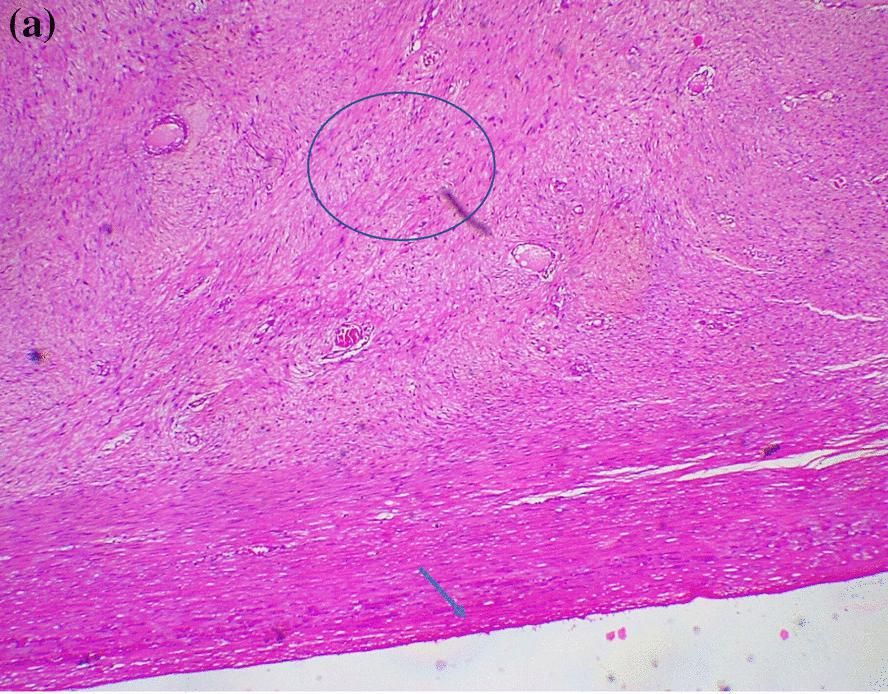
Image: PMC9419363, CC BY - Desmoid-type fibromatosis
- Schwannoma
- Solitary fibrous tumour
- Leiomyosarcoma
A 68-year-old woman with long-standing knee osteoarthritis undergoes total knee replacement. A section taken perpendicular to the articular surface of the resected femoral condyle is stained with haematoxylin and eosin and is shown. Which type of cartilage forms the tissue seen covering this joint surface?
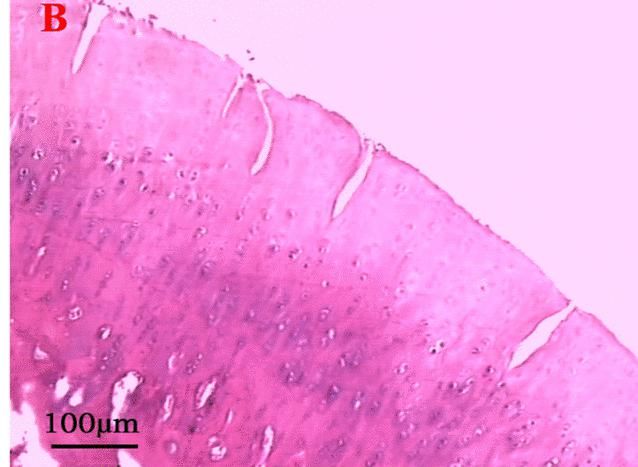
Image: PMC8848938, CC BY - Elastic cartilage
- Hyaline cartilage
- Fibrocartilage
- Dense fibrous connective tissue
A 55-year-old patient has a large, deep soft tissue mass that is biopsied before neoadjuvant chemotherapy. The high-power hematoxylin and eosin-stained section is shown. Which interpretation best fits the histology?
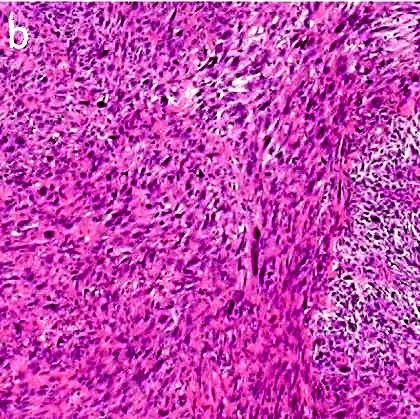
Image: PMC6728953, CC BY - A benign fibrous histiocytoma
- Nodular fasciitis
- Schwannoma with Antoni A and B areas
- A high-grade spindle cell sarcoma
Answer key
- B Chimeric transcription factor
- D CD4+ Helper cells
- B Abdominal mass
- C t (x; 18)
- D Originates from the synovial lining
- C Wide local excision
- B T cells
- B Compression of adjacent tissues
- D Normal WBC count in synovial fluid is 350 - 3500 / mm3
- C It is seen at >50 yrs of age
- A Originate from synovial lining
- B Synovial sarcoma
- B Knees
- C cd
- D The number of mitoses per high power field
- C Myositis ossificans
- D benign tumor
- B Synovial cell sarcoma
- C Synovial sarcoma
- A Alterations in the Adenomatous Polyposis Coli (APC) / beta-catenin pathway are noted
- A Desmoid-type fibromatosis
- B Hyaline cartilage
- D A high-grade spindle cell sarcoma
About these questions
Previous year questions on Joint and Soft Tissue Pathology for INI-CET (Institutes of National Importance Combined Entrance Test), from the Pathology section of the exam.
Most questions here come from previous-year papers of Indian postgraduate medical entrance and licensing exams; where a paper and year are recorded the question carries them. The image-based questions are original vignettes written around an openly licensed figure, and were never asked in any exam.
Pathology is worth about 15 of the 200 questions on the exam. See every subject’s weightage.
More in Pathology
- Lung Tumours
- Pituitary, Parathyroid and Endocrine Pancreas
- Thyroid Gland Pathology
- Adrenal Gland Pathology
- Breast Pathology
- Bone: Developmental Disorders, Infections and Tumours
- Dermatopathology
- CNS Infections and Cerebrovascular Disease
- Degenerative, Toxic and Metabolic CNS Disease
- Tumours of the CNS
- Peripheral Nerve and Neuromuscular Pathology
- Cell Genetics, Adaptation and Cell Injury