INI-CET · Pathology
Lung Tumours PYQs
- 33 live questions in Lung Tumours.
- Question set last updated .
33 questions with answers
Azzopardi effect is seen in ?
- squamous cell carcinoma
- large cell carcinoma
- small cell carcinoma
- adenocarcinoma lung
In which of the following forms of pulmonary carcinoma is the classic progression of metaplasia to dysplasia to carcinoma in situ observed
- Small-cell carcinoma
- Adenocarcinoma
- Large-cell carcinoma
- Squamous cell carcinoma
Most common lung cancer in non-smokers is:
- Adenocarcinoma
- Squamous cell carcinoma
- Oat cell carcinoma
- None of the above
A 65-year-old chronic smoker presents with a rapidly enlarging large hilar mass on a chest film associated with significant adenopathy. He also experiences recurrent hypoglycemic spells these days. A provisional diagnosis of Lung carcinoma being considered which of the following subtype will most commonly lead to this spectrum?
- Squamous cell carcinoma
- Adenocarcinoma
- Large cell carcinoma
- Small cell tumour
About mesothelioma, all are true except
- Develop in late middle age
- It is bilateral and symmetrical
- It is due to chronic exposure to asbestosis
- It shows biphasic pattern
Diffuse mesothelioma is seen with: (PGI Nov 2009)
- Asbestos
- Arsenic
- Tobacco use
- T.B
In small cell carcinoma of the lung one of the following is not seen -
- Hypercalcemia
- Hyponatremia
- Watery diarrhoea
- Hypokalemia
Scar in lung tissue may get transformed into
- Columnar cell carcinoma
- Oat cell carcinoma
- Squamous cell carcinoma
- Adenocarcinoma
Scar in lung tissue develops into:
- Adenocarcinoma
- Oat cell carcinoma
- Squamous cell carcinoma
- Columnar cell carcinoma
Marker of small cell cancer of lung is
- Chromogranin
- Cytokeratin
- Desmin
- Vimentin
Lung to lung metastasis is seen in ?
- Adenocarcinoma of lung
- Squamous cell carcinoma
- Small cell carcinoma
- Neuroendocrine tumor of lung
Most common type of carcinoma lung is-
- Small cell carcinoma
- Adenocarcinoma
- Squamous cell carcinoma
- Large cell carcinoma
A 67 year male smoker presents with haemoptysis and cough. Bronchoscopic biopsy revealed undifferentiated tumour. The immunohistochemical marker that can be most helpful is-
- Calretinin
- Vimentin
- Cytokeratin
- GGt
Least common cause of clubbing is:
- Adenocarcinoma
- Squamous cell cancer
- Small cell cancer
- Mesothelioma
Mesothelioma is differentiated from adenocarcinoma by:
- Presence of long slender microvilli
- Abundant altered mitochondria
- Ribosome clumps
- Dense secretory core granules
A 65 year old chronic smoker presented with a central lung mass with distal bronchiectasis and recurrent pneumonia. A greyish white tumor was resected. Which of the following histopathological finding is most likely to be seen -
- Small cells with scant cytoplasm, ill defined cell borders and hyperchromatic nuclei with nuclear moulding
- Derivatives of all three germ layers are seen
- Tall columnar cells with cytoplasmic and intra alveolar mucin
- Palisading or rosette - like arrangements of cells separated by abundant fibrovascular stroma
Show answer
A. Small cells with scant cytoplasm, ill defined cell borders and hyperchromatic nuclei with nuclear moulding
Think this answer is wrong? Report itWhich is the most common site for extrathoracic metastases in patients with lung carcinoma -
- Kidneys
- Liver
- Vertebral body
- Adrenal glands
Which paraneoplastic syndrome is not seen with small cell ca lung -
- PTH
- ACTH
- ADH
- Carcinoid syndrome
Apical lung carcinoma commonly manifests as:
- Pleural effusion
- Pericardial involvement
- Horner's syndrome
- Tumour obstruction of the airway
Primary pleural tumor is ?
- Mesothelioma
- Myxoma
- Lipoma
- Fibroma
A 75-year-old female with a long history of cigarette smoking is found to have a small tumor at the periphery of her right upper lobe. Initially, the tumor was believed to be a Stage I carcinoma (T1 NO MO), but after surgery it is found to be Stage II (T1 N1 MO). What is found at surgery that changed the staging?
- Involvement of the chest wall
- Positive bronchial lymph nodes
- Small cell histology
- Tumor at the carina
A 72-year-old man with a significant smoking history presents to the emergency room with complaints of dyspnea and truncal, arm, and facial swelling for one week. Physical examination is remarkable for facial erythema and facial, truncal, and arm edema with prominence of thoracic and neck veins. On chest x-ray, there is a mass in the right mediastinum with adenopathy. Which of the following is the MOST likely diagnosis?
- Adenocarcinoma
- Hodgkin's lymphoma
- Large cell carcinoma
- Small cell carcinoma
Most common histological form of lung Ca that metastasizes is -
- Squamous cell CA
- Adenocarcinoma
- Alveolar-carcinoma
- Small cell carcinoma
True about adenocarcinoma of lung - a) More common in female b) Smoking is not associated with c) Central cavitations d) Upper lobe involvement is most common e) Peripheral involvement
- abc
- bcd
- abe
- acd
Most common lung cancer in non-smokers is:
- Adenocarcinoma
- Squamous cell carcinoma
- Oat cell carcinoma
- None of the above
A 52-year-old woman presents with a 1-year history of upper truncal obesity and moderate depression. Physical examination shows hirsutism and moon facies. A CT scan of the thorax displays a hilar mass. A transbronchial lung biopsy discloses small cell carcinoma. Electron microscopy of this patient's lung tumor will most likely reveal which of the following cytologic features?
- Councilman bodies
- Hyperplasia of endoplasmic reticulum
- Mitochondrial calcification
- Neuroendocrine granules
A 58-year-old woman who has never smoked undergoes lobectomy for a peripheral lung nodule detected on screening CT. A hematoxylin and eosin-stained section of the tumour is shown. Which histological subtype of pulmonary adenocarcinoma does this growth pattern represent?
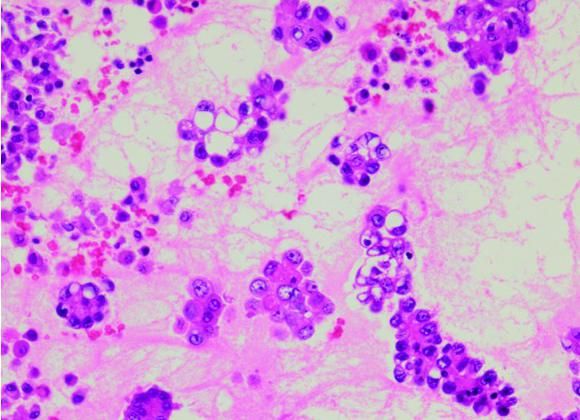
Image: PMC4114577, CC BY - Micropapillary predominant adenocarcinoma
- Acinar predominant adenocarcinoma
- Lepidic predominant adenocarcinoma
- Solid adenocarcinoma
A 69-year-old retired shipyard worker has three months of left-sided chest pain, breathlessness and a recurrent pleural effusion. The axial fused FDG PET/CT image is shown. Which diagnosis best explains the appearance?
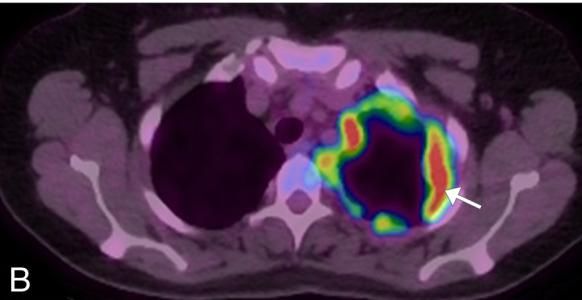
Image: PMC7343701, CC BY - Invasive thymoma
- Loculated empyema
- Tuberculous pleuritis
- Malignant pleural mesothelioma
A 62-year-old woman who has never smoked has an abnormality detected on a screening chest CT; the axial image through the lung apices is shown, with the lesion circled. Which histological subtype of primary lung cancer is most commonly associated with a peripheral part-solid ground-glass lesion of this kind?
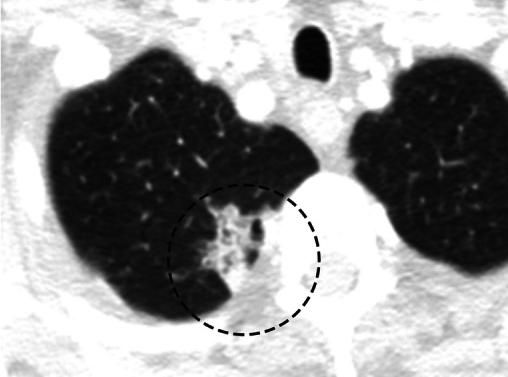
Image: PMC7343701, CC BY - Adenocarcinoma
- Typical carcinoid
- Squamous cell carcinoma
- Small cell carcinoma
A 67-year-old man with a 45 pack-year smoking history presents with cough and weight loss. The axial chest CT is shown, with the lesion circled. Which histological type of lung carcinoma most characteristically produces this appearance?
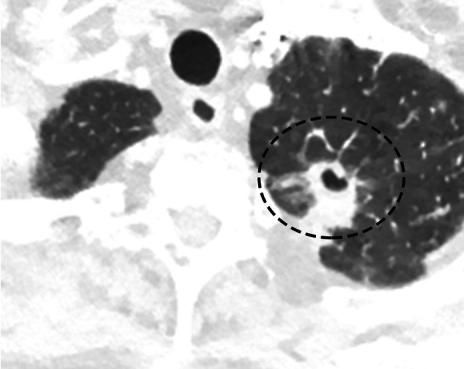
Image: PMC7343701, CC BY - Large cell carcinoma
- Small cell carcinoma
- Squamous cell carcinoma
- Adenocarcinoma in situ
A 64-year-old woman who has never smoked undergoes lobectomy for a peripheral lung mass. A hematoxylin and eosin section of the tumour is shown. Which histological type of lung cancer is this?
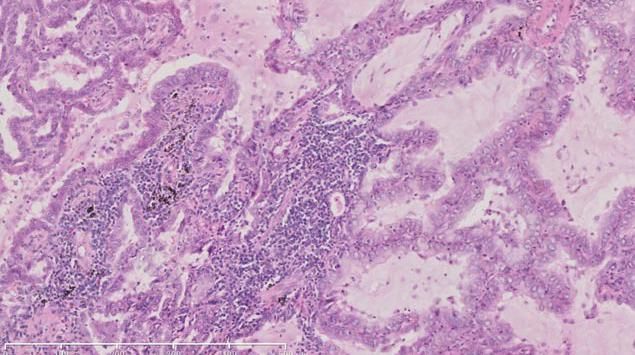
Image: PMC5392352, CC BY - Squamous cell carcinoma
- Small cell carcinoma
- Adenocarcinoma
- Malignant mesothelioma
A 64-year-old smoker with a hilar lung mass undergoes transbronchial needle aspiration. The haematoxylin and eosin stained cell block section is shown: it contains syncytial sheets of large tumour cells with abundant cytoplasm, vesicular nuclei and prominent nucleoli, set in a dense background of small mature lymphocytes, with focal necrosis. Which of the following is the most appropriate diagnosis?
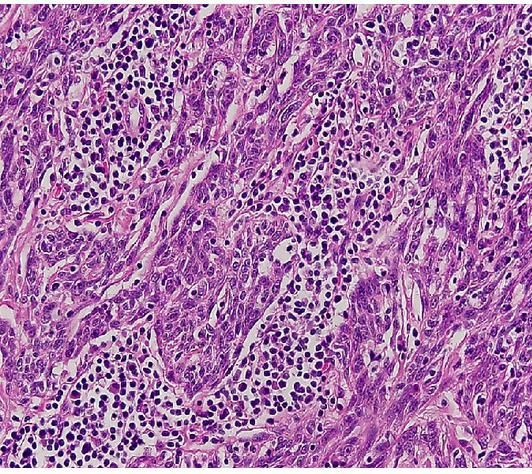
Image: PMC3833058, CC BY - Necrotising granulomatous inflammation
- Non-small cell carcinoma
- Non-Hodgkin lymphoma
- Small cell carcinoma
A 48-year-old woman has several months of progressive dyspnoea and wheeze that was treated as asthma. Bronchoscopy shows a submucosal polypoid mass narrowing the lower trachea. A haematoxylin and eosin section of the biopsy is shown. What is the most likely diagnosis?
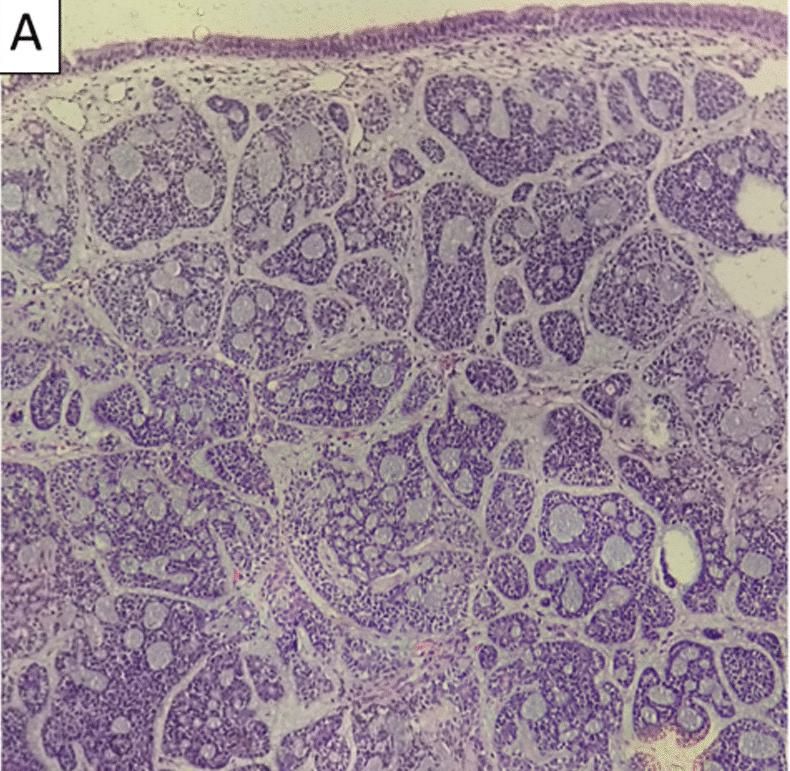
Image: PMC9208154, CC BY - Mucoepidermoid carcinoma
- Squamous cell carcinoma
- Adenoid cystic carcinoma
- Typical carcinoid tumour
Answer key
- C small cell carcinoma
- D Squamous cell carcinoma
- A Adenocarcinoma
- D Small cell tumour
- B It is bilateral and symmetrical
- A Asbestos
- A Hypercalcemia
- D Adenocarcinoma
- A Adenocarcinoma
- A Chromogranin
- A Adenocarcinoma of lung
- B Adenocarcinoma
- C Cytokeratin
- C Small cell cancer
- A Presence of long slender microvilli
- A Small cells with scant cytoplasm, ill defined cell borders and hyperchromatic nuclei with nuclear moulding
- D Adrenal glands
- A PTH
- C Horner's syndrome
- A Mesothelioma
- B Positive bronchial lymph nodes
- D Small cell carcinoma
- D Small cell carcinoma
- C abe
- A Adenocarcinoma
- D Neuroendocrine granules
- A Micropapillary predominant adenocarcinoma
- D Malignant pleural mesothelioma
- A Adenocarcinoma
- C Squamous cell carcinoma
- C Adenocarcinoma
- B Non-small cell carcinoma
- C Adenoid cystic carcinoma
About these questions
Previous year questions on Lung Tumours for INI-CET (Institutes of National Importance Combined Entrance Test), from the Pathology section of the exam.
Most questions here come from previous-year papers of Indian postgraduate medical entrance and licensing exams; where a paper and year are recorded the question carries them. The image-based questions are original vignettes written around an openly licensed figure, and were never asked in any exam.
Pathology is worth about 15 of the 200 questions on the exam. See every subject’s weightage.
More in Pathology
- Gastric Pathology
- Small Bowel Pathology
- Large Bowel: Non-Neoplastic Disease
- Large Bowel: Neoplastic Disease
- Congenital Anomalies, ARDS and Lung Infections
- Obstructive and Restrictive Lung Disease
- Pituitary, Parathyroid and Endocrine Pancreas
- Thyroid Gland Pathology
- Adrenal Gland Pathology
- Breast Pathology
- Bone: Developmental Disorders, Infections and Tumours
- Joint and Soft Tissue Pathology