INI-CET · Pathology
Congenital Anomalies, ARDS and Lung Infections PYQs
- 11 live questions in Congenital Anomalies, ARDS and Lung Infections.
- 1 of 11 questions carries a recorded exam year: 2017.
- Question set last updated .
11 questions with answers
Which of the following condition is characterized by presence pf hyaline deposits in alveolar walls?
- Interstitial lung disease
- Asthma
- Hyaline membrane disease
- Chronic bronchitis
All of the following features are seen in the viral pneumonia except:
- Presence of interstitial inflammation
- Predominance of alveolar exudate
- Bronchiolitis
- Multinucleate giant cells in the bronchiolar wall
most important cell damage in pathogenesis of ARDS is
- alveolar cell type 1
- alveolar cell type 2
- endothelial cell of capillary
- due to macrophages
The feature of shock lung is
- Diffuse alveolar damage
- Usual interstitial penumonitis
- Organizing pneumonia
- Bronchilolitis
Dominant cell type in grey hepatization stage of community acquired pneumonia is
- Eosinophils
- Neutrophils
- Macrophages
- Monocytes
Gray hepatization of lungs is seen in day -
- 1
- 2-3
- 3-5
- 4-8
Gray hepatization of lungs is seen on day ?
- 1
- 2-3
- 3-5
- 5-7
In primary atypical pneumonia inflammatory cells accumulate in -
- Alveolar lumen
- Bronchioles
- Alveolar wall
- Pleural space
Hyaline membrane in the lung is seen in ?
- Respiratory distress syndrome
- Pulmonary edema
- Pneumococcal Pneumonia
- Acute viral hepatitis
Bronchogenic sequestration is seen in which lobe -
- Left lower lobe
- Right upper lobe
- Left middle lobe
- Left upper lobe
A 29-year-old woman has an incidentally detected posterior mediastinal cystic lesion that is excised intact. A hematoxylin and eosin section of the cyst wall is shown. Which epithelium lines this cyst?
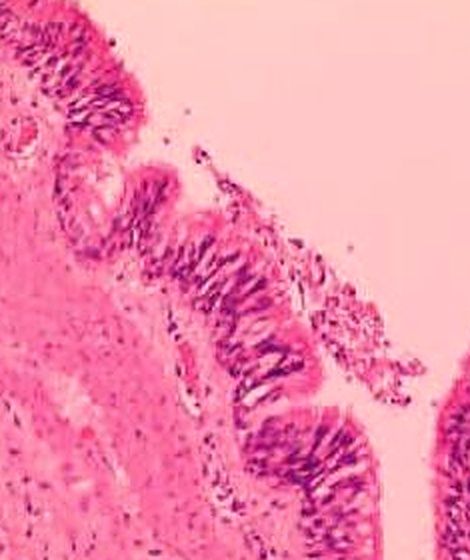
Image: PMC4839937, CC BY - Urothelium
- Keratinizing stratified squamous epithelium
- Pseudostratified ciliated columnar epithelium
- Single layer of flattened mesothelium
Answer key
About these questions
Previous year questions on Congenital Anomalies, ARDS and Lung Infections for INI-CET (Institutes of National Importance Combined Entrance Test), from the Pathology section of the exam.
Most questions here come from previous-year papers of Indian postgraduate medical entrance and licensing exams; where a paper and year are recorded the question carries them. The image-based questions are original vignettes written around an openly licensed figure, and were never asked in any exam.
Pathology is worth about 15 of the 200 questions on the exam. See every subject’s weightage.
More in Pathology
- Gallbladder and Pancreatic Disease
- Esophageal Pathology
- Gastric Pathology
- Small Bowel Pathology
- Large Bowel: Non-Neoplastic Disease
- Large Bowel: Neoplastic Disease
- Obstructive and Restrictive Lung Disease
- Lung Tumours
- Pituitary, Parathyroid and Endocrine Pancreas
- Thyroid Gland Pathology
- Adrenal Gland Pathology
- Breast Pathology