INI-CET · Pathology
Large Bowel: Neoplastic Disease PYQs
- 18 live questions in Large Bowel: Neoplastic Disease.
- 1 of 18 questions carries a recorded exam year: 2017.
- Question set last updated .
18 questions with answers
False about familial polyposis colon cancer syndrome:
- Autosomal recessive transmission
- Associated with fibroma and osteomas
- Associated with brain tumors
- 100% chance of colon carcinomas
Which of the following colonic polyps is not premalignant?
- Juvenile polyps
- Hamartomatous polyps associated with Peutz Jeghers Syndrome
- Villous adenomas
- Tubular adenomas
Strong correlation with colorectal cancer is seen in
- Peutz-Jegher's polyp
- Familial polyposis coli
- Juvenile polyposis
- Hyperplastic polyp
All of the following genes are implicated in colon carcinoma by classical pathway except
- APC
- K-ras
- Beta-catenin
- Mismatch repair genes
Gardner syndrome does not include:
- Osteomas
- Epidermoid cysts
- Osteosarcoma
- Impacted permanent teeth
Mucocutaneous circumoral pigmentation is found in:
- Peutz-Jeghers syndrome
- Plummer-Vinson syndrome
- Lead poisoning
- Bechet's syndrome
True about familial adenomatous polyposis is?
- Also known as Lynch syndrome
- FAP gene is located on 5p21
- 100% risk of malignancy in classical variety
- Males are usual carriers
On rectal examination, a patient is found to have a large, fungating mass protruding into the rectal lumen. Biopsy of this mass demonstrates an invasive malignant tumor composed of glandular structures. The development of this condition is most strongly associated with
- Diverticulitis
- Diverticulosis
- Juvenile polyposis syndrome
- Ulcerative colitis
Colonic polyp that has maximum chance of malignant transformation
- Hyperplastic polyp
- Adenomatous polyp
- Juvenile polyp
- Polyp of Peutz-Jeghers syndrome
The adenomatous polyp of large bowel are most often situated in -
- Ascending colon
- Transverse colon
- Descending colon
- Sigmoid colon
Gene associated with familial adenomatous polyposis is?
- p53
- Rb
- APC
- RET
Peutz Jeghers syndrome-all are true EXCEPT:
- Pigmentation of lips & oral mucosa
- Polyposis of jejunum
- Radiotherapy is the treatment of choice
- May turn malignant
In Peutz-Jeghers syndrome, polyps are mainly seen in:
- Rectum
- Colon
- Esophagus
- Jejunum
Most common site for colon cancer is ?
- Caecum
- Transverse colon
- Rectosigmoid
- Ascending colon
A 62-year-old man presents with rectal bleeding and altered bowel habit. A colorectal biopsy stained with hematoxylin and eosin is shown; intact surface epithelium is present at the top of the field. Which process is best demonstrated in the underlying tissue?
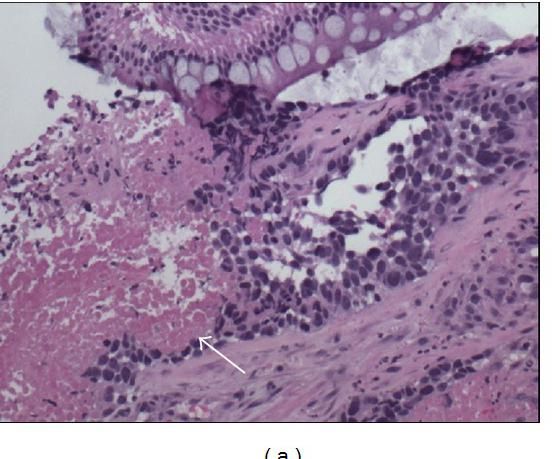
Image: PMC4124645, CC BY - Crypt abscesses of active ulcerative colitis
- Ischaemic mucosal atrophy with hyalinised lamina propria
- Nests of invasive carcinoma with tumour necrosis
- A reactive submucosal lymphoid aggregate
A 71-year-old man undergoes removal of a colonic polyp detected at screening colonoscopy. The haematoxylin and eosin stained section is shown, with irregular, angulated and cribriform glands lined by stratified hyperchromatic epithelium infiltrating a desmoplastic, inflamed stroma. What is the diagnosis?
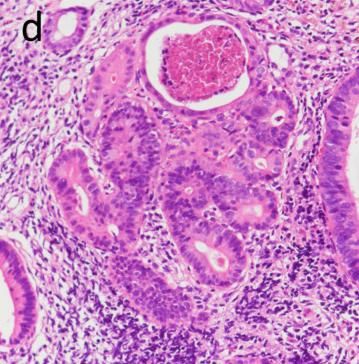
Image: PMC7689808, CC BY - Chronic active colitis with crypt distortion
- Tubular adenoma with low-grade dysplasia
- Hyperplastic polyp
- Invasive adenocarcinoma
A 63-year-old man reports four months of altered bowel habit with intermittent dark rectal bleeding and is found to have iron-deficiency anaemia. The colonoscopic view of his sigmoid colon is shown. Biopsies were taken from this lesion. Which result is most likely?
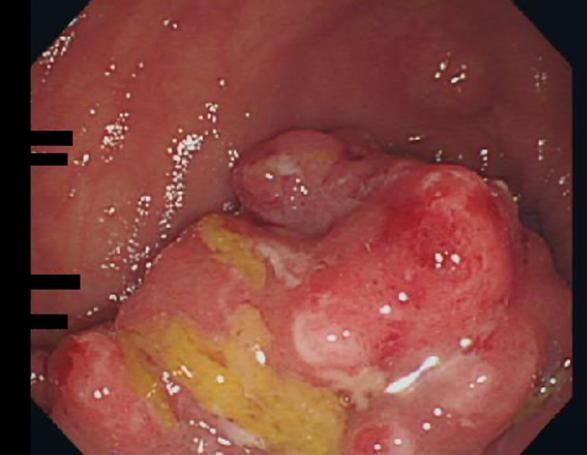
Image: PMC7900365, CC BY - Ulcerative colitis
- Submucosal lipoma
- Diverticular disease
- Adenocarcinoma
A 60-year-old man reports several weeks of rectal bleeding and tenesmus. A haematoxylin and eosin section of the endoscopic biopsy from the rectal mass is shown, containing irregular, angulated glands lined by crowded, pseudostratified, hyperchromatic epithelium set within a desmoplastic stroma. What is the most likely diagnosis?
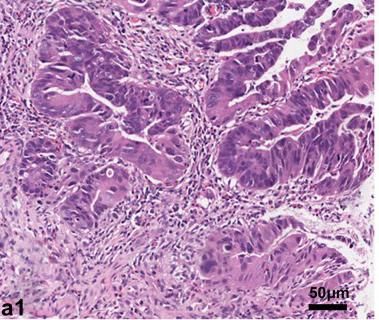
Image: PMC6434387, CC BY - Active ulcerative colitis
- Invasive adenocarcinoma
- Hyperplastic polyp
- Well-differentiated neuroendocrine tumour
Answer key
- A Autosomal recessive transmission
- A Juvenile polyps
- B Familial polyposis coli
- D Mismatch repair genes
- C Osteosarcoma
- A Peutz-Jeghers syndrome
- C 100% risk of malignancy in classical variety
- D Ulcerative colitis
- B Adenomatous polyp
- D Sigmoid colon
- C APC
- C Radiotherapy is the treatment of choice
- D Jejunum
- C Rectosigmoid
- C Nests of invasive carcinoma with tumour necrosis
- D Invasive adenocarcinoma
- D Adenocarcinoma
- B Invasive adenocarcinoma
About these questions
Previous year questions on Large Bowel: Neoplastic Disease for INI-CET (Institutes of National Importance Combined Entrance Test), from the Pathology section of the exam.
Most questions here come from previous-year papers of Indian postgraduate medical entrance and licensing exams; where a paper and year are recorded the question carries them. The image-based questions are original vignettes written around an openly licensed figure, and were never asked in any exam.
Pathology is worth about 15 of the 200 questions on the exam. See every subject’s weightage.