NEET PG · Anatomy
Vertebral Column PYQs
- 28 live questions in Vertebral Column.
- 5 of 28 questions carry a recorded exam year: 2018, 2019.
- Question set last updated .
28 questions with answers
Left-Right movement of skull occurs at
- C2 - C3
- Atlanto - occipital joint
- Atlanto - axial joint
- C4 - C5
Structure forming the Posterior 1/3 of vertebral canal is
- Posterior Longitudinal Ligament
- Ligamentum Flavum
- Posterior 1/3 of Vertebral Body
- Posterior 1/3 of Intervertebral Disc
What is normally seen in lumbar spine:-
- Scoliosis
- Lordosis
- Kyphosis
- Recurvatum
Ligamentum flavum consists of which fibres:-
- Type-I collagen
- Type-II collagen
- Reticular
- Elastic
Normal Curvature seen in Lumbar
- Lordosis
- Kyphosis
- Scoliosis
- Recurvatum
what is true regarding chassaignac's tubercle ?
- it is landmark of otic ganglion
- it is seen in occipital region of skull
- it is anterior tubercle of transverse process of c6 vertebra
- all the above
Show answer
C. it is anterior tubercle of transverse process of c6 vertebra
Think this answer is wrong? Report itHemivertebra is a defect of
- Body
- Transverse process
- Spine
- Posterior vertebral arches
Primary curvatures of vertebral column are
- Cervical & lumbar
- Thoracic & sacral
- Cervical & thoracic
- Thoracic & Lumbar
Which cervical vertebra that does not have a body or spinous process?
- C1
- C2
- C3
- C4
For side to side movement at neck which of the following joint involved (2019)
- Atlanto - axial joint
- Atlanto -occipital joint
- Occipital -axial joint
- C6 - C7 articulation
The movements at the _____ joint permit a person to look to the right and left
- Atlanto-occipital
- Atlanto-axial
- C2-C3
- C3-C4
Epidural venous plexus is located in
- Basal ganglia adjacent to pons
- At the junction of middle and posterior cranial fossa
- In vertebral canal below duramater
- In vertebral canal above duramater
Craniovertebral joint does not include:
- Occipital condyle
- Axis
- Atlas
- Wings of sphenoid
The typical cervical differs from thoracic vertebra in that it
- Has a triangular body
- Has a foramen transversarium
- Superior articular facet directed backwards and upwards
- Has a large vertebral body
Ligamentum flavum consists of:
- Type-II collagen
- Type-III collagen
- Reticulin
- Elastin
Which of the following has the most prominent spine?(Kerala 2008)
- C7
- T2
- C2
- L3
True about Atlanto-axial joint
- Vertebral artery passes posterior to foramen magnum
- Atlanto-occipital joint has flexion and extension movement
- Posterior longitudinal ligament does not pass through the spinal canal
- Atlanto-axial is ellipsoid joint
Show answer
B. Atlanto-occipital joint has flexion and extension movement
Think this answer is wrong? Report itNormal Curvature seen in Lumbar spine:
- Lordosis
- Kyphosis
- Scoliosis
- Recurvatum
Lumbar spine normally has
- Kyphosis
- Lordosis
- Scoliosis
- Gibus
Which is not a characteristic of a typical cervical vertebra?
- Has a triangular vertebral canal
- Has foramen transversarium
- Superior articular facet is directed backwards and upwards
- Has a large vertebral body
The lumbar region of the vertebral column permits all of the following movements, EXCEPT:
- Flexion
- Rotation
- Extension
- Lateral flexion
Difference between typical cervical & thoracic vertebra
- Has a triangular body
- Has a foramen transversarium
- Superior articular facet directed backwards & upwards
- Has a large vertebral body
Foramen Transversarium transmit
- Inferior jugular vein
- Inferior petrosal sinus
- Sigmoid sinus
- Vertebral artery
A 50-year-old man suffering from carcinoma of prostate showed areas of sclerosis and collapse of T10 and T 11 vertebrate was most probably through
- Sacral canal
- Lymphatic vessel
- Internal vertebral plexus of veins
- Superior rectal
A 38-year-old male is admitted to the emergency department after a car collision. During physical examination several lacerations in the back are discovered. Pain from lacerations or irritations of the skin of the back is conveyed to the central nervous system by which of the following?
- Dorsal primary rami
- Communicating rami
- Ventral primary rami
- Ventral roots
A typical feature of thoracic vertebrae
- Body is heart shaped
- Large body
- Triangular vertebral foramen
- Spine is short
Number of vertebrae is usually constant in
- Cervical
- Thoracic
- Lumbar
- Sacral
A young man presents with a hard, slowly enlarging swelling at the back of the neck. The lateral cervical radiograph shows a lobulated, densely calcified mass in continuity with the posterior bony elements of the mid-cervical vertebrae. From which part of the vertebra does the lesion arise?
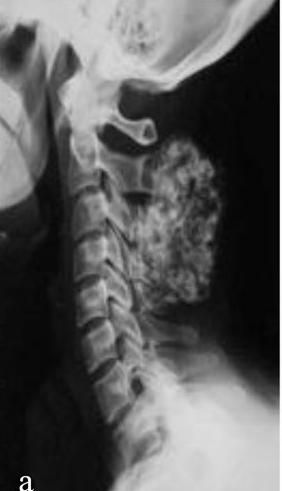
Image: PMC6032692, CC BY - Spinous process
- Pedicle
- Transverse process
- Vertebral body
Answer key
- C Atlanto - axial joint
- B Ligamentum Flavum
- B Lordosis
- D Elastic
- A Lordosis
- C it is anterior tubercle of transverse process of c6 vertebra
- A Body
- B Thoracic & sacral
- A C1
- A Atlanto - axial joint
- B Atlanto-axial
- D In vertebral canal above duramater
- D Wings of sphenoid
- B Has a foramen transversarium
- D Elastin
- A C7
- B Atlanto-occipital joint has flexion and extension movement
- A Lordosis
- B Lordosis
- D Has a large vertebral body
- B Rotation
- B Has a foramen transversarium
- D Vertebral artery
- C Internal vertebral plexus of veins
- A Dorsal primary rami
- A Body is heart shaped
- A Cervical
- A Spinous process
About these questions
Previous year questions on Vertebral Column for NEET PG (National Eligibility cum Entrance Test - Postgraduate), from the Anatomy section of the exam.
Most questions here come from previous-year papers of Indian postgraduate medical entrance and licensing exams; where a paper and year are recorded the question carries them. The image-based questions are original vignettes written around an openly licensed figure, and were never asked in any exam.
Anatomy is worth about 11 of the 200 questions on the exam. See every subject’s weightage.
More in Anatomy
- Pelvic Walls, Pelvic Floor and Perineum
- Lower Limb Osteology
- Hip, Knee and Ankle Joints
- Lower Limb Musculature
- Lumbosacral Nerves and Lower Limb Vessels
- Femoral Triangle, Popliteal Fossa and Foot Arches
- Classification of Bones, Joints and Cartilage
- Muscle Types and Tendon Structure
- General Organisation of Vessels, Lymphatics and Nerves
- Skin, Fascia and Ligaments
- Gametogenesis
- First Two Weeks: Fertilisation to Implantation