NEET PG · Pathology
Pathology of the Male Genital Tract PYQs
- 13 live questions in Pathology of the Male Genital Tract.
- Question set last updated .
13 questions with answers
Induration of seminal vesicle is seen most often in
- Tuberculosis
- Gonorrhea
- Syphilis
- Lymphogranuloma venereum
A baby is born with a testicular mass. Histologic sections made of the homogeneous yellow white mass after its removal demonstrate epithelial-lined spaces that have flattened-to-cuboidal epithelial cells with vacuolated cytoplasm containing eosinophilic, hyaline-like globules. Scattered structures resembling primitive glomeruli (endodermal sinuses) are also seen. If appropriate immunohistochemical stains are performed, the eosinophilic cytoplasmic globules would most likely contain which of the following?
- Alpha-fetoprotein
- Estrogen receptors
- Human chorionic gonadotropin
- Human papilloma virus
A 23-year-old, sexually active man has been treated for Neisseria gonorrhoeae infection 6 times during the past 5 years. He now comes to the physician because of the increasing number and size of warty lesions slowly enlarging on his external genitalia during the past year. On physical examination, there are multiple 1- to 3-mm sessile, nonulcerated, papillary excrescences over the inner surface of the penile prepuce. These lesions are excised, but 2 years later, similar lesions appear. Which of the following conditions most likely predisposed him to the development of these recurrent lesions?
- Candida albicans infection
- Circumcision
- Human papillomavirus infection
- Neisseria gonorrhoeae infection
A 58-year-old man presents to the emergency department with severe back pain. His history is negative for trauma and he has no other complaints. He denies urinary frequency, hesitancy, or dysuria. A digital rectal examination confirms the presence of a firm, hard, asymmetrical and stony prostate, suggestive of prostatic malignancy. In addition to PSA, which of the following markers can be demonstrated in the tumour cells?
- AMACR
- AFP
- Podoplanin
- OCT-3/4
All the following are testicular dysgenesis syndromes except:
- Cryptorchidism
- Epispadias
- Poor sperm quality
- Hypospadias
Commonest histological type of carcinoma testis is:
- Teratoma
- Yolk sac tumour
- Seminoma
- Choriocarcinoma
Predisposing features for germ cell tumour - a) Cryptorchidism b) Testicular feminising syndrome c) Klinefelter's syndrome d) Smoking e) Right side more common than Left side
- bcde
- abcd
- abce
- abde
Reinke crystalloids can be seen in which of the following sex cord-stromal tumours?
- Leydig cell tumour
- Granulosa cell tumour
- Gonadoblastoma
- Thecoma
All are true about seminomas except:
- Most common type of germ cell tumor
- Anaplastic seminomas is associated with a worse prognosis
- Almost never occur in infants
- Spermatocytic seminoma is slow growing with good prognosis
Show answer
B. Anaplastic seminomas is associated with a worse prognosis
Think this answer is wrong? Report itA 25 year old man undergoes orchiectomy for a testicular tumor. Microscopically, the tumor shows a variety of patterns, including lobules containing large cells with watery cytoplasm, structures resembling primitive glomeruli, syncytiotrophoblast, and shafts of undifferentiated cells with focal glandular differentiation. Which of the following terms most accurately describes this tumor?
- Choriocarcinoma
- Embryonal carcinoma
- Mixed tumor
- Seminoma
The commonest site for extragonadal germ cell tumor
- Pineal gland
- Mediastinum
- Retroperitoneum
- Sacrococcygeal region
A 72-year-old man with a rising serum PSA is found on CT to have several peritoneal nodules. A core needle biopsy of one nodule is taken and an immunohistochemical stain for prostate-specific antigen is shown. How is this stain best interpreted?
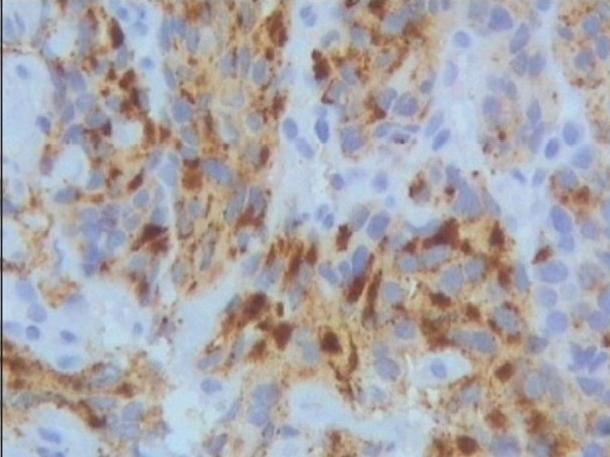
Image: PMC2938557, CC BY - Only background macrophages are labelled, so the stain is non-contributory
- The pattern is that of a primary peritoneal mesothelioma
- The tumour cells are PSA positive, indicating metastatic prostatic adenocarcinoma
- The tumour cells are PSA negative, which excludes a prostatic origin
Show answer
C. The tumour cells are PSA positive, indicating metastatic prostatic adenocarcinoma
Think this answer is wrong? Report itA 64-year-old man has a raised serum PSA and a firm irregular prostate on digital rectal examination. A needle biopsy is taken and the haematoxylin and eosin stained section is shown, revealing a dense infiltrate of lymphocytes admixed with sheets of pale epithelioid and foamy histiocytes; no malignant glands are identified. What is the most likely diagnosis?
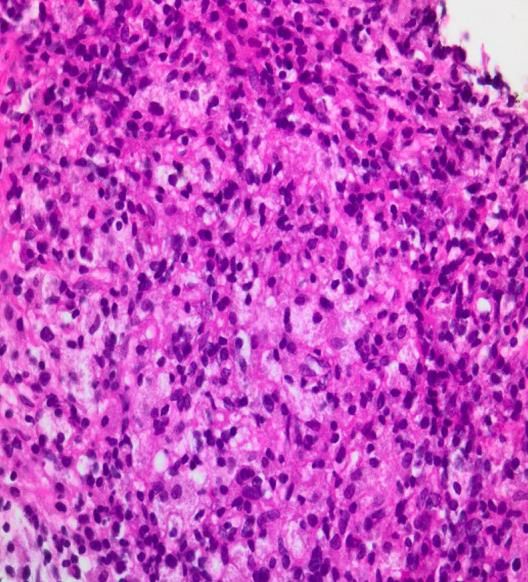
Image: PMC6982502, CC BY - Granulomatous prostatitis
- Benign prostatic hyperplasia
- Prostatic infarct
- Gleason pattern 5 adenocarcinoma
Answer key
- A Tuberculosis
- A Alpha-fetoprotein
- C Human papillomavirus infection
- A AMACR
- B Epispadias
- C Seminoma
- C abce
- A Leydig cell tumour
- B Anaplastic seminomas is associated with a worse prognosis
- C Mixed tumor
- B Mediastinum
- C The tumour cells are PSA positive, indicating metastatic prostatic adenocarcinoma
- A Granulomatous prostatitis
About these questions
Previous year questions on Pathology of the Male Genital Tract for NEET PG (National Eligibility cum Entrance Test - Postgraduate), from the Pathology section of the exam.
Most questions here come from previous-year papers of Indian postgraduate medical entrance and licensing exams; where a paper and year are recorded the question carries them. The image-based questions are original vignettes written around an openly licensed figure, and were never asked in any exam.
Pathology is worth about 17 of the 200 questions on the exam. See every subject’s weightage.