NEET PG · Pathology
Renal Tumours PYQs
- 28 live questions in Renal Tumours.
- 8 of 28 questions carry a recorded exam year: 2017, 2018, 2019.
- Question set last updated .
28 questions with answers
Bellini duct cancer is seen in which of the following?
- Liver
- Kidney
- Heart
- Spleen
A child presents with abdominal mass. Biopsy showed a triphasic tumour with areas of small blue cells. Which of the following is a feature of this tumour?
- MYCN amplification
- C-MYC overexpression
- WT1 mutation
- RB deletion
Birt-Hogg-Dube syndrome associated with:
- Renal cell carcinoma
- Lung Ca
- Stomach Ca
- Ovarian Ca
Birt-Hogg-Dube syndrome is associated with increased risk of malignancy in which of the following organs?
- Stomach
- Lung
- Kidney
- Ovaries
Sickle cell anemia is associated with which type of RCC?
- Medullary
- Papillary
- Chromophobe
- Colloid
All among the following are markers of Wilms' tumor except:
- Desmin
- Vimentin
- TTF 1
- Cytokeratin
Loss of 'Y' chromosome is associated with which of the following types of renal cell carcinoma (RCC)?
- Clear cell RCC
- Papillary RCC
- Chromophobe RCC
- Collecting duct RCC
Sickle cell disease is associated with which type of renal cell carcinoma?
- Medullary
- Papillary
- Chromophobe
- Colloid
Chromophilic Renal Cell Carcinoma is associated with
- 3p
- Trisomy 7 and 17
- 6q
- t(3, 11)
A 48 years old female presents with seizure, recurrent gross hematuria and left flank abdominal pain. Abdominal CT reveals left perinephric hematoma with 3 cm angiomyolipoma along with multiple right renal angiomyolipoma measuring 1.5 to 6.5 cm. What would be the most probable diagnosis?
- VHL syndrome
- Autosomal dominant polycystic kidney disease
- Tuberous sclerosis
- Hereditary angiolipoma
Pulsatile mets seen in which cancer-
- Lung cancer
- Prostate cancer
- Renal cancer
- Breast cancer
The most common histological variant or renal cell carcinoma is -
- Clear cell type
- Chromophobe type
- Papillary type
- Tubular type
Most common variant of RCC is
- Clear cell
- Papillary
- Chromophobe
- Collecting duct
Chromophobe variant of renal cell carcinoma is associated with -
- VHL gene mutations
- Trisomy of 7 and 17 (+7, +17)
- 3 p deletions (3p-)
- Monosomy of 1 and Y (-1, -Y)
Which of the following renal tumours is associated with tuberous sclerosis?
- Angiomyolipoma
- Renal papillary adenoma
- Nephroblastoma
- Oncocytoma
All are markers of Wilms' tumor except:
- Desmin
- Vimentin
- TTF 1
- Cytokeratin
Bilateral Renal cell carcimoma is seen in
- Eagle Barett's syndrome
- Beckwith Weideman syndrome
- Von Hippel Lindau disease
- Bilateral Angiomyolipoma
Polycythemia is seen with which tumor -
- Renal cell carcinoma
- Endometrial carcinoma
- Lung carcinoma
- Fibrosarcoma
Chromosome for RCC is -
- 3
- X
- 22
- 20
Chromophobe variant of renal cell is associated with -
- VHL gene mutations
- Trisomy of 7 and 17 (+7, +17)
- 3 p deletions (3p-)
- Monosomy of 1 and Y (-1, -Y)
Oncocytic carcinoma arises from -
- Perivascular
- Glomerulus
- Loop of henle
- Collecting duct
The most important prognostic factor of Wilms tumor-
- Histopathology
- Ploidy of cells
- Age < 1 y
- Mutation of c 1p gene
Renal cell carcinoma is related to gene located on chromosome ?
- 3
- X
- 22
- 20
From which of the following renal oncocytoma arises ?
- Loop of henle
- Collecting duct
- Proximal tubule
- Bowman's capsule
Most common carcinoma is associated with IVC metastasis
- Small cell carcinoma lung
- Gastric adenocarcinoma
- Renal cell carcinoma
- Papillary carcinoma thyroid
A 58-year-old man undergoes nephrectomy for a well-circumscribed 6 cm renal mass. The hematoxylin and eosin-stained section shows solid nests of cells with abundant granular eosinophilic cytoplasm, sharply outlined cell membranes, wrinkled nuclei and perinuclear clearing. What is the most likely diagnosis?
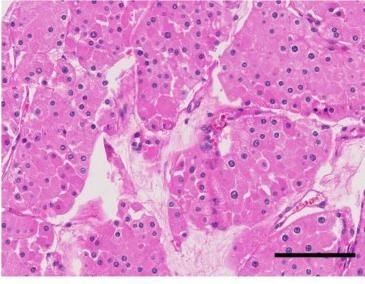
Image: PMC6826417, CC BY - Collecting duct carcinoma
- Papillary renal cell carcinoma
- Chromophobe renal cell carcinoma
- Clear cell renal cell carcinoma
A 66-year-old man undergoes radical nephrectomy for a solid renal mass that had earlier been sampled by percutaneous core biopsy. A low-power hematoxylin and eosin section taken at the tumour edge, including the capsule and perinephric fat, is shown. Which subtype of renal cell carcinoma does the tumour architecture indicate?
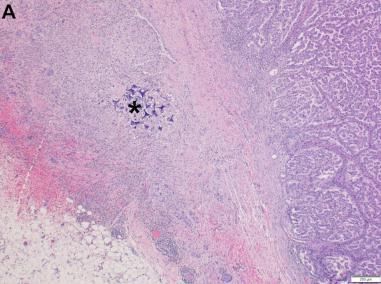
Image: PMC8127231, CC BY - Papillary renal cell carcinoma
- Chromophobe renal cell carcinoma
- Collecting duct carcinoma
- Clear cell renal cell carcinoma
A 3-year-old boy is brought with an abdominal mass discovered by his mother while bathing him. Imaging shows a large unilateral renal mass, and nephrectomy is performed. The haematoxylin and eosin stained section is shown, containing sheets of small blue cells that condense into primitive abortive tubules and rosette-like structures within a cellular stroma. What is the most likely diagnosis?
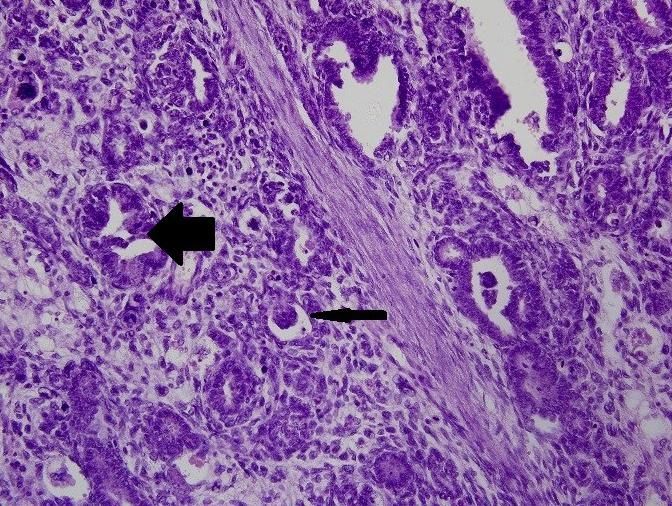
Image: PMC4715884, CC BY - Clear cell sarcoma of the kidney
- Nephroblastoma
- Mesoblastic nephroma
- Neuroblastoma metastatic to the kidney
Answer key
- B Kidney
- C WT1 mutation
- A Renal cell carcinoma
- C Kidney
- A Medullary
- C TTF 1
- B Papillary RCC
- A Medullary
- B Trisomy 7 and 17
- C Tuberous sclerosis
- C Renal cancer
- A Clear cell type
- A Clear cell
- D Monosomy of 1 and Y (-1, -Y)
- A Angiomyolipoma
- C TTF 1
- C Von Hippel Lindau disease
- A Renal cell carcinoma
- A 3
- D Monosomy of 1 and Y (-1, -Y)
- D Collecting duct
- A Histopathology
- A 3
- B Collecting duct
- C Renal cell carcinoma
- C Chromophobe renal cell carcinoma
- A Papillary renal cell carcinoma
- B Nephroblastoma
About these questions
Previous year questions on Renal Tumours for NEET PG (National Eligibility cum Entrance Test - Postgraduate), from the Pathology section of the exam.
Most questions here come from previous-year papers of Indian postgraduate medical entrance and licensing exams; where a paper and year are recorded the question carries them. The image-based questions are original vignettes written around an openly licensed figure, and were never asked in any exam.
Pathology is worth about 17 of the 200 questions on the exam. See every subject’s weightage.