INI-CET · Pathology
Hypersensitivity Reactions and Autoimmune Disease PYQs
- 33 live questions in Hypersensitivity Reactions and Autoimmune Disease.
- 1 of 33 questions carries a recorded exam year: 2018.
- Question set last updated .
33 questions with answers
Which of the following cannot be diagnosed without positive ANA?
- Drug induced lupus
- SLE
- Sjogren syndrome
- Scleroderma
Ram Devi presented with generalized edema sweating and flushing tachycardia and fever after bee sting. This is :
- T cell mediated cytotoxicity
- IgE mediated reaction
- IgG mediated reaction
- IgA mediated hypersensitivity reaction
Patch test is what type of hypersensitivity reaction?
- Type I
- Type II
- Type III
- Type IV
Lack of reaction to our own HLA ( human leukocyte antigen ) is known as?
- Autoimmunity
- Clonal selection
- Tolerance
- Complement system
All of the following autoimmune disorder are more common in females except
- ITP
- Multiple sclerosis
- Type I diabetes
- Scleroderma
Which of the following is not an autoimmune disorder?
- Ulcerative colitis
- Grave's disease
- Rheumatoid arthritis
- SLE
Anaphylaxis is mediated by
- 5-hydroxytryptamine
- Heparin
- Prostaglandin
- All of these
A type of immediately occurring reaction in which antigens combine with antibodies already attached to the surface of mast cells and basophils is called:
- Type I hypersensitivity
- Type II hypersensitivity
- Type III hypersensitivity
- Type IV hypersensitivity
Serum sickness syndrome is:
- A transplant immunity
- An anaphylactic shock
- Systemic arthus reaction
- None of the above
In penicillin allergy, penicillin acts as a:
- Hapten
- Carrier
- Super antigen
- Toxin
Patch test is a type of:
- Immediate hypersensitivity
- Antibody mediated hypersensitivity
- Immune complex mediate hypersensitivity
- Delayed type hypersensitivity
Skin prick test showing an immediate wheal-and-flare response is used to diagnose which type of hypersensitivity reaction?
- I
- II
- III
- All
Type IV Hypersensitivity-
- Farmer's lung
- Contact hypersensitivity
- Immediate hypersensitivity
- Myasthenia gravis
A 45 yr old patient presents with fever, night sweats, weight loss. On X ray a mass in apical lobe of lung is seen. On histopathology found to have caseous necrosis. What is the underlying process?
- Enzymatic degeneration
- Hypersensitivity reaction with modified macrophages, lymphocytes and giant cells
- Acute decrease in blood supply
- decreased growth factors
Show answer
B. Hypersensitivity reaction with modified macrophages, lymphocytes and giant cells
Think this answer is wrong? Report itGranuloma formation is seen with which hypersensitivity reaction?
- Type 1
- Type 2
- Type 3
- Type 4
Immune complex deposition is -
- Type I HS
- Type II HS
- Type III HS
- Type IV HS
Which type of immune responses responsible for caseation necrosis in TB?-
- Cell-mediated immunity
- Antibody mediated reaction
- Allergic reaction
- Immune complexes
Tuberculin test positivity indicates -
- Good humoral immunity
- Infection with mycobacterium
- Good cell mediated immunity
TH1 is involved in which type of hypersensitivity?
- Type 1
- Type 2
- Type 3
- Type 4
All combinations are true, except -
- Erythema nodosum leprosum-Type III hypersensitivity
- Post streptococcal glomerulonephritis -Type III hypersensitivity
- Schick test - delayed hypersensitivity
- Mismatched blood transfusion - Type II hypersensitivity
Antinuclear antibodies are seen in:
- SLE
- RA
- Sjogrens syndrome
- All
SLE is which type of hypersensitivity reaction:
- Type I hypersensitivity
- Type II hypersensitivity
- Type III hypersensitivity
- Type IV hypersensitivity
Rh incompatibility is-
- Type I hypersensitivity
- Type II hypersensitivity
- Type III hypersensitivity
- Type IV hypersensitivity
Necrotizing arteritis with fibrinoid necrosis is ?
- Immediate hypersensitivity
- Cell mediated immunity
- Antigen-antibody complex mediated
- Cytotoxic cell mediated
Example of Type IV hypersensitivity is -
- Serum sickness
- Granulomatous reaction
- Shwartzman reaction
- Arthus reaction
A typical example of an immunologically mediated collagen, connective tissue disorder:
- Pemphigus
- Bullous pemphigoid
- Lupus erythematosus
- Lichen planus
During development, all the antigens of self are introduced to thymic cells in-order to be removed to prevent autoimmunity. Which of the following genes is involved in the process?
- NOTCH1
- AIRE
- RB gene
- CPK gene
Lupus erythematosus is
- Reactive Lesion
- Degenerative condition
- Autoimmune disorder
- Neoplastic condition
Steven-Johnson syndrome involves
- Type I hypersensitivity reaction
- Type II hypersensitivity reaction
- Type III hypersensitivity reaction
- Type IV hypersensitivity reaction
Allergic BPA which kind of hypersensitivity reaction ?
- Type I
- Type II
- Type III
- Type IV
Arthus reaction is what type of hypersensitivity reaction
- Localized immune complex
- Ag- Ab reaction
- Complement mediated
- Ab mediated
A 40 year old man has chronic cough with fever for several months. The chest radiograph reveals a diffuse reticulonodular pattern. Microscopically on transbronchial biopsy there are focal areas of inflammation containing epithelioid cell granuloma, Langhans giant cells, and lymphocytes. These findings are typical for which of the following type of hypersensitivity immunologic responses ?
- Type I
- Type II
- Type III
- Type IV
A 52-year-old woman reports several months of gritty eyes and a dry mouth requiring sips of water with meals; anti-Ro/SSA antibodies are positive. A labial minor salivary gland biopsy stained with haematoxylin and eosin is shown, with dense aggregates of small lymphocytes and plasma cells around ducts between preserved acini. Which diagnosis do these findings support?
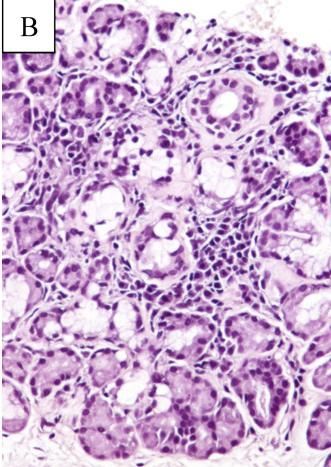
Image: PMC7764276, CC BY - IgG4-related sclerosing sialadenitis
- Sjogren syndrome
- Sialolithiasis with obstructive atrophy
- Mucoepidermoid carcinoma
Answer key
- B SLE
- B IgE mediated reaction
- D Type IV
- C Tolerance
- C Type I diabetes
- A Ulcerative colitis
- D All of these
- A Type I hypersensitivity
- C Systemic arthus reaction
- A Hapten
- D Delayed type hypersensitivity
- A I
- B Contact hypersensitivity
- B Hypersensitivity reaction with modified macrophages, lymphocytes and giant cells
- D Type 4
- C Type III HS
- A Cell-mediated immunity
- B Infection with mycobacterium
- D Type 4
- C Schick test - delayed hypersensitivity
- D All
- C Type III hypersensitivity
- B Type II hypersensitivity
- C Antigen-antibody complex mediated
- B Granulomatous reaction
- C Lupus erythematosus
- B AIRE
- C Autoimmune disorder
- D Type IV hypersensitivity reaction
- A Type I
- A Localized immune complex
- D Type IV
- B Sjogren syndrome
About these questions
Previous year questions on Hypersensitivity Reactions and Autoimmune Disease for INI-CET (Institutes of National Importance Combined Entrance Test), from the Pathology section of the exam.
Most questions here come from previous-year papers of Indian postgraduate medical entrance and licensing exams; where a paper and year are recorded the question carries them. The image-based questions are original vignettes written around an openly licensed figure, and were never asked in any exam.
Pathology is worth about 15 of the 200 questions on the exam. See every subject’s weightage.
More in General Pathology
- Lysosomal and Glycogen Storage Disorders
- Chromosomal and Other Genetic Disorders
- Features and Epidemiology of Neoplasia
- Molecular Basis of Cancer and Tumour Immunity
- Carcinogenesis, Paraneoplastic Syndromes and Tumour Markers
- Cells and Organs of the Immune System
- Immunodeficiency Disorders
- Amyloidosis and Transplant Rejection
- Histopathology Techniques and Special Stains
- Cell Genetics, Adaptation and Cell Injury
- Necrosis and Apoptosis
- Intracellular Accumulations, Pathological Calcification and Cell Ageing