INI-CET · Pathology
Features and Epidemiology of Neoplasia PYQs
- 33 live questions in Features and Epidemiology of Neoplasia.
- 2 of 33 questions carry a recorded exam year: 2018.
- Question set last updated .
33 questions with answers
Absence of differentiation is known as:-
- Metaplasia
- Anaplasia
- Dysplasia
- Hyperplasia
Which of the following is true about Anaplasia?
- Loss of cohesion between cells
- Loss of differentiation
- Change of epithelium type
- Benign and fully reversible
Ectopic rest of normal tissue is known as ?
- Choristoma
- Hamartoma
- Pseudotumor
- Lymphoma
Which is not seen in virus-induced tumour cells?
- Loss of orientation
- Loss of contact inhibition
- Change in size of cells
- Formation of micro tumour cells
A tumour that remains histologically benign and localized can still be fatal if it:
- Induce organ dysfunction
- Transform to carcinoma
- Metastasize to different organs
- All of the above
The following is not a feature of malignant transformation by cultured cells
- Increased cell density
- Increased requirement for growth factors
- Alteration of cytoskeletal structures
- Loss of anchorage
Histology of benign lesion is
- Well differentiated
- Atypical
- High mitotic figures
- Locally invasive
Which of the following is not a small round cell tumor?
- Neuroblastoma
- Retinoblastoma
- Ewing's sarcoma
- Hemangiosarcoma
Which one of the following is a connective tissue tumour:
- Lipoma
- Melanoma
- Carcinoma
- Papilloma
Which of the following is not a risk factor for malignancy
- DNA aneuploidy
- Male gender
- Invasive candidiasis
- Leukoplakia in non smokers
A rhabdomyoma is a tumour originating from
- Nerve tissue
- Smooth muscle
- Striated muscle
- Vascular endothelium
A squamous cell carcinoma of the oral cavity staged as T3N2M0 (AJCC TNM staging) is classified as:
- Stage I
- Stage II
- Stage III
- Stage IV
Which of the following malignancy is least commonly associated with lymphatic spread ?
- Basal Cell Carcinoma
- Squamous cell Carcinoma
- Malignant melanoma
- Merkel cell Carcinoma
Event of early acquisition of malignant phenotype of epithelium is an expression of:
- Cyclin a
- Cyclin b
- Cyclin c
- Cyclin d
All of the following conditions are premalignant except -
- Ulcerative colitis
- Crohn's disease
- Bronchiectasis
- Paget disease of bone
Which is the most common tumor leading to death in adults?
- Lung cancer
- Prostate cancer
- Colorectal cancer
- Leukemia
Which is the most common site of metastatic disease-
- Lung
- bone
- Liver
- Brain
The pre-malignant condition with the highest probability of progression to malignancy is
- Dysplasia
- Hyperplasia
- Leuoplakia
- Erythroplakia
Examination of a skin lesion demonstrates very abnormal squamous cells with a high nuclear/cytoplasmic ratio and clumped chromatin. These cells form nests within the epidermis that extend to the superficial surface of the epithelium. In some places, nests of these cells have central areas of abnormal keratin formation. The basement membrane is intact and no nests of cells are seen in the dermis. Which of the following terms best describes this lesion?
- Carcinoma in situ
- Dysplasia
- Invasive carcinoma
- Metaplasia
An epidemiologic study of cancer deaths recorded in the last half of the 20th century is conducted. The number of deaths for one particular cancer had increased markedly in developed nations. More than 30% of cancer deaths in men, and more than 24% of cancer deaths in women, were caused by this neoplasm in 1998. In some nations, prevention strategies reduced deaths from this cancer. Which of the following neoplasms was most likely identified by this study?
- Cerebral glioma
- Bronchogenic carcinoma
- Hepatocellular carcinoma
- Colonic adenocarcinoma
In TNM classification T3 stands for tumour size:
- >2 cm
- >4 cm
- <4 cm
- >4 cm with invasion of adjacent structure
Teratoma is best described as:
- Hamartomatous developmental manifestation consisting of three different layers
- Occurs most commonly in stomach and lungs
- Originates from mesodermal tissue
- Associated with very painful condition
Show answer
A. Hamartomatous developmental manifestation consisting of three different layers
Think this answer is wrong? Report itIncreased risk of cancer is seen in which of the following?
- Fibroadenoma of breast
- Bronchial asthma
- Chronic ulcerative colitis
- Leiomyoma of the uterus
Desmoplastic response is commonly seen in?
- Ovarian cancer
- Hodgkins Lymphoma
- Renal cell carcinoma
- Pancreatic carcinoma
Which of the following has the potential of undergoing `Spontaneous' malignant transformation?
- Osteomalacia
- Albright's syndrome
- Paget's disease of bones
- Osteogenesis imperfecta
Which of the following has propensity to metastasize through lymph nodes -
- Alveolar rhabdomyosarcoma
- Osteosarcoma
- Both
A 58-year-old man who chews tobacco presents with a persistent sore throat and a firm ulcerated mass of the tonsil. The H&E-stained biopsy is shown, in which irregular epithelial islands infiltrate the underlying stroma amid a dense lymphoid infiltrate. What is the most likely diagnosis?
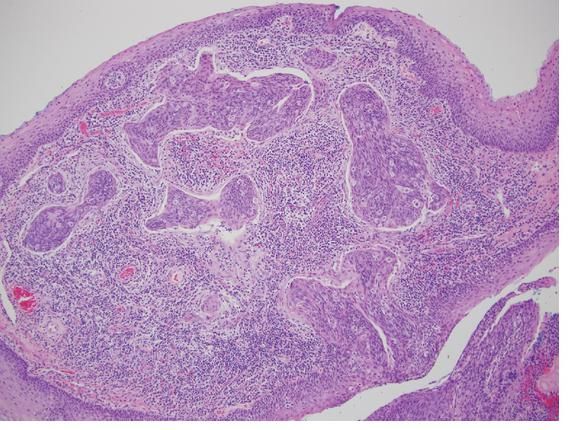
Image: PMC3139134, CC BY - Nodular sclerosis Hodgkin lymphoma
- Pleomorphic adenoma
- Invasive squamous cell carcinoma
- Reactive follicular hyperplasia of the tonsil
A 66-year-old man undergoes resection of a squamous cell carcinoma. A dual chromogenic immunostain of the specimen is shown, in which the nerve sheath marker labels brown and the epithelial (cytokeratin) marker labels red. Which prognostically adverse feature is demonstrated?
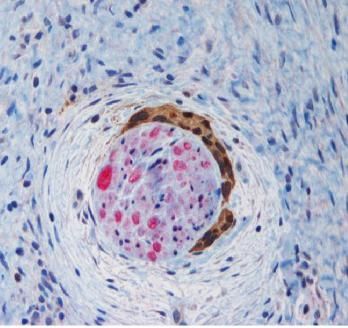
Image: PMC4312636, CC BY - Lymphovascular emboli
- Tumour budding at the invasive front
- Perineural invasion
- Extranodal extension of metastasis
A 62-year-old man with epigastric pain and weight loss undergoes biopsy of an infiltrative abdominal mass. The hematoxylin and eosin-stained section shows irregular, angulated malignant glands widely separated by abundant dense collagenous tissue. This stromal response to the tumour is best termed:
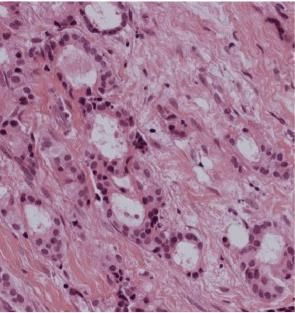
Image: PMC4444565, CC BY - Desmoplasia
- Granulation tissue formation
- Amyloid deposition
- Fibrous encapsulation of the tumour
A 55-year-old woman undergoes biopsy of a pelvic mass. A high-power hematoxylin and eosin-stained section of the lesion is shown. Which cytological feature seen here is the strongest indicator that this neoplasm is malignant?
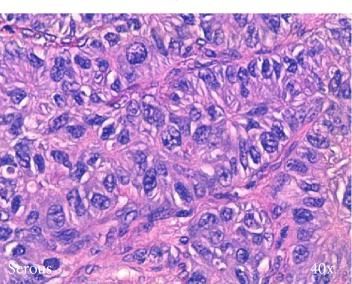
Image: PMC4486604, CC BY - Prominent single nucleoli within otherwise regular nuclei
- Marked nuclear pleomorphism with hyperchromasia and a high nuclear-to-cytoplasmic ratio
- Scattered mitotic figures without atypical forms
- Nuclear crowding and overlap without variation in nuclear size
Show answer
B. Marked nuclear pleomorphism with hyperchromasia and a high nuclear-to-cytoplasmic ratio
Think this answer is wrong? Report itA 66-year-old man who has smoked for 40 years has an ulcerated, indurated lesion. Biopsy stained with haematoxylin and eosin is shown: irregular infiltrating nests and islands of large polygonal cells with abundant eosinophilic cytoplasm, distinct cell borders and intercellular bridges, lying in a desmoplastic stroma. Which histological type of malignancy is shown?
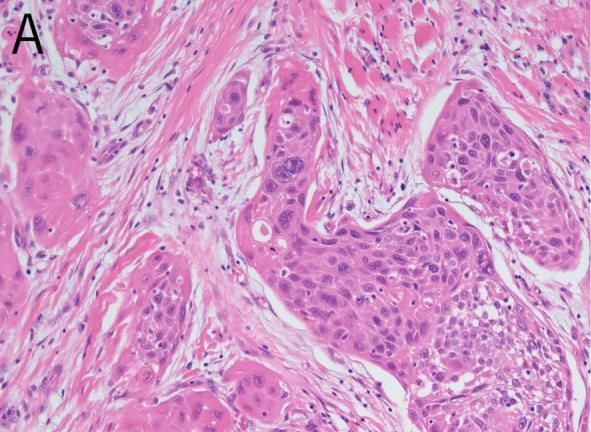
Image: PMC7049395, CC BY - Squamous cell carcinoma
- Adenocarcinoma
- Diffuse large B-cell lymphoma
- Small cell neuroendocrine carcinoma
A 52-year-old woman undergoes excision of a multiloculated cystic abdominal mass. A high-power hematoxylin and eosin section of the cyst wall is shown. Which description best fits the lining?
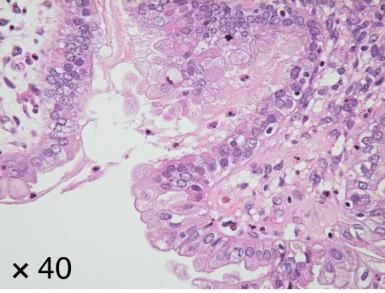
Image: PMC6120074, CC BY - Keratinizing stratified squamous epithelium
- Mucin-secreting columnar epithelium with papillary infolding and nuclear atypia
- A single flattened layer of mesothelium
- Pseudostratified ciliated columnar epithelium
Show answer
B. Mucin-secreting columnar epithelium with papillary infolding and nuclear atypia
Think this answer is wrong? Report itA 68-year-old man with prostatic adenocarcinoma undergoes pelvic lymph node dissection. A haematoxylin and eosin section of one node is shown, in which a sharply demarcated area of cohesive, pale epithelial cells forming small acini replaces part of the dense small-lymphocyte population. What does this demarcated area represent?
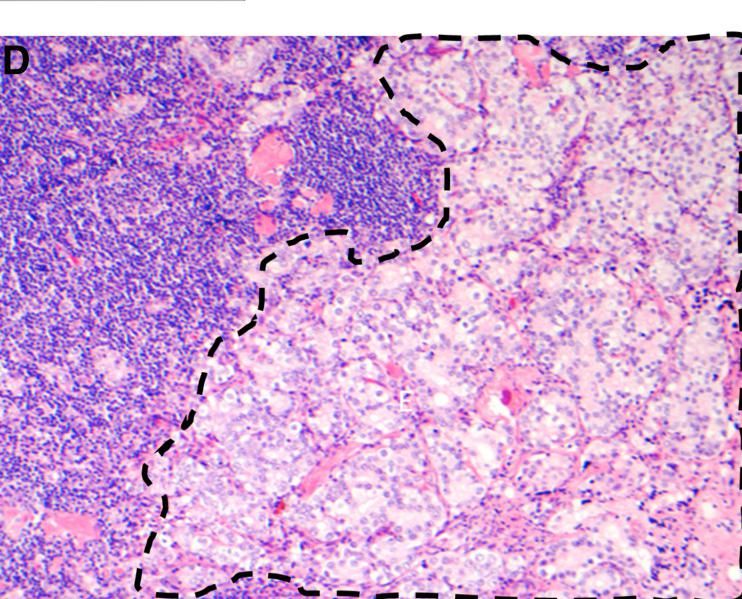
Image: PMC8679593, CC BY - A non-caseating epithelioid granuloma
- A reactive germinal centre
- A metastatic carcinoma deposit within the lymph node
- Nodular lymphocyte-predominant Hodgkin lymphoma
Show answer
C. A metastatic carcinoma deposit within the lymph node
Think this answer is wrong? Report it
Answer key
- B Anaplasia
- B Loss of differentiation
- A Choristoma
- C Change in size of cells
- A Induce organ dysfunction
- B Increased requirement for growth factors
- A Well differentiated
- D Hemangiosarcoma
- A Lipoma
- B Male gender
- C Striated muscle
- D Stage IV
- A Basal Cell Carcinoma
- D Cyclin d
- C Bronchiectasis
- A Lung cancer
- C Liver
- D Erythroplakia
- A Carcinoma in situ
- B Bronchogenic carcinoma
- B >4 cm
- A Hamartomatous developmental manifestation consisting of three different layers
- C Chronic ulcerative colitis
- D Pancreatic carcinoma
- C Paget's disease of bones
- A Alveolar rhabdomyosarcoma
- C Invasive squamous cell carcinoma
- C Perineural invasion
- A Desmoplasia
- B Marked nuclear pleomorphism with hyperchromasia and a high nuclear-to-cytoplasmic ratio
- A Squamous cell carcinoma
- B Mucin-secreting columnar epithelium with papillary infolding and nuclear atypia
- C A metastatic carcinoma deposit within the lymph node
About these questions
Previous year questions on Features and Epidemiology of Neoplasia for INI-CET (Institutes of National Importance Combined Entrance Test), from the Pathology section of the exam.
Most questions here come from previous-year papers of Indian postgraduate medical entrance and licensing exams; where a paper and year are recorded the question carries them. The image-based questions are original vignettes written around an openly licensed figure, and were never asked in any exam.
Pathology is worth about 15 of the 200 questions on the exam. See every subject’s weightage.
More in General Pathology
- Chemical Mediators and Granulomatous Inflammation
- Wound Healing and Tissue Repair
- Hemodynamic and Hemostatic Disorders
- Patterns of Inheritance
- Lysosomal and Glycogen Storage Disorders
- Chromosomal and Other Genetic Disorders
- Molecular Basis of Cancer and Tumour Immunity
- Carcinogenesis, Paraneoplastic Syndromes and Tumour Markers
- Cells and Organs of the Immune System
- Hypersensitivity Reactions and Autoimmune Disease
- Immunodeficiency Disorders
- Amyloidosis and Transplant Rejection