INI-CET · Pathology
Hemodynamic and Hemostatic Disorders PYQs
- 47 live questions in Hemodynamic and Hemostatic Disorders.
- 3 of 47 questions carry a recorded exam year: 2018.
- Question set last updated .
47 questions with answers
Virchows triad includes all except:-
- Endothelial injury
- Stasis of blood flow
- Hypercoagulability
- Platelet thrombus
Heart failure cells are -
- Lipofuscin granules in cardiac cells
- Pigmented alveolar macrophages
- Pigmented pancreatic acinar cells
- Pigment cells seen in liver
Factor V mutation is commonly associated with:-
- Hemarthrosis
- Hematemesis
- Thrombosis
- Epistaxis
Pale infarct is seen in all except:
- Lungs
- Spleen
- Kidney
- Heart
Thrombosis is initiated by
- platelet activation
- endothelial damage
- Coagulation cascade
- vasoconstriction of vessels
IN activated protein C resistant disorder due to inactivation ?
- factor 8
- factor 5
- factor 13
- factor 4
Initiating event of Endotoxic shock
- Endothelial injury
- Peripheral vasodilatation
- Cytokine action
- Decreased pumping of heart
Oedema occurs when plasma protein level is below
- 8 g/dl
- 2 g/dl
- 5 g/dl
- 10 g/dl
Who coined the term "Embolus" ?
- Mayo
- Allen
- Kocher
- Virchow
The pale infarct is seen in all except
- Spleen
- Kidney
- Lung
- Heart
Which of the following is not associated with haemorrhage?
- Ecchymosis
- Petechiae
- Melanosis
- Purpura
Transudate is characterized by:
- Associated inflammatory conditions
- Low protein content
- Tendency to clot
- Specific gravity of above 1.018
Which is responsible for adhesion of platelet on exposed collagen fibril after an injury
- Von willebrand factor
- Factor 8
- Factor 9
- Fibronectin
Difference in transudate & exudate is that the former has a:
- Low protein
- Cloudy appearance
- Increased specific gravity
- High protein
Primary causes of non-inflammatory edema include all of the following except:
- Increased intravascular pressure
- Decreased vascular permeability
- Obstruction of lymphatics
- Reduced plasma colloid oncotic pressure
A 20-year-old man is brought to the emergency room after rupturing his spleen in a motorcycle accident. His blood pressure on admission is 80/60 mm Hg. Analysis of arterial blood gasses demonstrates metabolic acidosis. This patient is most likely suffering from which of the following conditions?
- Acute pancreatitis
- Cardiogenic shock
- Hypersplenism
- Hypovolemic shock
Endotoxin shock is initiated by -
- Endothelial injury
- Peripheral vasodilation
- Increased vascular permeability
- Cytokines action
A patient with right heart failure secondary to tricuspid regurgitation is found to have increased liver enzymes. USG shows enlargement of the liver. If the patient is developing 'nutmeg liver', what can be the etiology?
- CVC
- Infarction of liver
- Amyloidosis
- Budd chiari syndrome
nutmeg liver is seen in
- Right sided heart failure
- Left sided heart failure
- Increase pulmonary pressure
- Decreased pulmonary pressure
A patient with respiratory symptoms undergoes bronchoalveolar lavage. Which of the following findings would be MOST suggestive that congestive heart failure is the cause of the symptoms?
- Ciliated bronchial epithelial cells
- Encapsulated pairs of small cocci
- Hemosiderin-laden macrophages
- Rhomboid-shaped crystals
Which plasma protein is necessary for adhesion of platelets to subendothelial fibres?
- Glycoprotein IIb
- Von Willebrand factor
- Platelet factor 3
- Factor X
Inhibition of platelet aggregation by -
- ADP
- Thromboxane A2
- Thrombin
- Bradykinin
Increased blood volume in a tissue resulting from arteriolar dilatation (an active process) is known as -
- Hyperemia
- Edema
- Congestion
- Purpura
Nutmeg liver occurs in
- Jaundice
- Chronic venous congestion
- Cirrhosis
- Hepatocellular carcinoma
All predispose to thrombosis except -
- Homocystinuria
- PNH
- Polycythemia
- Hypomagnesemia
Platelet adhesion to collagen occurs via:
- Factor VIII
- Factor IX
- von Willebrand factor
- Fibronectin
Partial or complete obstruction of some part of the C.V.S by a foreign body transported by the blood stream is termed as:
- Thrombosis
- Coagulation
- Ischaemia
- Embolism
vWF is useful in:
- Platelet adhesion
- Platelet aggregation
- Clot formation
- Fibrinolysis
Following are the various causes of edema except:
- Increase in hydrostatic pressure
- Decreased colloid osmotic pressure
- Due to lymphatic obstruction
- Decrease in intravascular pressure
Platelet Dense granules contain all except -
- ADP
- 5-HT
- Calcium
- vWF
Which of the following is responsible for adhesion of platelets to the vessel wall?
- Factor IX
- Von Willebrand factor
- Fibrinogen
- Fibronectin
Venous congestion of liver affects ?
- Midzone
- Perihepatic zone
- Centrilobular zone
- All the above
The type of embolism seen in fractures of long bones:
- Thrombo embolism
- Air embolism
- Fat embolism
- Amniotic fluid embolism
A 22-year-old woman with an uncomplicated pregnancy develops sudden dyspnea with cyanosis and hypotension intrapartum during routine vaginal delivery of a term infant. She has a generalized seizure and becomes comatose. Her condition does not improve over the next 2 days. Which of the following findings is most likely to be present in her peripheral pulmonary arteries?
- Aggregates of platelets
- Amniotic fluid
- Fat globules
- Gas bubbles
Heart failure cells are found in -
- Myocardium
- Lungs
- Liver
- Spleen
Dependent oedema is seen in:
- Cirrhosis.
- Malnutrition.
- Nephrotic syndrome.
- CCF
A 15-year-old girl incurs a cut to the sole of her foot after stepping on a piece of broken glass. On examination, a superficial 0.5-cm laceration ceases to bleed within 5 minutes after application of local pressure. Which of the following substances is released by endothelium and is most likely to counteract platelet aggregation near this site of injury?
- Glycoprotein IIb/IIIa
- Platelet-activating factor
- Prostacyclin
- Tissue-type plasminogen activator
Nutmeg liver seen in ?
- Alcoholic liver disease
- Chronic venous congestion
- Hepatoma
- Secondary carcinoma deposits in liver
Virchow's triad includes all ,except:
- Injury to vein
- Venous thrombosis
- Venous stasis
- Hypercoagulability of blood
A 36-year-old man dies during cardiac surgery. He had a history of long-standing rheumatic heart disease with mitral stenosis. At autopsy, the pathologist reports findings consistent with mitral stenosis and noted the presence of "heart failure cells." This finding results from
- activation of the coagulation cascade.
- chronic passive congestion of the lungs.
- hypoxic myocardial injury.
- myocardial hyperemia.
Heart failure cells are found in -
- Myocardium
- Lungs
- Liver
- Spleen
All are true about arterial thrombosis except?
- Retrograde growth
- Line of Zahn
- Complete lumen obstruction
- White thrombus
Sudden death, right sided heart failure (cor pulmonale) or cardiovascular collapse occur when
- Small pulmonary embolism
- Massive pulmonary embolism
- 60% or more of pulmonary artery is obstructed with emboli
- End artery obliteration
Show answer
C. 60% or more of pulmonary artery is obstructed with emboli
Think this answer is wrong? Report itLines of Zahn occur in -
- Postmortem clot
- Infarct
- Embolus
- Coralline thrombus
In a thrombus, the dark lines of zahn are due to
- Coagulated fibrin
- Aggregated proteins
- Aggregated platelets
- Aggregated R.B.C
Procoagulant factors produced by endothelial cells include:
- Thrombomodulin
- Prostacyclin
- Von Willebrand factor
- Thromboxane A2
A 34-year-old man with sickle cell disease develops sudden severe left upper quadrant pain. A contrast-enhanced CT of the abdomen is shown, with the arrow indicating the abnormality. Which pathological process is illustrated?
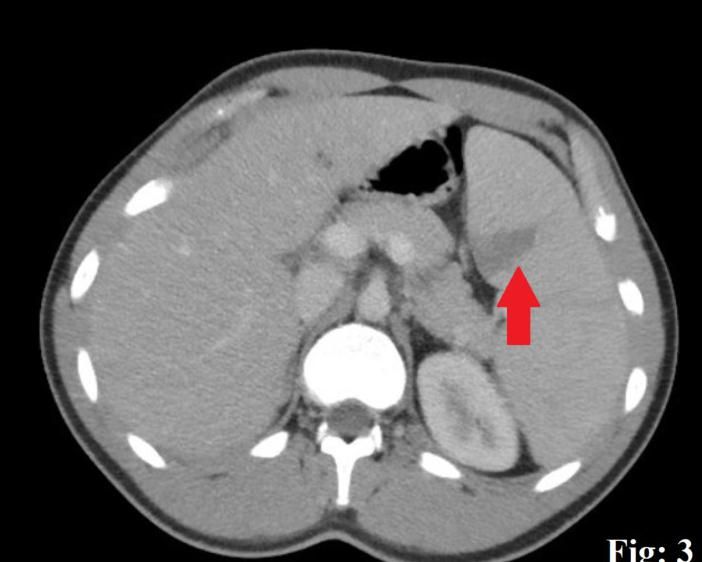
Image: PMC7029827, CC BY - Splenic haemangioma
- Splenic rupture with subcapsular haematoma
- Splenic abscess
- Splenic infarction
Answer key
- D Platelet thrombus
- B Pigmented alveolar macrophages
- C Thrombosis
- A Lungs
- B endothelial damage
- B factor 5
- C Cytokine action
- C 5 g/dl
- D Virchow
- C Lung
- C Melanosis
- B Low protein content
- A Von willebrand factor
- A Low protein
- B Decreased vascular permeability
- D Hypovolemic shock
- D Cytokines action
- A CVC
- A Right sided heart failure
- C Hemosiderin-laden macrophages
- B Von Willebrand factor
- D Bradykinin
- A Hyperemia
- B Chronic venous congestion
- D Hypomagnesemia
- C von Willebrand factor
- D Embolism
- A Platelet adhesion
- D Decrease in intravascular pressure
- D vWF
- B Von Willebrand factor
- C Centrilobular zone
- C Fat embolism
- B Amniotic fluid
- B Lungs
- D CCF
- C Prostacyclin
- B Chronic venous congestion
- B Venous thrombosis
- B chronic passive congestion of the lungs
- B Lungs
- C Complete lumen obstruction
- C 60% or more of pulmonary artery is obstructed with emboli
- D Coralline thrombus
- D Aggregated R.B.C
- C Von Willebrand factor
- D Splenic infarction
About these questions
Previous year questions on Hemodynamic and Hemostatic Disorders for INI-CET (Institutes of National Importance Combined Entrance Test), from the Pathology section of the exam.
Most questions here come from previous-year papers of Indian postgraduate medical entrance and licensing exams; where a paper and year are recorded the question carries them. The image-based questions are original vignettes written around an openly licensed figure, and were never asked in any exam.
Pathology is worth about 15 of the 200 questions on the exam. See every subject’s weightage.
More in General Pathology
- Cell Genetics, Adaptation and Cell Injury
- Necrosis and Apoptosis
- Intracellular Accumulations, Pathological Calcification and Cell Ageing
- The Acute Inflammatory Response
- Chemical Mediators and Granulomatous Inflammation
- Wound Healing and Tissue Repair
- Patterns of Inheritance
- Lysosomal and Glycogen Storage Disorders
- Chromosomal and Other Genetic Disorders
- Features and Epidemiology of Neoplasia
- Molecular Basis of Cancer and Tumour Immunity
- Carcinogenesis, Paraneoplastic Syndromes and Tumour Markers