INI-CET · Pathology
Wound Healing and Tissue Repair PYQs
- 16 live questions in Wound Healing and Tissue Repair.
- 3 of 16 questions carry a recorded exam year: 2018.
- Question set last updated .
16 questions with answers
Secondary healing mechanism is?
- Granuloma formation
- Scab formation
- Granulation tissue
- Neovascularization
Cell that can form the maximum number of other cells in the body is called?
- Totipotent
- Multipotent
- Pluripotent
- Lineage stem cells
Which of the following type of collagen is present in healing and granulation tissue?
- Type I
- Type II
- Type III
- Type IV
The typical appearance of 'Granulation tissue' is due to
- Thrombosed capillaries
- Budding ends of capillaries
- Densely packed collagen
- Chronic inflammatory cells
Which is not the action of TGF?
- Anti-inflammatory
- Proliferation of fibrous tissue
- Inhibition of metalloproteinases
- Anaphylaxis
The hormone having the maximum effect on granulation wound healing is:
- Thyroxine
- Cortisone
- Parathormone
- Epinephrine
Platelet derived growth factor is released in vessels from:
- Endothelial cells
- Fibroblasts
- Macrophages
- Alpha granules
For wound healing which mineral is helpful?
- Calcium
- Selenium
- Magnesium
- Copper
Half-life of TGF -B (beta) is
- 24 hrs
- 48 hrs
- 10-12 min
- 3-5 min
Ability of stem cells to cross barrier of differentiation to transform into a cell of another lineage expressing the molecular characteristics of different cell type with the ability to perform the function of the new cell type is referred as
- Trans-differentiation
- Re differentiation
- De differentiation
- Sub differentiation
Matrix metalloproteinases is ?
- Cathepsin
- Zn metalloproteinases
- Cu metalloproteinases
- Cd metalloproteinases
Stem cells are?
- Labile
- Stable
- Permanent
Which of the following helps in cell to cell adhesion?
- Interleukins
- Interferons
- E-Cadherin
- Matrix metallo proteinase
Neovascularization is maximum on:
- 3rd day
- 5th day
- 7th day
- 10th day
Fibroblast is derived from -
- Local mesenchyme
- Macrophage
- Endothelium
- Vessels
A 45-year-old man has persistent bloody diarrhoea, and colonoscopy shows a friable ulcerated area. A haematoxylin and eosin section of the biopsy is shown, in which the lamina propria is replaced by numerous small newly formed capillaries with plump endothelial cells set among a dense infiltrate of lymphocytes and plasma cells. The tissue shown is best described as which of the following?
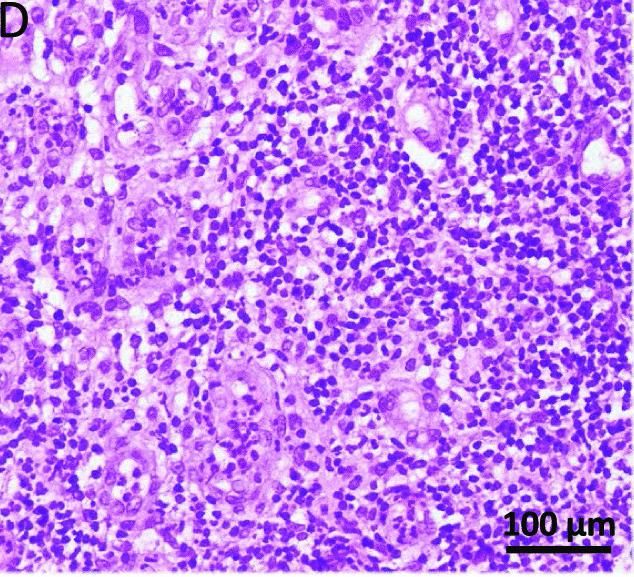
Image: PMC8390036, CC BY - Caseating granuloma
- Amyloid deposition
- High-grade epithelial dysplasia
- Granulation tissue
Answer key
About these questions
Previous year questions on Wound Healing and Tissue Repair for INI-CET (Institutes of National Importance Combined Entrance Test), from the Pathology section of the exam.
Most questions here come from previous-year papers of Indian postgraduate medical entrance and licensing exams; where a paper and year are recorded the question carries them. The image-based questions are original vignettes written around an openly licensed figure, and were never asked in any exam.
Pathology is worth about 15 of the 200 questions on the exam. See every subject’s weightage.
More in General Pathology
- Histopathology Techniques and Special Stains
- Cell Genetics, Adaptation and Cell Injury
- Necrosis and Apoptosis
- Intracellular Accumulations, Pathological Calcification and Cell Ageing
- The Acute Inflammatory Response
- Chemical Mediators and Granulomatous Inflammation
- Hemodynamic and Hemostatic Disorders
- Patterns of Inheritance
- Lysosomal and Glycogen Storage Disorders
- Chromosomal and Other Genetic Disorders
- Features and Epidemiology of Neoplasia
- Molecular Basis of Cancer and Tumour Immunity