NEET PG · Pathology
CNS Infections and Cerebrovascular Disease PYQs
- 13 live questions in CNS Infections and Cerebrovascular Disease.
- Question set last updated .
13 questions with answers
"Intranuclear inclusions" in oligodendrocytes are seen in
- Creutzfeldt Jacob disease
- Polio
- Japanese encephalitis
- Progressive multifocal leukoencephalopathy
All of the following are causes of vasogenic type of cerebral edema except
- Tumours
- Trauma
- Infections
- Hydrocephalus
Which of the following is most common location of intracranial neurocysticercoses:
- Brain parenchyma
- Spinal cord.
- Basal cisternae.
- Medulla oblongata.
Neurologic abnormalities have been noted in about one-third of patients with AIDS. Which of the following is NOT seen in HIV involvement of CNS?
- Perivascular giant cell
- Vacuolar degeneration of post column
- Microglial nodule formation
- Inclusion bodies
Perivascular lymphocytic and microglial nodules are seen in
- Multiple sclerosis
- HIV encephalitis
- Bacterial meningitis
- CMV encephalitis
Most common site of berry's aneury sm is-
- Vertebral artery
- Basilar artery
- Junction of anterior cerebral artery and anterior communicating artery
- Posterior cerebral artery
Show answer
C. Junction of anterior cerebral artery and anterior communicating artery
Think this answer is wrong? Report itPseudolaminar necrosis is a feature of -
- Cerebral infarct
- Renal infarct
- Hepatic infarct
- Cardiac infarct
A 15-year-old boy is rushed to the emergency room after suffering a tonic-clonic seizure 4 weeks after a spelunking expedition. The boy appears irritable and agitated, and his parents state that he has difficulty swallowing fluids. Lumbar puncture shows numerous lymphocytes. The patient becomes delirious, slips into a coma, and expires. At autopsy, the brain stem shows infiltrates of lymphocytes around small blood vessels and evidence of neuronophagia. Some neurons contain eosinophilic inclusions. What is the proper name for these neuronal inclusions?
- Councilman bodies
- Hirano bodies
- Lewy bodies
- Negri bodies
Complex granular corpuscles are produced by -
- Oligodendrocytes
- Astrocytes
- Microglia
- Vascular endothelium
All are true about pyogenic meningitis except ?
- Increased CSF protein
- Pleocytosis
- Markedly decreased CSF glucose
- Decreased CSF C- reactive protein
A 12-year-old boy develops fever, accompanied by occasional headaches, malaise, fatigue, and nausea a month after being bitten by a dog. One day later, he experiences episodes of rigidity, hallucinations, breath-holding, and difficulty swallowing because of uncontrollable oral secretions. Dr. Louis Pasteur is consulted. He writes: "The death of this child appearing to be inevitable, I decided, not without lively and sore anxiety, as may well be believed, to try ....... the method which I had found constantly successful with dogs. Consequently, 60 hours after the bites was inoculated under a fold of skin with half a syringeful of the spinal cord of a rabbit. In the following days, fresh inoculations were made. I thus made 13 inoculations." The boy survives. Which of the following histologic findings in the brain of the dog is most likely to be present?
- Multinucleate giant cells
- Negri bodies
- Perivascular lymphocytes
- Pseudocysts with bradyzoites
A 30-year-old man is admitted with high fever, severe headache, photophobia and neck rigidity, and dies within 48 hours. The gross appearance of the brain at autopsy is shown. What is the most likely diagnosis?
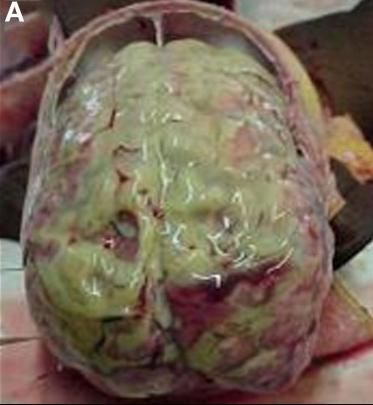
Image: PMC4139913, CC BY - Glioblastoma with mass effect
- Acute pyogenic leptomeningitis
- Extensive middle cerebral artery territory infarction
- Subarachnoid haemorrhage from a ruptured berry aneurysm
A 32-year-old man with new-onset seizures has a cystic lesion excised. The haematoxylin and eosin stained section is shown at low power, displaying a folded, undulating, cuticular membrane with a delicate microvillous surface enclosing a loose parenchymal core, without any host epithelial lining. What is the most likely organism?
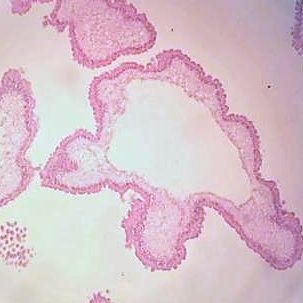
Image: PMC7124892, CC BY - Echinococcus granulosus
- Toxoplasma gondii
- Taenia solium larva
- Entamoeba histolytica
Answer key
- D Progressive multifocal leukoencephalopathy
- D Hydrocephalus
- A Brain parenchyma
- D Inclusion bodies
- B HIV encephalitis
- C Junction of anterior cerebral artery and anterior communicating artery
- A Cerebral infarct
- D Negri bodies
- C Microglia
- D Decreased CSF C- reactive protein
- B Negri bodies
- B Acute pyogenic leptomeningitis
- C Taenia solium larva
About these questions
Previous year questions on CNS Infections and Cerebrovascular Disease for NEET PG (National Eligibility cum Entrance Test - Postgraduate), from the Pathology section of the exam.
Most questions here come from previous-year papers of Indian postgraduate medical entrance and licensing exams; where a paper and year are recorded the question carries them. The image-based questions are original vignettes written around an openly licensed figure, and were never asked in any exam.
Pathology is worth about 17 of the 200 questions on the exam. See every subject’s weightage.
More in Pathology
- Thyroid Gland Pathology
- Adrenal Gland Pathology
- Breast Pathology
- Bone: Developmental Disorders, Infections and Tumours
- Joint and Soft Tissue Pathology
- Dermatopathology
- Degenerative, Toxic and Metabolic CNS Disease
- Tumours of the CNS
- Peripheral Nerve and Neuromuscular Pathology
- Cell Genetics, Adaptation and Cell Injury
- Necrosis and Apoptosis
- Intracellular Accumulations, Pathological Calcification and Cell Ageing