NEET PG · Pathology
Tumours of the CNS PYQs
- 38 live questions in Tumours of the CNS.
- 4 of 38 questions carry a recorded exam year: 2017, 2018, 2019.
- Question set last updated .
38 questions with answers
Most common primary for brain metastasis is which of the following?
- Lung cancer
- Head and neck cancer
- Prostate cancer
- Breast cancer
Tumor arises from embryonic neural cells?
- Fibrous astrocytoma
- Neuroglioma
- Ependymoma
- Medulloblastoma
Most common site of intracranial metastasis is from primary carcinoma of
- Breast
- Lungs
- Stomach
- Testes
Tumour arising from Rathke's pouch is
- Meningioma
- Glioma
- Craniopharyngioma
- Ependymoma
In children which of the following virus has been implicated in the pathogenesis of choroid plexus tumour?
- Simian virus 40
- HIV
- Herpes simplex
- Hepatitis B
All of the following are features of pilocytic astrocytoma Except
- Rosenthal fibres
- Eosinophilic granular bodies
- Microcalcifications
- Hair like projections
The most common site of brain metastasis is
- Cerebrum
- Cerebellum
- Medulla oblongata
- Pons
Which of the following is the most common tumour associated with neurofibromatosis in a child?
- Juvenile myelomonocytic leukemia
- Acute lymphoblastic leukemia
- Acute monocytic leukemia
- Acute myeloid leukemia
Highly vascular tumor of brain and spinal cord in adults:
- Metastasis
- Pilocytic astrocytoma
- Hemangioblastoma
- Cavernous malformation
Most common cause of Carcinomatous meningitis -
- Carcinoma breast
- Carcinoma lung
- Carcinoma gut
- Malignant melanoma
The most common physical sign of cerebral metastasis
- Epilepsy
- Focal neurological deficit
- Papilloedema
- Visual defects
Which of the following statement about astrocytoma is false -
- Low grade tumors are more common in children
- These are mostly infratentorial in children
- Pilocytic astrocytoma is most common childhood brain tumor
- These are much more common in females than males
A 47-year-old female complains of headache, changes in vision and seizures for the past 2 years. She has now developed weakness of the right side of the body. A CT scan ordered by the physician shows a well-circumscribed mass abutting the skull in the left hemisphere. Contrast-enhanced MRI shows a homogeneously enhancing, dural-based extra-axial mass with a dural tail. What is the next step in management of this patient?
- Surgical excision
- Chemotherapy with Adriamycin
- Cerebral angiography with tumor embolization
- Preoperative radiation therapy followed by surgical excision
Which of the following is the most common type of Glial tumors ?
- Astrocytomas
- Medulloblastomas
- Neurofibromas
- Ependymomas
In children, most common posterior fossa tumour is-
- Meningiomas
- Astrocytoma
- Medulloblastoma
- Glioblastoma multiforme
Neurofibromatosis I is most commonly associated with
- Brain stem gliomas
- Optic pathway glioma
- Sub ependymal pilocytic astrocytoma
- Glioblastoma multiforme
Which of the following statements about Von-Hippel Lindau syndrome is true
- Multiple tumors are rarely seen
- craniospinal hemangioblastomas are common
- Supratentorial lesions are common
- Tumors of Schwann cells are common
Schwannoma of spinal nerve roots is seen in?
- Neurofibromatosis 1
- Neurofibromatosis 2
- Turcot syndrome
- Li - Fraumeni syndrome
Von Hippel Lindau is associated with all except
- Endo lymphatic sac tumors
- Hemangioendotheliomas
- Pheochromocytoma
- Islet cell tumors
Which of the following brain tumors does not spread via CSF -
- Germ cell tumors
- Medulloblastoma
- CNS lymphoma
- Craniopharyngioma
Child with infratentorial tumour with spinal seedling is
- Medulloblastoma
- Meningioma
- Astrocytoma
- Glioblastoma
All of the following hereditary conditions predispose to CNS tumors, except -
- Neurofibromatosis 1 & 2
- Tuberous sclerosis
- Von-Hippel-Lindau syndrome
- Xeroderma pigmentosum
True about gliomas -
- Metastasize commonly to liver
- Glioma multiforme is slow growing tumour
- Supratentorial
- Classified based on gross appearance
In children most common posterior fossa tumour is:
- Meningiomas
- Astrocytoma
- Medulloblastoma
- Glioblastoma multiforme
Most common site of glioblastoma multiforme is -
- CP angle
- Frontal lobe
- Brain stem
- Occipital lobe
Rosenthal fibres are -
- Intranuclear inclusions
- Intracytoplasmic inclusions
- Present extracellularly
- Part of cell membrane
A 10-year-old girl develops ataxia and hydrocephalus. CT scan shows a midline cerebellar mass. Which of the following is the most likely diagnosis
- Meningioma
- Medulloblastoma
- Neurofibroma
- Astrocytoma
Most common glial tumor -
- Ependymomas
- Astrocytoma
- Meningioma
- Neurofibroma
A 40 year old lady is diagnosed to have brain tumor in frontal lobe. The lesion is characterized by focal necrosis surrounded by ring like enhancement. The most likely diagnosis is:
- Glioblastoma multiforme
- Oligodendroglioma
- Ependymoma
- Astrocytoma
Cerebellar hemangioblastoma and retinal tumors are seen in:
- Von Hippel Lindau syndrome
- Neurofibromatosis type 1
- Tuberous sclerosis
- Neurofibromatosis type 2
Which of the following tumors is associated with drop metastasis?
- Astrocytoma
- Ependymoma
- Medulloblastoma
- Oligodendroglioma
A 50-year-old woman presents with a 5-year history of headaches, generalized tonic-clonic seizures, and bilateral leg weakness. Skull films reveal hyperostosis of the calvarium. Biopsy of the responsible lesion shows a whorling pattern of the cells. Which of the following is the most likely diagnosis?
- Arachnoid cyst
- Glioblastoma multiforme
- Meningioma
- Metastatic breast cancer
Rosenthal fibers are -
- Intranuclear inclusions
- intracytoplasmic inclusions
- Present extracellularly
- Part of cell membrane
Rosenthal fibres in pilocytic astrocytoma characteristically contain which of the following, along with ubiquitin?
- Heat shock proteins (alpha-B crystallin and HSP27)
- Neurofilament proteins
- Tau protein
- Globulins
Show answer
A. Heat shock proteins (alpha-B crystallin and HSP27)
Think this answer is wrong? Report itWhich of the following is not true about Glioblastoma..
- Also known as Butterfly tumor
- Frontal lobe of the brain is common location
- It belongs to WHO grade 3 Astrocytoma
- Serpentine necrosis and glomeruloid bodies
A 16-year-old boy with no prior medical problems has complained of headaches for the past 9 months. There are no abnormal findings on physical examination. CT scan of the head shows an enlargement of the lateral cerebral ventricles and third ventricle. A lumbar puncture is performed with normal opening pressure, and clear CSF is obtained, which has a slightly elevated protein, normal glucose, and no leukocytes. Which of the following intracranial lesions is most likely to cause these findings?
- Aqueductal stenosis
- Cerebral abscess
- Cryptococcal meningitis
- Ependymoma
Histologic sections from a mass originating from the meninges would most likely reveal
- Antoni A areas and rare Verocay bodies
- A whorled pattern and rare psammoma bodies
- Endothelial proliferation and serpentine areas of necrosis
- "Fried-egg" appearance of tumor cells
A 46-year-old man presents with headache and bitemporal hemianopia. Imaging shows a partly cystic suprasellar mass, which is resected. The haematoxylin and eosin stained section, viewed at high power, shows nests and papillary fronds of well-formed squamous epithelium supported by fibrovascular cores, without mitotic activity or necrosis. What is the most likely diagnosis?
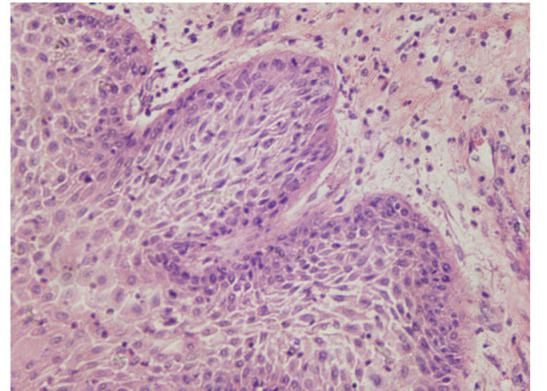
Image: PMC4246612, CC BY - Rathke cleft cyst
- Craniopharyngioma
- Pituitary adenoma
- Germinoma
Answer key
- A Lung cancer
- D Medulloblastoma
- B Lungs
- C Craniopharyngioma
- A Simian virus 40
- C Microcalcifications
- A Cerebrum
- A Juvenile myelomonocytic leukemia
- C Hemangioblastoma
- A Carcinoma breast
- B Focal neurological deficit
- D These are much more common in females than males
- A Surgical excision
- A Astrocytomas
- B Astrocytoma
- B Optic pathway glioma
- B craniospinal hemangioblastomas are common
- B Neurofibromatosis 2
- B Hemangioendotheliomas
- D Craniopharyngioma
- A Medulloblastoma
- D Xeroderma pigmentosum
- C Supratentorial
- B Astrocytoma
- B Frontal lobe
- B Intracytoplasmic inclusions
- B Medulloblastoma
- B Astrocytoma
- A Glioblastoma multiforme
- A Von Hippel Lindau syndrome
- C Medulloblastoma
- C Meningioma
- B intracytoplasmic inclusions
- A Heat shock proteins (alpha-B crystallin and HSP27)
- C It belongs to WHO grade 3 Astrocytoma
- D Ependymoma
- B A whorled pattern and rare psammoma bodies
- B Craniopharyngioma
About these questions
Previous year questions on Tumours of the CNS for NEET PG (National Eligibility cum Entrance Test - Postgraduate), from the Pathology section of the exam.
Most questions here come from previous-year papers of Indian postgraduate medical entrance and licensing exams; where a paper and year are recorded the question carries them. The image-based questions are original vignettes written around an openly licensed figure, and were never asked in any exam.
Pathology is worth about 17 of the 200 questions on the exam. See every subject’s weightage.
More in Pathology
- Breast Pathology
- Bone: Developmental Disorders, Infections and Tumours
- Joint and Soft Tissue Pathology
- Dermatopathology
- CNS Infections and Cerebrovascular Disease
- Degenerative, Toxic and Metabolic CNS Disease
- Peripheral Nerve and Neuromuscular Pathology
- Cell Genetics, Adaptation and Cell Injury
- Necrosis and Apoptosis
- Intracellular Accumulations, Pathological Calcification and Cell Ageing
- The Acute Inflammatory Response
- Chemical Mediators and Granulomatous Inflammation