NEET PG · Pathology
Breast Pathology PYQs
- 41 live questions in Breast Pathology.
- 3 of 41 questions carry a recorded exam year: 2017, 2018, 2020.
- Question set last updated .
41 questions with answers
A middle aged female presented with a 4cm mass in upper outer quadrant of the breast. Biopsy showed densely packed cells within large lakes of mucin. Which of the following is the most likely diagnosis of this patient?
- Medullary carcinoma of breast
- Colloid carcinoma of breast
- Tubular carcinoma of breast
- Papillary carcinoma of breast
E- cadherin mutation is seen in which type of carcinoma:
- IDC
- Lobular carcinoma
- Metaplastic carcinoma
- Metastasis
Which of the following shows breast necrosis and calcification?
- Comedo sub type of DCIS
- Cribriform sub type of DCIS
- Colloid carcinoma
- Lobular carcinoma in situ
In which of the following types of Carcinoma Breast, Comedo growth pattern is seen?
- Ductal carcinoma in situ
- Medullary carcinoma
- Lobular carcinoma in situ
- Infiltrating lobular carcinoma
Signet-ring cells are found in which type of breast cancer
- Papillary carcinoma
- Tubular carcinoma
- Invasive ductal carcinoma
- Invasive lobular carcinoma
35 yr old lady presents with a lump in the upper outer quadrant of breast Histopathology shows cells in pools of mucin and faint nuclei
- Adenocarcinoma
- colloidal carcinoma
- Medullary carcinoma
- Lobular carcinoma
All are characteristics of a breast papilloma except
- Myoepithelial cells present
- Apocrine metaplasia is seen
- Hyperplasia of adjacent ducts
- Regular polarized gland pattern
Her-2 neu receptor is used in breast carcinoma for
- Screening of the breast carcinoma
- Diagnosis of cancer
- Predicting response to treatment
- Detect recurrence
A 24-year-old woman is breastfeeding 3 weeks after giving birth to a normal term infant. She notices fissures in the skin around her left nipple. Over the next 3 days, a 5-cm region near the nipple becomes erythematous and tender. Purulent exudate from a small abscess drains through a fissure. Which of the following organisms is most likely to be cultured from the exudate?
- Candida albicans
- Lactobacillus acidophilus
- Listeria monocytogenes
- Staphylococcus aureus
A 55-year-old female presents to the surgeon with breast symptoms. Her right breast is swollen, red and tender. The physician palpates a firm area in the breast and suspects inflammatory breast cancer. Which of the following best describes the histological changes observed in this disorder?
- Acute inflammation in breast carcinoma
- Chronic inflammation in breast carcinoma
- Dermal lymphatic invasion by cancer cells
- Epidermal invasion by cancer cells
The type of mammary ductal carcinoma in situ (DCIS) most likely to result in a palpable abnormality in the breast is:
- Apocrine DCIS
- Neuroendocrine DCIS
- Well differentiated DCIS
- Comedo DCIS
A 50-year-old woman has a lumpectomy following mammographic discovery of a carcinoma of the breast. Which of the following is a well-known characteristic or association of breast cancer?
- Low-fat diet
- Positive family history
- Excessive thinness
- Multiparity
Breast CA with best prognosis
- Mucinous
- Medullary
- Invasive ductal
- Lobular Ca
AKT1 E17K somatic mutation is associated with
- Gastric carcinoma
- Breast carcinoma
- Ovarian carcinoma
- Pancreatic carcinoma
A 13-year-old male presents with bilateral enlargement of his breasts. Physical exam is otherwise unremarkable, and the breast enlargement is thought to be a normal variation at puberty. Histologic sections of breast tissue would most likely reveal
- Proliferation of ducts in hyalinized fibrous tissue with periductal edema
- Atrophic ductal structures with increased numbers of lipocytes
- Dilated ducts filled with granular, necrotic, acidophilic debris
- Granulomatous inflammation surrounding ducts with numerous plasma cells
Show answer
A. Proliferation of ducts in hyalinized fibrous tissue with periductal edema
Think this answer is wrong? Report itWhich of the following breast lesions is considered to have the greatest potential for eventual progression to a malignant lesion?
- Apocrine metaplasia
- Blue dome cyst
- Epithelial hyperplasia
- Fat necrosis
Somatic mutation E17K in the PH domain of AKT-1 gene mutation is associated with?
- Stomach
- Breast
- Ovary
- Pancreas
True about histology in infilterating lobular breast carcinoma-
- Single file pattern
- Pleomorphic cells in sheets
- Cribriform pattern
- Pin wheel pattern
Arrange the following in increasing order for risk of malignancy 1. Fibroadenoma 2. Sclerosing adenosis 3. Atypical ductal hyperplasia 4. Lobular carcinoma in situ
- 2, 1, 3, 4
- 1, 2, 3, 4
- 1, 2, 4, 3
- 2, 1, 4, 3
All are benign conditions except -
- Fibroadenoma
- Cystosarcoma phyllodes
- Pagets disease of nipple
- Galactocele
The most specific immunohistochemical marker to rule out invasive ductal carcinoma would be?
- Ki-67
- p 63
- Desmin
- HER 2 / neu
Cystosarcoma phylloides is tumor of
- Breast
- Liver
- Colon
- Uterus
Which of the following is NOT true about the gene mutations leading to breast carcinoma?
- Most common mutation in inherited breast carcinoma is BRCA 1
- BRCA 1 mutation is present in most of the cases of breast carcinoma
- Inherited breast carcinomas make about 5-10 % of the total cases
- p53 mutation also increases chances of colon and brain cancer
Show answer
B. BRCA 1 mutation is present in most of the cases of breast carcinoma
Think this answer is wrong? Report itPhyllodes tumor most commonly presents in ?
- 2nd decade
- 3rd decade
- 4th decade
- 6th decade
All of the following are invasive carcinoma of breast except - a) Comedo carcinoma b) Colloid carcinoma c) Lobular carcinoma in situ d) Medullary carcinoma
- a
- bc
- ad
- ac
Male breast cancer wrong statement-
- Brca2 seen in 6% cases
- Lobular carcinoma is common
- DUCTAL carcinoma is most common subtype
- Colloid carcinoma can be seen
Gynecomastia is not associated with which of the following?
- Use of Anabolic steroids
- A person with (45, XO) karyotype
- Alcoholic cirrhosis
- Antiretroviral therapy
BRCA 1 responsible which histological type breast cancer?
- Tubular carcinoma
- Colloid carcinoma
- Papillary carcinoma
- Medullary carcinoma
Proliferating breast mass is
- Duct ectasia
- Fibroadenoma
- Adenosis
- Papilloma
Which of the following mutations in a tumor suppressor agent causes breast carcinoma:-
- p 43
- p 53
- p 73
- p 83
Women carrying BRCA 1 gene are more likely to develop which type of breast carcinoma -
- Medullary
- Lobular
- Colloid
- Secretory
In which one of the following types of carcinoma of the breast, is a biopsy of the opposite breast advised ?
- Inflammatory carcinoma
- Medullary carcinoma
- Lobular carcinoma
- Scirrhous carcinoma
A 55-year-old man presents with a solitary breast mass and biopsy reveals malignant cells. Immunohistochemical staining show that the tumor cells are positive for estrogen receptor (ER) and negative for Her2/neu. What is the most likely diagnosis?
- Basal cell carcinoma
- Invasive ductal carcinoma
- Medullary carcinoma
- Tubular adenoma
Breast Ca is not a/w -
- BRCA 1 & BRCA 2
- Apocrine metaplasia
- Atypical ductal hyperplasia
- All
35-year-old woman following traumatic injury to right breast presents with a firm, round lump in right breast which is painless. Which statement is false regarding the condition she is having?
- Dystrophic calcification can be seen
- Liquefactive fat necrosis
- Multinucleate giant cells and lipid laden macrophages present
- Increased risk of breast cancer
A 66-year-old man presents with a firm subareolar breast lump. The left panel of the figure shows the haematoxylin and eosin section of the biopsy; the right panels show immunohistochemistry performed on the same lesion. Based on the appearance of the haematoxylin and eosin section, which is the most likely diagnosis?
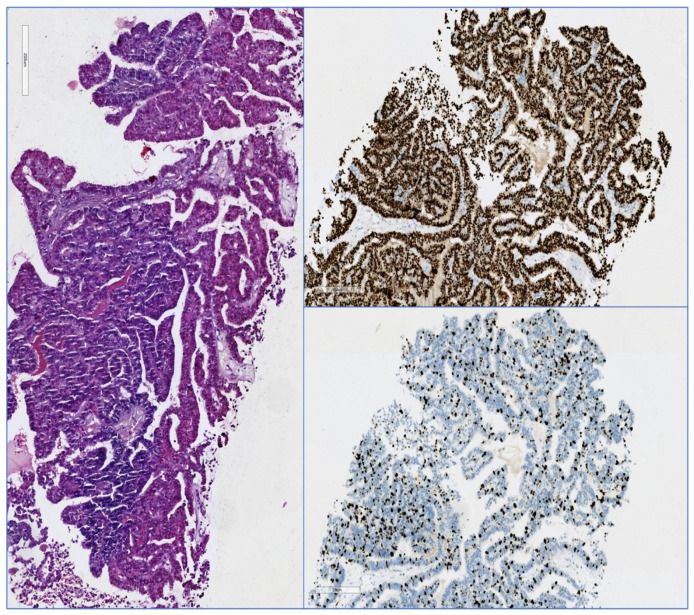
Image: PMC9323942, CC BY - Papillary carcinoma
- Invasive lobular carcinoma
- Invasive carcinoma of no special type with a solid growth pattern
- Gynaecomastia
A 46-year-old woman presents with blood-stained discharge from a single duct of the right nipple. No lump is palpable and imaging shows a dilated retroareolar duct. The excised duct lesion is shown (hematoxylin and eosin). What is the most likely diagnosis?
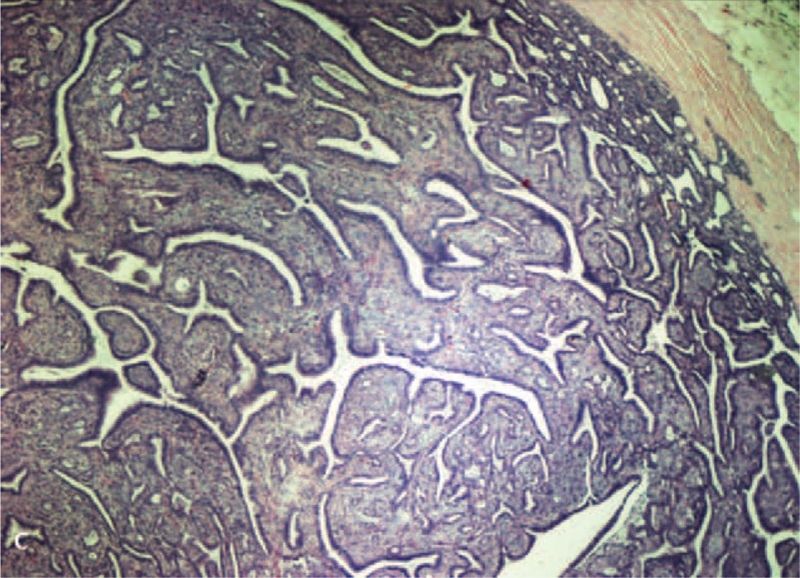
Image: PMC4998391, CC BY - Comedo-type ductal carcinoma in situ
- Duct ectasia with periductal mastitis
- Intraductal papilloma
- Fibroadenoma
A 52-year-old woman has a hard, irregular, 3 cm lump fixed to the underlying tissue in the upper outer quadrant of the left breast. A core needle biopsy is shown (hematoxylin and eosin). What is the most likely diagnosis?
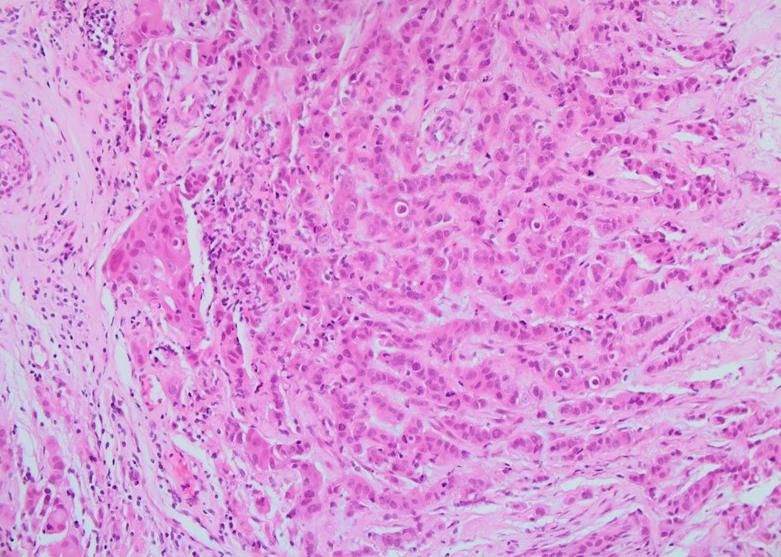
Image: PMC5669532, CC BY - Fat necrosis
- Invasive carcinoma of no special type
- Radial scar
- Sclerosing adenosis
A 55-year-old woman undergoing wide local excision for an invasive breast carcinoma has a sentinel axillary lymph node removed and examined. The hematoxylin and eosin section is shown. What does the node contain?
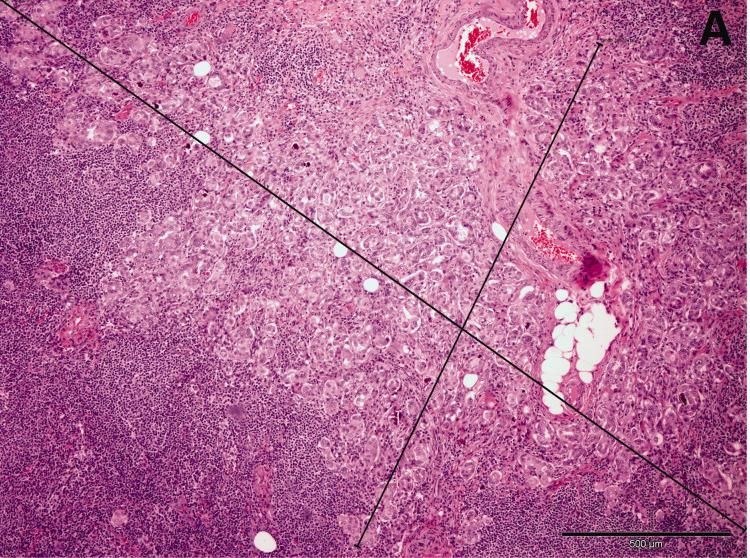
Image: PMC5810224, CC BY - Sinus histiocytosis
- Non-caseating granulomas
- A deposit of metastatic carcinoma
- Reactive follicular hyperplasia
A 52-year-old woman is recalled from breast screening for a cluster of pleomorphic microcalcifications. A stereotactic core biopsy is performed and the haematoxylin and eosin stained section is shown, in which a duct is expanded by a highly atypical epithelial proliferation with central necrotic debris containing coarse, dark, granular material, while the surrounding stroma shows no infiltrating tumour cells. What is the most likely diagnosis?
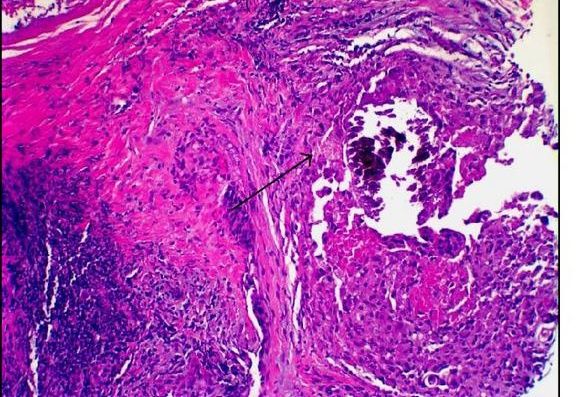
Image: PMC3350088, CC BY - High-grade ductal carcinoma in situ with comedo necrosis and calcification
- Fibroadenoma with infarction
- Sclerosing adenosis with stromal calcification
- Invasive ductal carcinoma of no special type
Show answer
A. High-grade ductal carcinoma in situ with comedo necrosis and calcification
Think this answer is wrong? Report itA 58-year-old woman treated 4 years earlier for carcinoma of the breast presents with a firm, fixed nodule in the anterior abdominal wall. The excised nodule is submitted for histopathology and the haematoxylin and eosin stained section is shown, in which small irregular clusters and cords of atypical epithelial cells permeate dense collagenous and fatty tissue. What does the biopsy show?
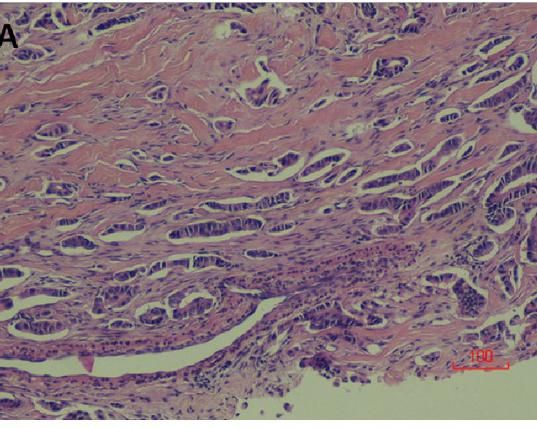
Image: PMC3806398, CC BY - Granulomatous panniculitis
- Infiltrating carcinoma involving fibroadipose tissue
- Fat necrosis with foamy macrophages
- Desmoid-type fibromatosis
Show answer
B. Infiltrating carcinoma involving fibroadipose tissue
Think this answer is wrong? Report it
Answer key
- B Colloid carcinoma of breast
- B Lobular carcinoma
- A Comedo sub type of DCIS
- A Ductal carcinoma in situ
- D Invasive lobular carcinoma
- B colloidal carcinoma
- D Regular polarized gland pattern
- C Predicting response to treatment
- D Staphylococcus aureus
- C Dermal lymphatic invasion by cancer cells
- D Comedo DCIS
- B Positive family history
- A Mucinous
- B Breast carcinoma
- A Proliferation of ducts in hyalinized fibrous tissue with periductal edema
- C Epithelial hyperplasia
- B Breast
- A Single file pattern
- B 1, 2, 3, 4
- C Pagets disease of nipple
- B p 63
- A Breast
- B BRCA 1 mutation is present in most of the cases of breast carcinoma
- D 6th decade
- D ac
- B Lobular carcinoma is common
- B A person with (45, XO) karyotype
- D Medullary carcinoma
- D Papilloma
- B p 53
- A Medullary
- C Lobular carcinoma
- B Invasive ductal carcinoma
- B Apocrine metaplasia
- D Increased risk of breast cancer
- A Papillary carcinoma
- C Intraductal papilloma
- B Invasive carcinoma of no special type
- C A deposit of metastatic carcinoma
- A High-grade ductal carcinoma in situ with comedo necrosis and calcification
- B Infiltrating carcinoma involving fibroadipose tissue
About these questions
Previous year questions on Breast Pathology for NEET PG (National Eligibility cum Entrance Test - Postgraduate), from the Pathology section of the exam.
Most questions here come from previous-year papers of Indian postgraduate medical entrance and licensing exams; where a paper and year are recorded the question carries them. The image-based questions are original vignettes written around an openly licensed figure, and were never asked in any exam.
Pathology is worth about 17 of the 200 questions on the exam. See every subject’s weightage.
More in Pathology
- Congenital Anomalies, ARDS and Lung Infections
- Obstructive and Restrictive Lung Disease
- Lung Tumours
- Pituitary, Parathyroid and Endocrine Pancreas
- Thyroid Gland Pathology
- Adrenal Gland Pathology
- Bone: Developmental Disorders, Infections and Tumours
- Joint and Soft Tissue Pathology
- Dermatopathology
- CNS Infections and Cerebrovascular Disease
- Degenerative, Toxic and Metabolic CNS Disease
- Tumours of the CNS