NEET PG · Pathology
Obstructive and Restrictive Lung Disease PYQs
- 30 live questions in Obstructive and Restrictive Lung Disease.
- 2 of 30 questions carry a recorded exam year: 2017, 2019.
- Question set last updated .
30 questions with answers
Which of the following is true about alpha 1 antitrypsin?
- Inhibits elastase
- Inhibits trypsinogen activation in pancreas
- Inhibits trypsin activating protease
- Inhibits chymotrypsin
a1-antitrypsin deficiency chromosome is located on chromosome.. ?
- 10
- 14
- 17
- 11
WHICH of the following cell is most commonly associated with chronic allergic asthma ?
- TH17
- TH1
- TH 2
- TH 4
True about panacinar emphysema:
- Apical region commonly involved
- Usually presents in 6th decade
- Alpha-1 antitrypsin deficiency
- Involves whole lung
Increased Reid Index is used to characterized:
- Chronic Bronchitis
- Bronchiectasis
- Bronchial Asthma
- Emphysema
Liver cirrhosis is associated with which type of emphysema in Pizz phenotype mutation?
- Centriacinar
- Panacinar
- Paraseptal
- Multifocal
A family suffering a hereditary form of severe emphysema, with some family members also showing hepatic disease. Liver biopsy in one of the family members demonstrates increased reactivity with antibodies directed against a-1-antitrypsin. Serum levels of the enzyme are low, leading to increased activity of a number of serine proteases. Increased activity of which of the following serine proteases has been most closely tied to the emphysema that develops in these patients?
- Chymotrypsin
- Elastase
- Plasmin
- Thrombin
Alpha-1 antitrypsin deficiency causes
- centri acinar emphysema
- panacinar emphysema
- centrilobar emphysema
- irregular emphysema
Most common type of emphysema
- Panacinar emphysema
- Irregular emphysema
- Centriacinar emphysema
- Paraseptal emphysema
Which of the following morphological changes in the lungs would be found in this patient of asthma
- Destruction and dilation of the bronchi and bronchioles
- Free air in the interstitium
- Viscid mucus plugs in the small airways
- Peribronchiolar fibrosis
A 35-year-old man has a 5-year history of episodic wheezing and coughing. The episodes are more common during the winter months, and he has noticed that they often follow minor respiratory tract infections. In the period between the episodes, he can breathe normally. There is no family history of asthma or other allergies. On physical examination, there are no remarkable findings. A chest radiograph shows no abnormalities. A serum IgE level and WBC count are normal. Which of the following is the most likely mechanism that contributes to the findings in his illness?
- Accumulation of alveolar neutrophilic exudate
- Bronchial hyperreactivity to chronic inflammation
- Emigration of eosinophils into bronchi
- Hyperresponsiveness to Aspergillus spores
Show answer
B. Bronchial hyperreactivity to chronic inflammation
Think this answer is wrong? Report itAlpha-1 antitrypsin deficiency occurs in
- Emphysema
- Bronchiectasis
- Empyema
- Bronchogenic carcinoma
A 50-year-old man dies of a respiratory illness that had been characterized by dyspnea, cough, and wheezing expiration of many years' duration. Initially episodic, his "attacks" had increased in frequency and at the time of death had become continuous and intractable. At autopsy, which of the following is the most likely histologic finding in the lungs?
- Bronchial smooth muscle hypertrophy with proliferation of eosinophils
- Diffuse alveolar damage with leakage of protein-rich fluid into alveolar spaces
- Dilation of air spaces with destruction of alveolar walls
- Hypoplasia of bronchial mucus-secreting submucosal glands
Show answer
A. Bronchial smooth muscle hypertrophy with proliferation of eosinophils
Think this answer is wrong? Report itReid index is useful in the diagnosis of:
- Chronic bronchitis
- Bronchial asthma
- Bronchiectasis
- Emphysema
In centrilobular (centriacinar) emphysema, there is an abnormal, permanent enlargement of the -
- Respiratory bronchioles
- Alveolar ducts
- Small bronchi
- Bronchioles
A 50-year old man has a 30 year history of smoking. For approximately 6 months per year for the preceding 5 years, he has had copious sputum production. This sputum production is most likely closely related to increased numbers of which of the following cell types in his bronchioles and small (less than 3 mm) bronchi?
- Goblet cells
- Smooth muscle cells
- Squamous cells
- Type I pneumocytes
Alveolar hemorrhage and hemosiderin laden macrophages ?
- Sarcoidosis
- Goodpasture syndrome
- Bronchial pneumonia
- Bronchiectasis
Which of the following dust exposure has been linked to the development of mesothelioma?
- Asbestos
- Barium
- Silica
- Cotton
α1 -antitrypsin deficiency is associated with -
- Centriacinar emphysema
- Panacinar-emphysema
- Paraseptal-emphysema
- Irregular-emphysema
Commonest type of clinically significant emphysema is ?
- Centriacinar
- Obstructed
- Irregular
- Panacinar
Which of the types of asbestos is LEAST associated with mesothelioma ?
- Chrysotile
- Crocidolite
- Amosite
- Tremolite
Reid index is useful in-
- Glomerulonephritis
- Chronic bronchitis
- Cirrhosis
- MI
All of the following are true regarding histological features of asbestosis, except:
- Diffuse pulmonary interstitial fibrosis
- Asbestos bodies are consist of asbestos fibers coated with an calcium-containing material
- Fibrosis begins around respiratory bronchioles and alveolar ducts and extends to involve adjacent alveolar sacs and alveoli
- Pleural plaques are collections of dense collagen
Show answer
B. Asbestos bodies are consist of asbestos fibers coated with an calcium-containing material
Think this answer is wrong? Report itAlpha 1 antitrypsin deficiency is associated with?
- Panacinar-emphysema
- Centriacinar-emphysema
- Paraseptal-emphysema
- Irregular-emphysema
The following does not occur with asbestosis -
- Methaemoglobinemia
- Pneumoconiosis
- Pleural mesothelioma
- Pleural calcification
All of the following statement are true regarding idiopathic pulmonary fibrosis, except:
- Pleural surfaces developed "cobblestoned" appearance
- Areas of fibrosis, occur preferentially in the lower lobes and subpleural regions
- Fibroblastic foci are the earliest lesion
- Masson bodies are characteristic
Curschmann spiral is characteristic of which of the following airway disease:
- Chronic bronchitis
- Emphysema
- Atelectasis
- Bronchial asthma
Alpha-1 antitrypsin deficiency causes
- Emphysema
- Bronchitis
- Bronchiectasis
- Pneumonia alba
A 68-year-old man has two years of progressive exertional breathlessness, finger clubbing and bibasal fine crackles. A haematoxylin and eosin section from his surgical lung biopsy is shown, demonstrating dense collagenous fibrosis enclosing clusters of enlarged cystic airspaces. This appearance is most characteristic of which pattern of interstitial lung disease?
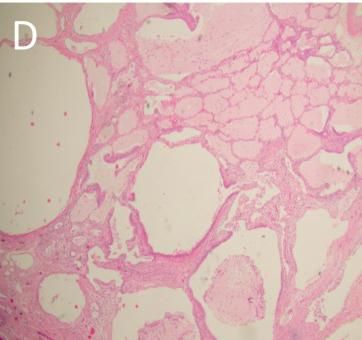
Image: PMC6473802, CC BY - Diffuse alveolar damage in the exudative phase
- Pulmonary alveolar proteinosis
- Usual interstitial pneumonia with honeycomb change
- Desquamative interstitial pneumonia
Show answer
C. Usual interstitial pneumonia with honeycomb change
Think this answer is wrong? Report itA 55-year-old woman has six weeks of dry cough, malaise and low-grade fever with patchy bilateral peripheral consolidation on imaging that has failed two courses of antibiotics. A surgical lung biopsy stained with haematoxylin and eosin is shown. What is the most likely diagnosis?
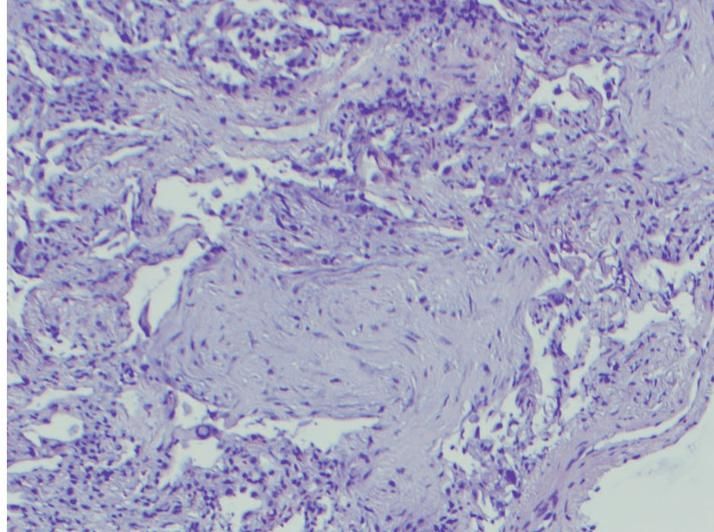
Image: PMC9172897, CC BY - Organizing pneumonia
- Pulmonary alveolar proteinosis
- Usual interstitial pneumonia
- Diffuse alveolar damage, exudative phase
Answer key
- A Inhibits elastase
- B 14
- C TH 2
- C Alpha-1 antitrypsin deficiency
- A Chronic Bronchitis
- B Panacinar
- B Elastase
- B panacinar emphysema
- C Centriacinar emphysema
- C Viscid mucus plugs in the small airways
- B Bronchial hyperreactivity to chronic inflammation
- A Emphysema
- A Bronchial smooth muscle hypertrophy with proliferation of eosinophils
- A Chronic bronchitis
- A Respiratory bronchioles
- A Goblet cells
- B Goodpasture syndrome
- A Asbestos
- B Panacinar-emphysema
- A Centriacinar
- A Chrysotile
- B Chronic bronchitis
- B Asbestos bodies are consist of asbestos fibers coated with an calcium-containing material
- A Panacinar-emphysema
- A Methaemoglobinemia
- D Masson bodies are characteristic
- D Bronchial asthma
- A Emphysema
- C Usual interstitial pneumonia with honeycomb change
- A Organizing pneumonia
About these questions
Previous year questions on Obstructive and Restrictive Lung Disease for NEET PG (National Eligibility cum Entrance Test - Postgraduate), from the Pathology section of the exam.
Most questions here come from previous-year papers of Indian postgraduate medical entrance and licensing exams; where a paper and year are recorded the question carries them. The image-based questions are original vignettes written around an openly licensed figure, and were never asked in any exam.
Pathology is worth about 17 of the 200 questions on the exam. See every subject’s weightage.
More in Pathology
- Esophageal Pathology
- Gastric Pathology
- Small Bowel Pathology
- Large Bowel: Non-Neoplastic Disease
- Large Bowel: Neoplastic Disease
- Congenital Anomalies, ARDS and Lung Infections
- Lung Tumours
- Pituitary, Parathyroid and Endocrine Pancreas
- Thyroid Gland Pathology
- Adrenal Gland Pathology
- Breast Pathology
- Bone: Developmental Disorders, Infections and Tumours