NEET PG · Pathology
Esophageal Pathology PYQs
- 16 live questions in Esophageal Pathology.
- 1 of 16 questions carries a recorded exam year: 2019.
- Question set last updated .
16 questions with answers
False statement about Barret esophagus is:-
- Goblet cells seen on histology
- Patient may lead to malignancy after few years
- Columnar to squamous metaplasia
- Chronic GERD is the predisposing factor
Commonest benign tumor of the esophagus
- Papilloma
- Leiomyoma
- Adenoma
- Hemangioma
Which of the following viruses does not produce viral esophagitis
- Herpes
- Adenovirus
- Varicella
- Cytomegalovirus
Oesophagitis in immuno compromised person is caused by all except is -
- HSV
- HIV
- Varicella
- CMV
Volcano ulcers in esophagus are seen in
- Herpetic esophagitis
- Candida esophagitis
- Apthous ulcer in crohn
- HIV esophagitis
Plummer- Vinson syndrome
- Is due to folic acid deficiency
- Common in males
- Not associated with oral premalignancy
- Strong association with post-cricoid carcinoma
Which is the BEST site for taking biopsy in a case of viral oesophagitis?
- Edge of ulcer
- Base of ulcer
- Adjacent indurated area around ulcer
- Surrounding normal mucosa
A 50-year-old obese man (BMI = 32 kg/m2) comes to the physician complaining of indigestion after meals, bloating, and heartburn. Vital signs are normal. A CT scan of the abdomen reveals a hiatal hernia of the esophagus. Endoscopic biopsy shows thickening of the basal layer of the squamous epithelium, upward extension of the papillae of the lamina propria, and an increased number of neutrophils and lymphocytes. Which of the following is the most likely diagnosis?
- Esophageal varices
- Mallory-Weiss syndrome
- Reflux esophagitis
- Schatzki mucosal ring
The following are predisposing factors for esophageal Ca Except -
- Plummer-Vinson syndrome
- Tylosis palmaris
- Chronic Achalasia
- Benzene therapy
A 3-year-old child has attained enough mobility, curiosity, and dexterity to explore places in the home that should not be accessed. The child finds a bottle with a liquid under the kitchen sink, and he drinks it. Within minutes he has chest pain. His mother takes him to the emergency department and brings the bottle. Analysis of the residual contents reveals a pH of 12. Which of the following complications is most likely to occur following this injury?
- Pharyngeal diverticulum
- Esophageal stenosis
- Gastric lymphoma
- Duodenal ulceration
A 40-year-old immunocompromised patient presented with complaints of dysphagia. Upper GI endoscopy showed multiple serpiginous ulcers in the distal esophagus. What is the diagnosis?
- Candida
- CMV
- Herpes
- Eosinophilic esophagitis
Pathology in achalasia cardia is?
- Degeneration of nerves
- Muscular atrophy
- Hypertrophy of nerves
- Hypertrophy of muscles
Triad of Plummer Vinson syndrome includes all of the following except:
- Iron Deficiency Anaemia
- Dysphagia
- Atrophic Glossitis
- Koilonychia
A 71-year-old male presents with dysphagia and is found to have a 5-cm mass that is located in the middle third of the esophagus and extends into adjacent lung tissue. A biopsy from this mass would most likely reveal
- A mass composed of benign cartilage
- A mass composed of benign smooth-muscle cells
- Infiltrating groups of cells forming glandular structures
- Infiltrating sheets of cells forming keratin
A 24-year-old man with atopy reports several years of dysphagia for solids and one episode of food bolus impaction. Endoscopy shows concentric rings and linear furrows in the oesophagus, and biopsies are taken. The haematoxylin and eosin stained section is shown, in which the squamous epithelium contains numerous cells with bilobed nuclei and bright red cytoplasmic granules, most dense in the superficial layers, together with basal cell hyperplasia. What is the most likely diagnosis?
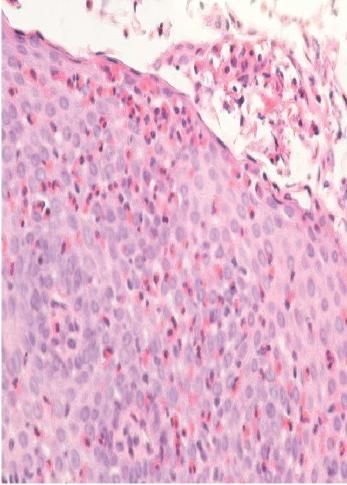
Image: PMC6877992, CC BY - Herpes simplex oesophagitis
- Reflux oesophagitis
- Eosinophilic oesophagitis
- Candida oesophagitis
A 62-year-old man who smokes and drinks heavily reports several months of intermittent dysphagia. At upper gastrointestinal endoscopy the mid-oesophageal mucosa is sprayed with Lugol iodine solution, giving the appearance shown, in which a broad pale area fails to take up the stain against the surrounding brown-stained mucosa. What does the unstained area most likely represent?
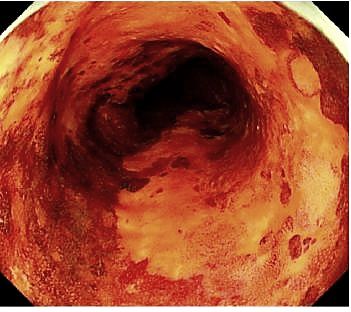
Image: PMC5937592, CC BY - Columnar-lined (Barrett) metaplasia
- Adherent candidal plaques
- Glycogen-depleted neoplastic squamous epithelium
- Normal squamous epithelium with retained glycogen
Answer key
- C Columnar to squamous metaplasia
- B Leiomyoma
- B Adenovirus
- B HIV
- A Herpetic esophagitis
- D Strong association with post-cricoid carcinoma
- A Edge of ulcer
- C Reflux esophagitis
- D Benzene therapy
- B Esophageal stenosis
- B CMV
- A Degeneration of nerves
- D Koilonychia
- D Infiltrating sheets of cells forming keratin
- C Eosinophilic oesophagitis
- C Glycogen-depleted neoplastic squamous epithelium
About these questions
Previous year questions on Esophageal Pathology for NEET PG (National Eligibility cum Entrance Test - Postgraduate), from the Pathology section of the exam.
Most questions here come from previous-year papers of Indian postgraduate medical entrance and licensing exams; where a paper and year are recorded the question carries them. The image-based questions are original vignettes written around an openly licensed figure, and were never asked in any exam.
Pathology is worth about 17 of the 200 questions on the exam. See every subject’s weightage.