NEET PG · Pathology
Tumours of the Liver and Biliary Tract PYQs
- 8 live questions in Tumours of the Liver and Biliary Tract.
- Question set last updated .
8 questions with answers
Not a risk for cholangiocarcinoma -
- Hepatolithiasis
- Hepatitis C
- Clonorchis sinensis
- Choledocholithiasis
Cancer caused by chronic parasitic infection -
- Cholangiocarcinoma
- Hepatic cell Ca
- Ca GB
- Ca pancreas
Von-Meyenburg's complexes are seen in?
- Brain
- Liver
- Kidney
- Spleen
A 64-year-old man is investigated for a solitary 5 cm mass in the right lobe of the liver; endoscopy and cross-sectional imaging show no tumour anywhere else. A core biopsy is performed, and the H&E sections in panels A and B are shown, in which the asterisk marks residual non-neoplastic hepatocytes; answer from panels A and B only. Which is the most likely diagnosis?
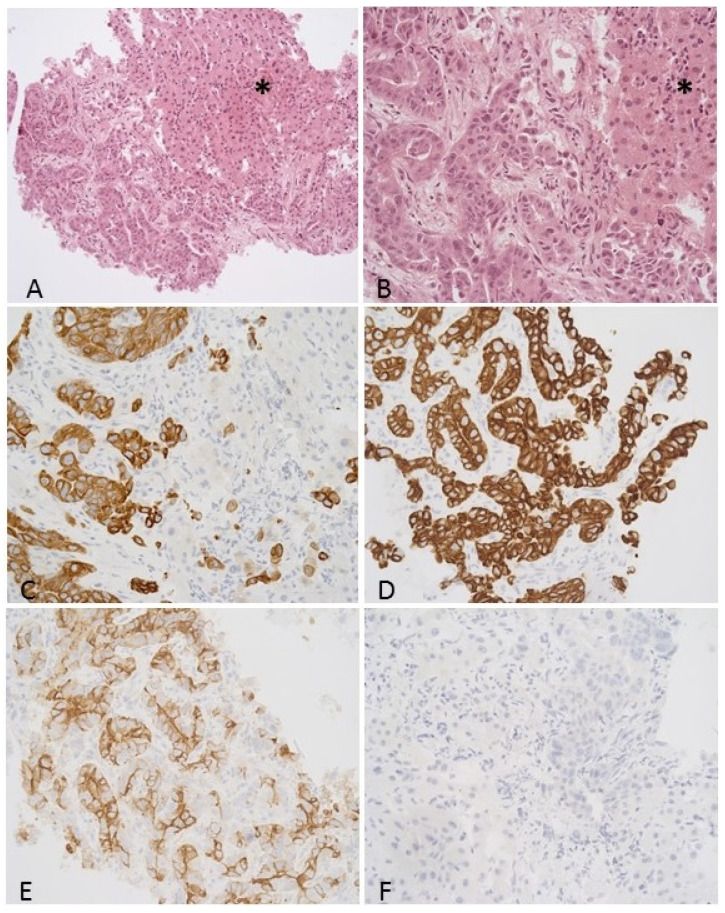
Image: PMC8750273, CC BY - Intrahepatic cholangiocarcinoma
- Hepatocellular carcinoma, pseudoglandular pattern
- Metastatic colorectal adenocarcinoma
- Bile duct adenoma
A 64-year-old man presents with anorexia, weight loss and progressive obstructive jaundice. Imaging shows a solitary 5 cm mass in the right lobe of the liver with capsular retraction; serum alpha-fetoprotein is normal and there is no cirrhosis. An ultrasound-guided core biopsy of the mass is stained with haematoxylin and eosin and is shown. What is the most likely diagnosis?
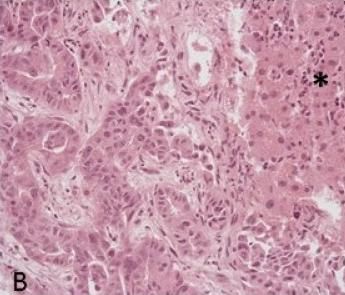
Image: PMC8750273, CC BY - Focal nodular hyperplasia
- Hepatocellular adenoma
- Hepatocellular carcinoma
- Intrahepatic cholangiocarcinoma
A 24-year-old man dies of disseminated malignancy. At autopsy, the sliced liver is shown: the background parenchyma is smooth and non-cirrhotic but contains several sharply demarcated, rounded, pale tan nodules of differing sizes scattered through both lobes. What do these nodules most likely represent?
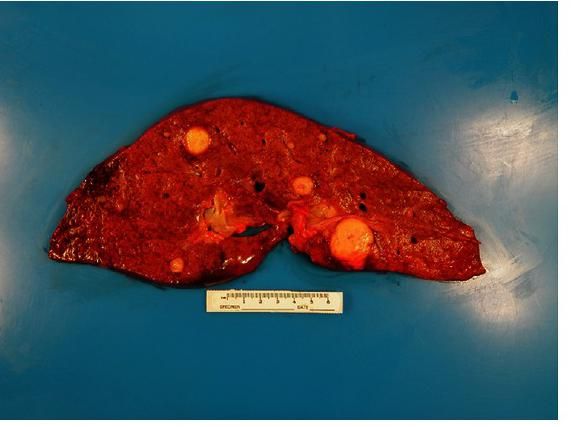
Image: PMC3673319, CC BY - Metastatic tumour deposits
- Multiple hydatid cysts
- Regenerative nodules of macronodular cirrhosis
- Hepatocellular carcinoma with satellite nodules
A 61-year-old man with long-standing cirrhosis is found to have a 5 cm liver mass and a markedly raised serum alpha-fetoprotein. A hematoxylin and eosin-stained core biopsy of the mass is shown. What is the most likely diagnosis?
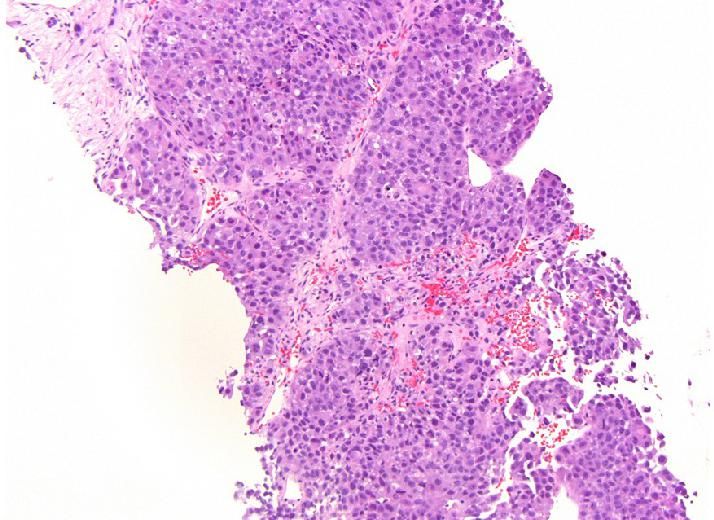
Image: PMC4283353, CC BY - Hepatic haemangioma
- Metastatic colorectal adenocarcinoma
- Intrahepatic cholangiocarcinoma
- Hepatocellular carcinoma
A 58-year-old man with long-standing hepatitis B related cirrhosis is found to have a 4 cm arterially enhancing liver nodule and a serum alpha-fetoprotein of 820 ng/mL. A core biopsy of the nodule is stained with haematoxylin and eosin and shown. Which diagnosis best fits the tumour illustrated?
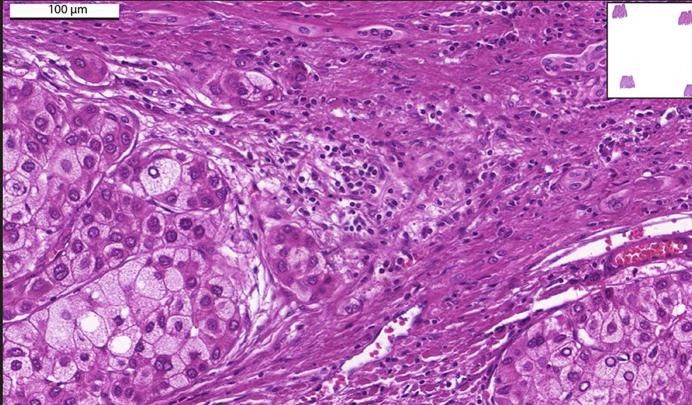
Image: PMC6960181, CC BY - Hepatic haemangioma
- Focal nodular hyperplasia
- Regenerative cirrhotic nodule
- Hepatocellular carcinoma
Answer key
About these questions
Previous year questions on Tumours of the Liver and Biliary Tract for NEET PG (National Eligibility cum Entrance Test - Postgraduate), from the Pathology section of the exam.
Most questions here are original image-based vignettes written around openly licensed figures, and were never asked in any exam. The rest come from previous-year papers of Indian postgraduate medical entrance and licensing exams; where a paper and year are recorded the question carries them.
Pathology is worth about 17 of the 200 questions on the exam. See every subject’s weightage.