INI-CET · Pathology
Chemical Mediators and Granulomatous Inflammation: questions 51 to 96
Questions 51 to 96 of 96 on Chemical Mediators and Granulomatous Inflammation. Page 1 has the facts about the topic.
Questions 51 to 96 of 96
Principal cell in granuloma is -
- Lymphocyte
- Histiocyte
- Langhans
- Giant cell
C1 is controlled by?
- Calcium
- Magnesium
- Manganese
- Phosphate
Which of the following is not an activator of alternate complement system?
- Factor H
- IgA
- Bacteria
- Immune complex
In Cyclooxygenase pathway, the formation of the arachidonic acids products which of the following helps in the promote platelet aggregation and vasoconstriction-
- C5a
- Thromboxane A2
- Leukotriene B4
- C1 activators
Granulomatous inflammatory reaction is caused by all, except-
- M. Tuberculosis
- M. Leprae
- Yersinia pseudotuberculosis
- Mycoplasma
C5a act as a/an?
- Opsonin
- Chemotactic agent
- MAC
- Vasodilator
Which among the following is a vasoconstrictor?
- Histamine
- PGI2
- Bradykinin
- TXA2
All of the following are mediators of inflammation except -
- Tumour necrosis factor (TNF-a)
- Interleuekin-1
- Myeloperoxidase
- Prostaglandins
The macrophage to epitheliod conversion in Mycobacterium tuberculosis infection is mediated by:
- TNF alpha
- IFN-g
- IL-4
- TGF-Beta
C-C beta chemokine includes
- IL-8
- Eotaxin
- Lymphotactin
- Fractalkine
Which of the following cells are more abundant in chronic inflammation than in acute inflammation?
- Plasma cells
- Eosinophils
- Neutrophils
- Normoblasts
The role of Bradykinin in process of inflammation is -
- Vasoconstriction
- Bronchodilator
- Opsonisation
- Increased vascular permeability
Which of the following are/is not an activator of alternate complement system?
- Factor H
- IgA
- Bacteria
- Toxin
Actions of bradykinin include all of the following, except
- Vasodilatation
- Bronchodilatation
- Increased vascular permeability
- Pain
Which of the following is a chemotactic factor:
- Prostaglandins
- Prostacyclins
- Thromboxanes
- Leukotrienes
Epitheloid like giant cells are seen in all the following except-
- Leprosy
- Ulcerative Colitis
- Crohns disease
- Brucellosis
Which of the following cytokines are anti-inflammatory in nature?
- IL-4
- IL-10
- TGF-β
- All of the above
An example of CXC chemokine is_____.
- IL 8
- IL 2
- Lymphotactin
- Fractalkine
PAF does not cause
- Brochoconstriction
- Vasoconstriction
- Decreased vascular permeability
- Vasodialation
Leukotrienes cause all of the following, EXCEPT:
- Vasodilation
- Vasoconstriction
- Increased vascular permeability
- None of the above
Tissue macrophages are called
- Monocytes
- Histiocytes
- Plasma cells
- Epitheloid cells
The most important function of epithelioid cells in tuberculosis is:
- Phagocytosis
- Secretory
- Antigenic
- Healing
The most important function of epithelioid cells in tuberculosis is -
- Phagocytosis
- Secretory
- Antigenic
- Healing
Not an example of granulomatous disease -
- TB
- Leprosy
- Sarcoidosis
- Mycoplasma
Vasoconstricting mediator is -
- Prostacyclin
- Thromboxane-A2
- PGD2
- Lipoxins
Which interleukin is associated with fever and inflammation?
- Interleukin 1
- Interleukin 12
- Interleukin 5
- Interleukin 2
Most important cytokine responsible for the synthesis of acute phase protein
- IL-1
- IL-6
- IL -11
- TNF alpha
Serotonin, a mediator of inflammation in our body, is secreted /released by:
- Leukocytes
- Endothelial cell
- Mast cell
- Platelet
Chemotaxis is the main function of?
- C5a
- ICAM1
- P-selectin
- IL-5
All of the following are mediators of acute inflammation except -
- Angiotensin
- Prostaglandin E2
- Kallikrein
- C 3a
Factor present in the final common terminal complement pathway is -
- C4
- C3
- C5
- Protein B
Which of the following factors are present in the final common terminal complement pathway?
- C4
- C3
- C5
- Protein B
Endogenous chemoattractant is:
- C5a
- Bacterial products
- Lipopolysaccharide A
- C8
The Earliest feature of Tuberculosis is:
- Caseation
- Lymphocytosis
- Giant cells (Langhans)
- Granuloma
A stellate granuloma is seen in?
- Crohn's disease
- Hodgkin's disease
- Cat scratch disease
- Berrylliosis
Foci of granulomatous inflammation show all of the following except?
- Eosinophils
- Epithelioid cells
- Fibrosis
- Lymphocytes
Most important inflammatory mediator -
- TNF
- IL2
- Interferon
- PAF
Which of the following statement about Bradykinin is true?
- Causes pain
- Causes bronchodilation
- Causes vasoconstriction
- Decreases vascular permeability
C3 convertase acts on
- C4b2b
- C4b2B3a
- C4b
- C3
A 46-year-old man with three months of low-grade fever, night sweats and weight loss is found to have mediastinal lymphadenopathy, and a node is biopsied. The photomicrograph of the haematoxylin and eosin stained section is shown. Which histological pattern of inflammation does it demonstrate?
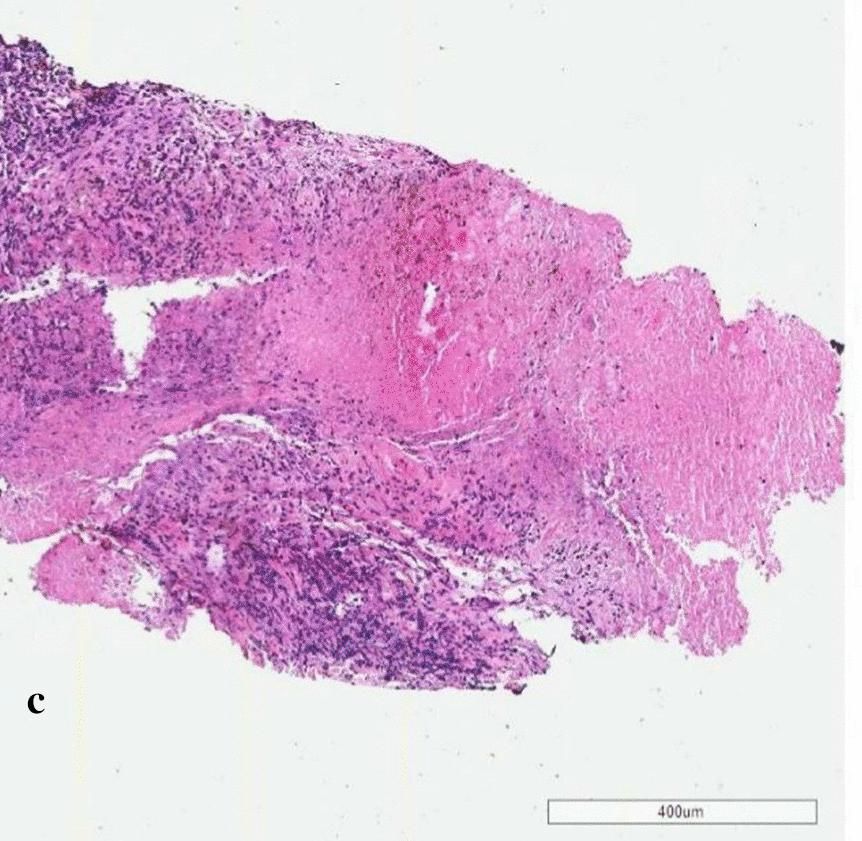
Image: PMC8265008, CC BY - Necrotising granulomatous inflammation with a rim of epithelioid cells
- Non-necrotising sarcoid-type granulomas without any necrosis
- Suppurative inflammation forming a neutrophil-rich abscess
- Fibrinoid necrosis of vessel walls with surrounding nuclear dust
Show answer
A. Necrotising granulomatous inflammation with a rim of epithelioid cells
Think this answer is wrong? Report itA 32-year-old woman with bilateral hilar lymphadenopathy and a raised serum angiotensin-converting enzyme level undergoes a lymph node biopsy. The H&E-stained section is shown, containing compact collections of epithelioid histiocytes with occasional giant cells, cuffed by lymphocytes, and without any central necrosis. How is this inflammatory reaction best characterised?
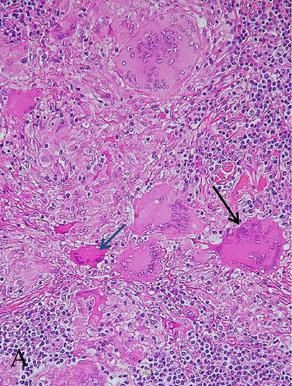
Image: PMC3916803, CC BY - Acute suppurative inflammation
- Fibrinoid necrotising vasculitis
- Non-caseating granulomatous inflammation
- Caseating granulomatous inflammation
A 34-year-old man is investigated for prolonged fever, weight loss and pancytopenia. A hematoxylin and eosin-stained bone marrow trephine biopsy is shown. Which abnormality is present within the marrow space?
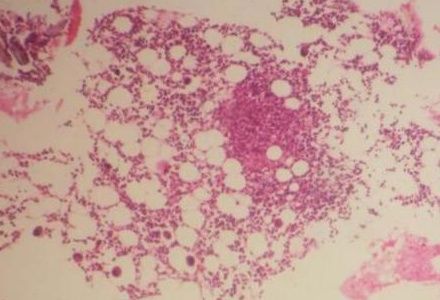
Image: PMC4344176, CC BY - Sheets of blasts replacing the marrow
- A metastatic carcinoma deposit
- A focal granuloma
- Dense reticulin fibrosis with osteosclerosis
A 46-year-old woman is investigated for unilateral hydronephrosis and a thickened distal ureter. A ureteric biopsy stained with haematoxylin and eosin is shown, with arrows marking the key abnormality. Which histological finding is illustrated?
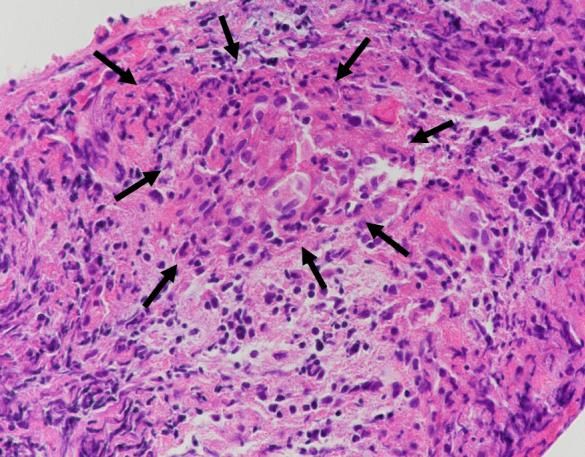
Image: PMC7310021, CC BY - Nests of invasive urothelial carcinoma
- Sheets of foamy macrophages with cholesterol clefts
- Amorphous eosinophilic amyloid deposits
- Non-caseating epithelioid cell granulomas
A 38-year-old man has three months of cough, evening fever and weight loss. A low-power hematoxylin and eosin section of a lung lesion is shown. Which lesion is illustrated?
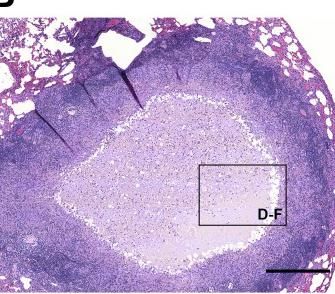
Image: PMC6080910, CC BY - Pyogenic abscess
- Necrotizing (caseating) granuloma
- Bland ischaemic infarct
- Non-necrotizing sarcoid granuloma
An immunocompromised patient develops a chronic destructive brain lesion with a granulomatous, perivascular inflammatory reaction. A high-power haematoxylin and eosin section of the brain biopsy is shown, containing several rounded organisms 20-40 micrometres across, each with pale foamy cytoplasm and a single nucleus with a prominent central karyosome. What are these organisms?
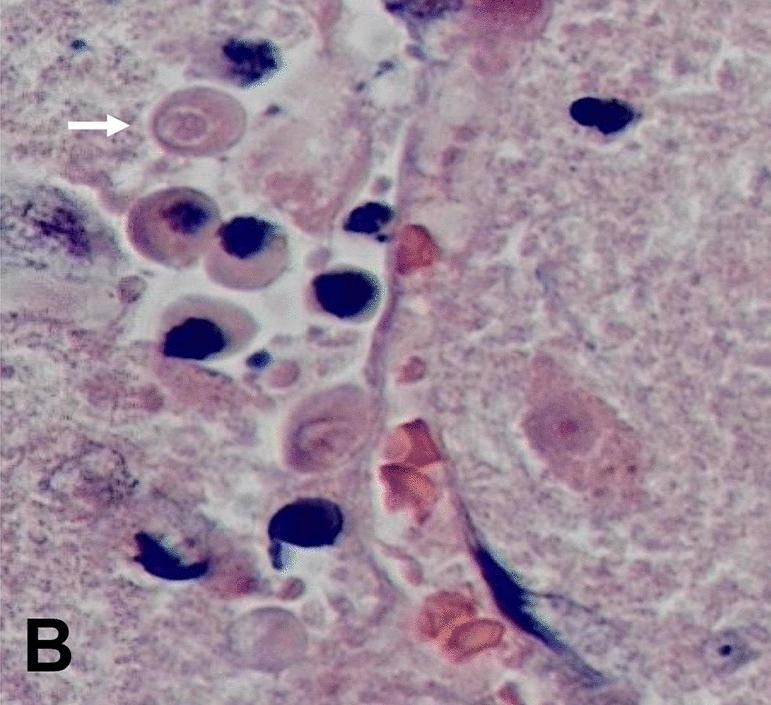
Image: PMC8760828, CC BY - Free-living amoebic trophozoites
- Histoplasma capsulatum yeasts
- Cryptococcus neoformans yeasts
- Toxoplasma gondii bradyzoite cysts
A 29-year-old woman is investigated for cough and exertional breathlessness. Chest imaging shows bilateral hilar lymphadenopathy, she has tender red shin nodules, and serum angiotensin-converting enzyme is raised. A transbronchial lung biopsy stained with haematoxylin and eosin is shown. What is the most likely diagnosis?
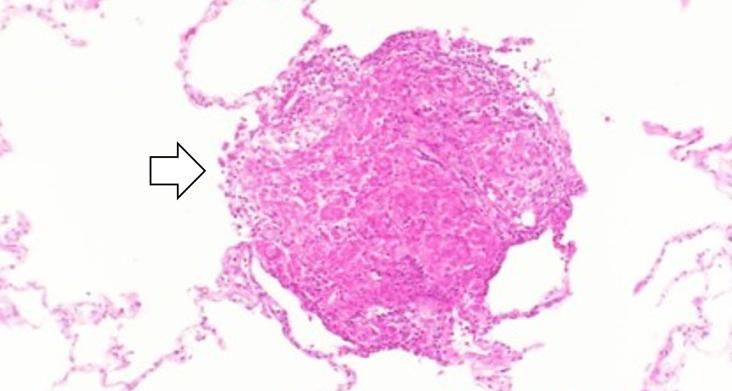
Image: PMC8976752, CC BY - Sarcoidosis
- Hypersensitivity pneumonitis
- Miliary tuberculosis
- Granulomatosis with polyangiitis
Answer key
- B Histiocyte
- A Calcium
- A Factor H
- B Thromboxane A2
- D Mycoplasma
- B Chemotactic agent
- D TXA2
- C Myeloperoxidase
- B IFN-g
- B Eotaxin
- A Plasma cells
- D Increased vascular permeability
- A Factor H
- B Bronchodilatation
- D Leukotrienes
- B Ulcerative Colitis
- D All of the above
- A IL 8
- C Decreased vascular permeability
- A Vasodilation
- B Histiocytes
- B Secretory
- B Secretory
- D Mycoplasma
- B Thromboxane-A2
- A Interleukin 1
- B IL-6
- D Platelet
- A C5a
- A Angiotensin
- C C5
- C C5
- A C5a
- B Lymphocytosis
- C Cat scratch disease
- A Eosinophils
- A TNF
- A Causes pain
- D C3
- A Necrotising granulomatous inflammation with a rim of epithelioid cells
- C Non-caseating granulomatous inflammation
- C A focal granuloma
- D Non-caseating epithelioid cell granulomas
- B Necrotizing (caseating) granuloma
- A Free-living amoebic trophozoites
- A Sarcoidosis
More in General Pathology
- Amyloidosis and Transplant Rejection
- Histopathology Techniques and Special Stains
- Cell Genetics, Adaptation and Cell Injury
- Necrosis and Apoptosis
- Intracellular Accumulations, Pathological Calcification and Cell Ageing
- The Acute Inflammatory Response
- Wound Healing and Tissue Repair
- Hemodynamic and Hemostatic Disorders
- Patterns of Inheritance
- Lysosomal and Glycogen Storage Disorders
- Chromosomal and Other Genetic Disorders
- Features and Epidemiology of Neoplasia